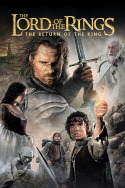
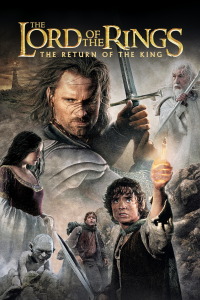
Review of The Lord of the Rings: The Return of the King (2003) by Moviemastereddy — 16 Apr 2016
A “King” that earns its crown, Peter Jackson’s final installment in his monumental “The Lord of the Rings” represents that filmmaking rarity — a third part of a trilogy that is decisively the best of the lot. With epic conflict, staggering battles, striking landscapes and effects, and resolved character arcs all leading to a dramatic conclusion to more than nine hours of masterful storytelling, “The Return of the King” is an urgently paced 200-minute film without an ounce of fat — until unfortunate multiple endings that go on and on, as if Jackson couldn’t bear to let go.
In the rarefied world of large-scaled cinematic triptychs, three in the modern era quickly come to mind that, initially at least, combined striking cinematic prowess with enormous public enthusiasm: “The Godfather,” “Star Wars” and “The Matrix.” In the first two instances, the second film was by general consensus the best and most adventurous, while the third was by far the weakest across the boards.
What Jackson and New Line so boldly did right was to shoot all three in one continuous stretch rather than start from scratch each time.
Of all the wonders associated with this trio of films — the literate, generally well structured overall script, the perfection of the New Zealand locations, the visionary scenic designs, the exceptional visual effects, the costumes, hair and armor, and the excellent cast — perhaps the most impressive feat of all has been Jackson’s ability to keep it all in his head through the years and deliver a cohesive work with a proper sense of balance and proportion.
Unlike his predecessors in the trilogy business, of course, Jackson had a ready-made three-part text to work from, one constructed to pay off in the climactic installment. And pay off it does, in ways guaranteed to satisfy the multitudes around the world who embraced the first two films, and even to impress non-card-carrying members of the massive Tolkien-Jackson cult.
Still, anyone who hasn’t seen the first two pics won’t have a clue what’s going on at the outset of “The Return of the King.” With much struggle behind him but the worst yet to come, Frodo (Elijah Wood) is increasingly feeling the weight of being the Ringbearer as he and his faithful friend Sam (Sean Astin) make their way toward Mount Doom, the place where the Ring was made and the only place it can be destroyed, thus thwarting Sauron’s attempt to destroy humankind.
In a way new to the trilogy, the emotional momentum surges along with the physical action. After early ambivalence over his responsibility for the Ring, Frodo grows into the job; after long dodging his royal inheritance, Aragorn finally rises to the occasion; Sam, especially, emerges as a three-dimensional character of intense devotion to Frodo even after he has been tricked by the Iago-like Gollum and exiled by his closest friend; and the ineffectual Hobbits Pippin and Merry take on some size, figuratively if not literally.
The building sense of dread is palpable. With the belching Mount Doom and its all-powerful hovering Eye in the distance, humankind and Orcs alike traverse an already stark landscape that will shortly become scorched. Dreadful giant screeching dragons, called Fell Beasts, flap down out the sky to pluck hapless soldiers off their feet and horses. And the Orcs are assisted by yet more monsters, including Hulk-like Trolls and towering, long-tusked mastodons known as Mumakil, that strike terror and make resistance seem futile.
With these forces massing to decide the fate of civilization, Gandalf tries to buy time for Frodo to plunge the Ring into the lava at Mount Doom. To greater effect than he has at any point in the three films, Jackson cuts among different sets of activity, the most spectacular being the battle and the most emotionally intense being Frodo’s painful, inch-by-inch journey.
The siege of Minas Tirith may well be the mother of all cinematic battles; certainly no pre-CGI war film ever featured a scene involving upwards of 200,000 soldiers. But that’s how many Orcs maraud the city, and the details are extraordinary: the huge stones catapulted at the fortifications from mobile towers; the fire-breathing dragon battering ram that crashes through the main gates; the earth-shaking Mumakil that raze all before them with scythe-like tusks and carry dozens of men; the gradual movement of the battle from the ground to the upper levels of the exquisitely designed citadel. All of “The Lord of the Rings” has been building to this, and it delivers entirely.
All the outstanding technical and craft achievements that have been duly honored in the previous installments are at least equaled and sometimes trumped here, especially in regard to how involved the creatures are this time. There has been no let-up in creativity, only intensification.
So Jackson has done it.
This review of The Lord of the Rings: The Return of the King (2003) was written by Moviemastereddy on 16 Apr 2016.
The Lord of the Rings: The Return of the King has generally received very positive reviews.
Was this review helpful?