Review of The Long Voyage Home (1940) by Edith N — 03 Jan 2011
John Wayne Should've Followed His Instincts.
I get it. John Ford had himself a group of people he liked to work with, and he stuck with it. I can respect that. Really, it seems true of most of the Great Directors, living and dead. If they had a chance to control their cast and crew, they worked with people they knew they could deal with. Or, in the Kinski/Herzog dynamic, who they knew could give them the work they wanted. Some time ago, I came across a feature on Empire Online discussing forty great director/actor pairings. Oh, I disagreed with a lot of their choices, but not with this one. John Ford and John Wayne made twenty-one movies together. Only two pairings on the list even come close to that, and they're both numbers in their teens. (Bergman/Von Sydow and Kurosawa/Mifune, for the curious.) For both of them, among their greatest and most famous works were with each other.
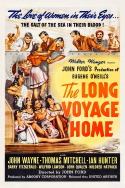
That doesn't mean the casting works here. You see, John Wayne plays Ole Olsen, a young man who left his farm in Sweden and went to sea. The story here is woven around the tales of a handful of men sailing on the [i]Glencairn[/i] from the West Indies to the UK bringing munitions to the war-torn island. They're a motley bunch. Driscoll (Thomas Mitchell) and Cocky (Barry Fitzgerald) are Irishman, bound together despite their mutual dislike by their love of their homeland. Smitty (Ian Hunter) is brooding and turns out to have abandoned a family, including a wife who refuses to think of him as dead. Axel Swanson (John Qualen), I think, is another Scandinavian, this one with a convincing accent even though the actor was born in Vancouver. The men all seem to know that they will someday die at sea, but since Ole has a home and a family, they are determined that he will not join them in that fate. They will get him on a ship back to Sweden as soon as the ship they're on reaches port.
This is considered John Ford's first World War II movie, and I suppose I can see why. After all, the reason these men are on this particular voyage is that they are shipping TNT to the UK, where it will serve the war interest. The driving force behind one of the film's only dramatic sequences is the idea that a secretive man might be a Nazi spy. The ship is attacked as they sail into the Channel. When they do hit port, the newspaper headlines are all about the German invasion of Norway. And the movie's final moments are made tragic not by ordinary circumstances but by the events of the war. However, for a large amount of the story as a whole, it literally does not matter when the movie was set. The world is the ship. The ship is as isolated in the middle of the sea as the Earth is in the middle of space. They know that the ship they are on could be sunk at any time, but that is not a fate limited to men on ships during time of war.
One of the things I found problematic about this film was that the events after the [i]Glencairn[/i] gets to port take up too much of it. Mind, the final tragedy of the film takes place on shore and must have its setup. I do know this. However, for example, the woman who drinks with Olsen is given more characterization than she needs. It's not that I think she needs to be one-dimensional. It's more that I don't think she needs to be two-dimensional. Ford lingers on her so long that I began to think there would be some reason for all that development. She didn't want to do what she did, but once it's done, she seems to have moved on entirely. She's not important, and the way the film portrays her, we think she's going to be. What she does is important; she is not. Just now, I looked at how long the film was, and the answer is "far shorter than I thought." It isn't necessarily that I wanted the movie to be shorter. It's more that I wanted the length to be spread differently.
And then, yes, there is John Wayne. He doesn't talk much in the movie, or didn't that I noticed, and that was great. Certainly John Wayne did just fine in the portrayal of the Strong Silent Type. But every time he opened his mouth, it killed it. I've heard that his accent was actually considered pretty good by experts; I haven't heard the reaction of actual Swedes. The issue may just have been that I know it was John Wayne. He didn't want to take the role. He thought he would make a terrible Swede. It wasn't that he was that huge of a star; his breakout role was the year before. (Speculation holds that part of the reason he worked so hard to stay out of the war was that he didn't think he was a big enough star to get hired again when he came back.) However, I count seven movies with the word "trail" in the title before then. There are exceptions, but people who know him knew him as a cowboy. It's only worse now. And surely there were [i]actual[/i] Swedes around to take the part!
This review of The Long Voyage Home (1940) was written by Edith N on 03 Jan 2011.
The Long Voyage Home has generally received positive reviews.
Was this review helpful?