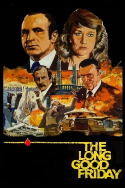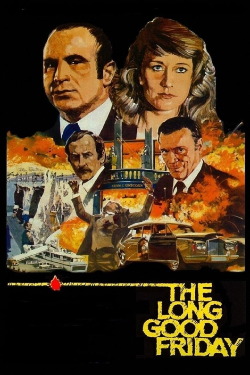
Review of The Long Good Friday (1980) by Brad M — 12 Nov 2010
Stunted, butters with his thinning hair delineating a rotund Chevy and teeth that invariably look to be gnashing, Harold has a monk on he hasn't had to lose for quite awhile. Ten years, it's implied here and there. We eventually have the privilege of seeing why things go better when he keeps it in check. He runs the London harbor and aims to arrange the most ambitious real estate deal in Europe with Mafia funds from the States and the unspoken support of the London underworld society. He cannot Adam-and-Eve that in one weekend his entire existence can go to cock. Harold's a babbling brook, except he lives in a penthouse, fixes a 'spiffing' yacht in the Thames, has the devotion of a bright and diplomatic bird, and expounds zealously on the decade of harmony he's helped parley in the London crime world. Then a bomb 'stonks' his Rolls Royce and chauffeur. Another flattens his favorite battle cruiser. A third turns up in his casino, yet falls short of igniting. Who's after him? And why have they chosen this worst of all feasible occasions to do so, the Easter weekend when an American spiv's in town to deliberate investing millions in his real estate development? This rather dated but nonetheless 'spiffing' mint sooner or later does meet these questions, just enough to satisfy a reply, no more, no less. Nevertheless the purpose of the film isn't to explore Harold's right two-and-eight. It's to take a gander at this sod, this heap of paradoxes. He's such a character, such a cheesed-off bloke, responsive to the least slight, capable of smacking panic in the hearts of hard cases, yet a Jessie when his utterly contrasting 'swimbo' Victoria---scrubbed-up, 'nobby' and a dab hand where Harold is 'goppin',' daft and in a pig's arse---spits a few tacks. He's played by solid, beefy performer Bob Hoskins, who in this 1980 well 'ard has the agro and all mod cons of a younger Michael Caine. There's a scene where he hangs his mates upturned from meat hooks and grills them about the terror campaign, and other scenes where he soberly has a laugh with the local 'juves' and looks to arse-lick the Yank out of his millions.
He's strong-armed his way to top banana by being acquainted with precisely how things work and what switches to flip, and now here he is, signing his trousers about this unknown Bobby Dylan. That the filmmakers may be signifying that there's not much variation between legitimate corporate activities and the mob is perhaps the film's foremost thematic pleasure, while this modern-day Macbeth 'jackanory' moves along in a somewhat oblique manner, opening, if not at some batty midpoint, with a montage of apparently disparate events, held together by a spellbindingly rhythmic music theme, early enough in the introductory stage that we really haven't a Scooby-Do what occurs until particulars are unraveled at times quite far down the frog and toad. We grasp intuitively that Harold's no 'berk' from the instant we initially see him 'swanning' through Heathrow, though we don't know what. Shortly, at a cocktail soirà (C)e he hosts for the Yanks, we see an hopping pot of blokes whose backgrounds are unspecified to us nattering about the considerable expansion project Harold's designed, though its particulars are merely inferred. As the film proceeds, we swiftly gather that Harold's a mobster and the geezers are the city officials in his sky rocket, and we soon ascertain his big proposal. All the film's exposition abides by this pattern, in which we've no framework for names or locations and use the loaf to sort out the skinny until some in-passing line offers an anchor for whole plot strands. It's a simplistic yet challenging style of exposition, the style I tend to prefer.
What's more, Mackenzie, with a minimum of stylization and a pinch of dour pragmatism, calculatingly eschews establishing shots for the majority of the film, and we're continually plunged into places that have ostensibly no association with one another. The first shot is of an house in a pick 'n mix at sunrise. We never learn where this is, nor are we ever 'deffo' acquainted with what occurs inside. While this is a radical instance, it's characteristic of the film's movement, in which action frequently happens in indeterminate places that simply appear to materialize as required. This is a confidently restrained manner of constructing a film that's basically the account of a geezer who needs information and keeps ending up with the square root of sod-all. We're normally in on a little more information than Harold, however the swap, to guarantee that we're in due course equally without a Scooby, is that we have to assemble the film's culture through intermittently dispersed snippets.
Mirren's the dog's as Victoria, so classy and money that eck as like does one break concentration and question just how a bit of aw-right like this wound up with a chap like that. She wound up where she has as in Mirren's performance, that's unerringly where she's needed. Nevertheless it's thoroughly Hoskins' bag. This was his first film lead, and he possesses it like he'd been acting straight out of the womb. And the movie's closing shot is as brassy and lemon-tart as anything before it, a gutsy and magnetic two-minute close-up of Hoskins' contorting Chevy Chase as his mince pies avert back and forth, and his mouth fractures into a petrified roof tile. This full-on Monty is a right blinding time, not just for the Hoskins performance but also for the understated vim of Mackenzie's direction, the full-of-beans music, and, despite what you'd Adam-and-Eve, for the charming delicacy of when it occasionally decides to take the mickey bliss out of you.
This review of The Long Good Friday (1980) was written by Brad M on 12 Nov 2010.
The Long Good Friday has generally received very positive reviews.
Was this review helpful?