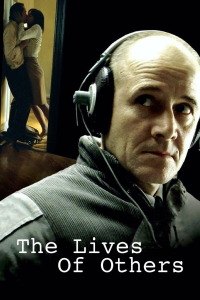
Review of The Lives of Others (2006) by Edith N — 01 Dec 2010
More Spies Per Capita Than Any Other European Society Ever.
I already told my Where I Was When the Berlin Wall Fell story just barely more than two months ago. I will not, therefore, retell it here. But I do have quite clear memories of the Cold War. I remember being told the Soviet Union was an Evil Empire. (Because calling people evil makes them less likely to want to bomb you.) I remember the stretch there where it seemed as though Soviet leaders were dropping dead about every half-hour. (I even remember Brezhnev, who lasted a hint longer than that.) And when Mikhail Gorbachev took office, well, he was going to be just one more leader who didn't like us. He'd probably last longer; he was younger. All of his predecessors were old enough to remember Lenin. (This is actually the same principle by which Karol Wojtyla became John Paul II--he was a lot younger than his predecessors.) But the idea that there wouldn't be a Communist Eastern Europe anymore never crossed my mind.
And so it is that, in 1984, in East Berlin, Hauptmann Gerd Wiesler (Ulrich Mühe) is spying on playwright Georg Dreyman (Sebastian Koch). While it is true that Dreyman is a determined socialist, one who espouses the Party principles and makes art glorifying the People's Struggle, this does not mean he is above suspicion. All things considered, he probably raises more suspicion because of that. It doesn't help that he's living with the beautiful actress Christa-Maria Sieland (Martina Gedeck). It doesn't help that Weisler's superior, Bruno Hempf (Thomas Thieme), is deep in lust with Sieland. It turns out, though, that Dreyman really is that devoted to the East German state, and he in fact wants to improve it by making it face its faults. Which includes smuggling out a piece about the high suicide rates in East Germany. This does not make Stasi best pleased with him, and all concerned are even more determined to find the information which will bring him down.
The largest citizen: Stasi agent ratio I have seen is 63:1. There are even estimates of one informer for every seven citizens. Basically, we're talking the single most paranoid police state ever. I mean, I don't know the current situation in North Korea, so they may have it beat, and there are a bunch of other places I wouldn't want to live/have lived, but still. Wow. I mean, [i]Simon Wiesenthal[/i] thought the East German government kept closer tabs on its citizens than the Third Reich. Yeah, he certainly agreed that the Nazi government was worse in most other ways, but not in that one. So the part of the movie no one argues about is that someone that idealistic could still be an obvious target for Stasi attentions. People argue with a lot of other aspects of it, not least that there could be that character in the first place, but the spying? Oh, yes. So many people were spying on others during the Communist era that any number of relationships were torn apart by it when the records were mad epublic.
Now, here's the part I find most believable. I believe absolutely that Hempf thinks that all he needs is to get Dreyman out of the way in order to make Sieland love him. I knew a kid in high school, a friend of my younger sister's, who was furious when David Duchovny got married, because she had I think been planning to spend summer vacation that year stalking him. And I said, "Oh, yeah, if he weren't married to Tea Leoni, you--a four-foot-nine high school freshman so socially stunted that you're hanging out with my sister of your own free will--would totally be his next choice." Or, you know, I didn't, because I have more tact than that most of the time, but it's what I was thinking. But people really do believe that. We really believe that, if the object of our affection weren't with the person they're with now, they'd be with us instead. And that must be a much more powerful delusion when you're, well, powerful.
The thing is, though, I still wish this movie had not won the Best Foreign Language Film Oscar. Really and seriously. It's quite good, and I think we as a nation need to consider these things now and again, but one of the films it beat was, first, better, and, second, was about a period in world history that your average American doesn't even realize happened. Everyone knows about the Cold War. However, I think fewer and fewer Americans know about the Spanish Civil War. (Given Generalissimo Francisco Franco is still dead and all.) And while this is a complex, serious, thoughtful film, I really just don't think it's as good as--you guessed it--[i]El Laberinto del Fauno[/i]. There is meticulous attention to detail on a lot of this; most locations and all surveillance equipment are authentic. (They weren't allowed to film in the actual Hohenschönhausen, because the director of the museum there objected to a Good Stasi Agent.) Partly, I just like [i]Fauno[/i] better; partly, I think it's better technically. I also must admit that it held my attention a lot better.
This review of The Lives of Others (2006) was written by Edith N on 01 Dec 2010.
The Lives of Others has generally received very positive reviews.
Was this review helpful?