Review of The Lives of Others (2006) by Elliot N — 12 Jul 2011
The Lives of Others won the Best Foreign Picture Oscar for 2006, while I do prefer Pan's Labyrinth, The Lives of Others is still and exceptional film and a worthy winner.
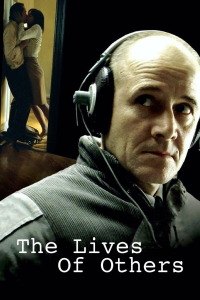
Set in Germany, 1984, The Lives of Others informs the world of the repressive, socialist government of the East German state. East Germany is a place where the media is regulated and negative opinions on the Socialist system are crushed all with the aid of Stasi (The East German secret police) who are more than willing to employ torture methods such as sleep deprivation. The Lives of Others mainly focuses on Stasi agent Captain Gerd Wiesler (A stunning performance by Ulrich Mühe) who relishes the opportunity to dig up some dirt on a famous writer Georg Dreyman (Sebastian Koch) and his actress wife but he soon has a change of heart.
Directed by first timer Florian Henckel von Donnersmarck, The Lives of Others is a masterpiece of cinema and one of the finest representations of European cinema at its best. The Lives of Others is a simple story, Minister Bruno Hempf (Thomas Thieme) wants Wiesler to frame writer Georg so Hempf could be with Georg's actress wife (who he is seeing). Wiesler seems keen to dig up the dirt on the writer but as he gains knowledge of their life, relationships and friends Wiesler begins to realise his own, quiet, lonely existence in which his empty house, ready meals and prostitutes causes him to envy the life of others, in particular the writer and the actress. As Wiesler listens in on their lives he begins to feel compassion and also begins to see the flaws in the Socialist system. This Stasi's agent change of heart becomes and central point of what is poignant story as director Florian Henckel von Donnersmarck tells the riveting story as simply but perfectly as possible not introducing any shock twists. This works for the better as without the twists in the story the whole film tells the lives of the German people in a very dark time (one of many dark times in 20th century German history) with respect.
Donnersmarck attempts to bring the gloom of the atmosphere in 1980s East Germany as the buildings in East Berlin are grey, bleak and lifeless, they do an incredible job of illuminating the bleak atmosphere in 1980s East Germany. The tension is built up superbly by the paranoid atmosphere that governments who employ secret police forces always build. In these types of situations it is impossible to know who to trust, who is an informant, it could be you're next door neighbour or one slip of the tongue could lead you in a life threatening situation. It's a terrifying thought. Secret police forces bring a climate of fear and mistrust and Donnersmarck mesmerising drama brings those two climates out supremely well. All this tension leads to one of the most satisfying and perfect endings that Donnersmarck could ever write. A truly spectacular, wonderfully written piece of work from a first time director who, sadly, has still yet to match the expectations that was expected of him from his first unforgettable film.
More than anything the performance by the late Ulrich Mühe stands up to be the most compelling factor of them all. Mühe flawless performance is what draws the audience in. No emotion may be shown on his stony, emotionless and expressionless face but in his mind we can tell that he is going through a massive change in heart doubting the brutal socialist system in the German Democratic Republic (A dictatorship, despite what the name suggests). Ulrich Mühe does this so well, so quietly and yet so beautifully that the audience truly cares for a man who, essentially, is part of a brutal government but the audience is sympathetic as he risks his life and his career to help those who have never met him. Some argument has been made about the conviction of Gerd Wiesler's transformation from cold blooded, emotionless Stasi agent to hero but he develops an emotional connection with Georg Dreyman as Wiesler is moved to tears by Dreyman performing Sonata for a Good Man in mourning for a loss of a good friend. The rest of the cast are superb, in particular Martina Gedeck as Dreyman's wife but they are all upstaged by Ulrich Mühe's quiet but dominating performance in the central role.
The story is sensational and the setting for this tense drama is similar to that of the German film Goodbye Lenin (1980s East Germany, fall of the Berlin Wall) but the way these two discuss the issues are completely different. Goodbye Lenin is a comedy about a socialist in a coma for eight months and waking up after the fall of the Berlin Wall, it's a satire. Granted there are some moments of humour (but one joke turns dark very quickly) but the great majority of Donnersmarck's film is dark, miserable and lifeless (atmosphericwise). The city feels like a wilderness with its bland buildings. There is one moving moment when the news that the Berlin Wall has fallen, this marked a time where people could move freely among Germany, a time when the country was united for the first time since 1949 and it marked the end of communism in Germany.
The Lives of Others ranks among the best films of the last decade; it is a worthy winner of the 2006 Best Foreign Picture Oscar beating Pan's Labyrinth (and others) to the award, personally I prefer the latter but The Lives Of Others is still and outstanding film with a superb performance from Ulrich Mühe.
5/5.
This review of The Lives of Others (2006) was written by Elliot N on 12 Jul 2011.
The Lives of Others has generally received very positive reviews.
Was this review helpful?