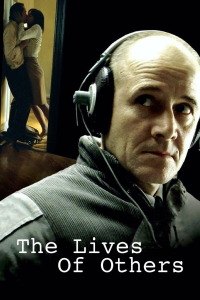
Review of The Lives of Others (2006) by Liam B — 17 Dec 2011
With The Lives of Others, first time director Florian Henkel von Donnersmarck paints a stunning portrait of life in East Germany during the Cold War. In a film that is half thriller and half drama, we are thrown into a world of grey streets and bleak existences reminiscent of the worlds inhabited in Terry Gilliamâ(TM)s Brazil and Michael Radfordâ(TM)s film adaptation of George Orwellâ(TM)s nightmarish 1984 (is it any coincidence that the events of The Lives of Others begins in that same year?) The Lives of Others is a work of fiction but could have very easily have been based on true events that occurred under the brutal oppression in East Germany by the secret police collectively known as the â~Stasiâ(TM), a group working for the GDR (German Democratic Republic). With over 10,000 employees and hundreds of ordinary members of the public blackmailed into working for them the Stasi controlled the people of East Germany under the iron fist of Soviet communism.
The Lives of Others introduces us to a man named Georg Dreyman (Sebastian Koch) who works as a popular playwright and lives with his beautiful actress wife Christa (Martina Gedeck). Christa is living with the guilt of secretly working as an informant to the Stasi, her name possibly inspired by the East German real life author Christa Wolf who it was revealed after the collapse of the Soviet Union was actually a Stasi informant. The couple move in the cultured circles of East German artists, whose creative expression and political beliefs are supressed by the communist censors. The extent of Stasi power is illustrated in a particularly tense scene in which one of their own employees dares to make an inoffensive joke at Stasi expense only to be threatened with his life being destroyed by government power. The central character of the film is a seemingly devout Stasi hardliner named Hauptmann Gerd Wiesler (Ulrich Muhe) whose personal life contrasts sharply with that of Georg and Christa. The difference between the couple and Hauptmann is effectively symbolised by with mise-en-scene in the presentation of their radically different apartment buildings. Georg and Christa live in a large apartment filled with the bright colours of art and literature, while Hauptmann spends his evenings in his small but practical one room apartment where he eats ready meals and finds companionship in the brief services of prostitutes. His cold demeanour and work-ethic seems to be hiding a vulnerable personality, himself a victim of the governmental oppression which causes him to neglect a fulfilling personal life in order to maintain his image as a hard Stasi agent.
When Georg is coaxed into hiding documents that will expose unflattering facts about East Germany he comes under the suspicious eye of a Stasi operation headed by Hauptmann who develops a perverse yet life changing obsession with Georg and Christaâ(TM)s lives. An odd relationship between them ensues, made all the more striking by the fact at no point in the film do Georg and Hauptmann have any direct interaction with each other. Hauptmann appears to see in them a glimpse of the life he could have had if he had lived in a different time and place. As the film progresses we see him connecting with his repressed emotions and displaying his growing empathy for the couple, shown in one scene to be crying to a piece of music he hears in their apartment and in a later moment risking his own life by hiding evidence that would have led to Georgâ(TM)s arrest. In this specific scene Donnersmarck captures perfectly the right tone of suspense, not voyaging into elaborate Hitchcock-esque territory and never losing the films sense of a cold subdued reality, an outstanding achievement for a directorial debut.
The performances are of the highest calibre with Ulrich Mulhe giving the performance of his career in his portrayal of Hauptmann. His expressions and body language often say more than his dialogue ever could. This performance is made more poignant as it one of Mulheâ(TM)s final films, released shortly before his early death in 2007, just as the film was finding an international audience. Superbly written by Donnersmarck, the interaction between characters often manages to be both touching and haunting. In a particularly profound scene, Christa is subtly advised by Hauptmann in what she believes is a chance encounter with a stranger, completely oblivious to the fact that she talks with her husbandâ(TM)s would-be captor who is aware of her every secret and has listened to her and Georg during their most intimate moments. In the late 1980s as the communist system begins to disintegrate, Hauptmann loses the little achievements he had in life but appears surprisingly by these events, suggesting that he has gained something far more valuable, he has gained his sense of humanity.
Released two years after Goodbye Lenin, an equally successful but dramatically different German film about life in East Germany, The Lives of Others explores the oppression of East Europe possibly in an effort to understand what happened and why, especially as communist ideology was ironically supposed to be a movement for the publicâ(TM)s best interests. As the film concludes we ask ourselves â~Why would anyone inflict this kind of torture on their own people?â(TM) Could it be that the government of East Germany were aware that they operate within a system which was doomed to failure? Did the government officials themselves live in the fear that any change would ultimately render them powerless and without purpose?
The Lives of Others reminds us of the importance of an individualâ(TM)s privacy and how such confidentiality is not a privilege to be earned or granted by the state but is a personâ(TM)s own birth-right. In the year 2011 we live in a society where both the media and the public seem united in the desire to know extensively about the personal lives of anyone in the public eye to the point where ordinary citizens have had their civil liberties violated in the form of mobile phone hacking. The vital and thought provoking lessons that can be learned from this excellent film hold significance which resounds in both the past and present.
This review of The Lives of Others (2006) was written by Liam B on 17 Dec 2011.
The Lives of Others has generally received very positive reviews.
Was this review helpful?