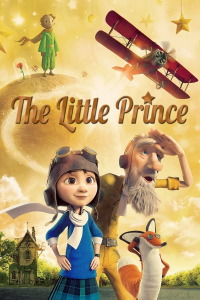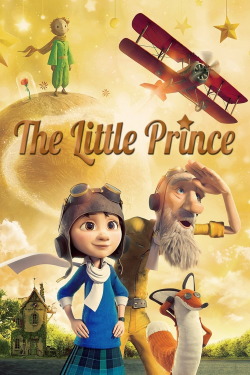
Review of The Little Prince (2015) by Rosaline A — 27 Apr 2016
Bridging the gap between classic children's novels and modern film, Mark Osborne brings to the screen a film that not only respects its roots in Saint-Exupery novella but also shines with its own originality. The Little Prince transforms the original children's book into a philosophical journey for all ages - although possibly more suited to adolescents and above, as the nostalgia is not lost on them. It poses issues firmly present in today's society through symbolism and Freudian elements. Problems such as architectures of confinement constructed around us by people and civilization and the effects it may have on the children and adolescent of today.
In fact, the movie may be split into two parts. The first being the adaptation of The Little Prince novella and the second being the modern story of a little girl in an adult's world. For the older audiences Osborne reminds us what the sparks in our childhood felt like and that the loss of our imagination and childishness should not necessarily come with aging. As for the younger generation, it is a lesson that everything moves on - including childhood - and that that's okay. As long as people don't find themselves drowning in the metaphoric boundaries drawn by society, there is nothing to fear.
The most obvious critic in the movie is that against the constraints of society. The perfectly patterned, cookie-cutter world of The Little Prince portrays a dismal parallel to our current metropolises all over the world. Surrounded by sharp edges and dull repetition, the city structure very much mirrors the initial lives of our characters. With the singular aim of being "essential", the characters lull themselves into a belief that their actions are beneficial and righteous even when they find themselves emotionally at odds with their decisions. In order to make money, to be productive, the characters are forced to sacrifice far too many things at far too young an age. The judging glances and whispered words in the background perfectly depict the constant surveillance people are under by both other individuals and themselves. Unfortunately, the boundaries drawn in society do not stop there. They even extend into the types of relationships you are permitted to keep.
A secondary critic of architectures of confinement is that of relationships. As soon as her mother discovers that the little girl has "made a friend", she naturally assumes the friend is female and says she can spend some time with "her" (00:31:44). The idea of the girl having a male friend, nonetheless the crazy old man from next door, doesn't exist. More prominent, however, is the relationship between the prince and his rose. This is a different form of confinement. Rather than the relationship being confined from the outside, the borders in the relationship developed naturally from the characters themselves. The rose was too demanding and "they were too young to know how to love" so the prince ran away.
The final form of architectures of restriction is that of the body and soul. The movie - and the book - deals heavily with the idea of spirit. The aviator perfectly summed this up when he narrated that as he held the boy he said to himself that what he sees there "is nothing but a shell" (00:50:38). The prince himself depicts a level of mature scholarly understanding when he says that his home is too far and he cannot carry his body with him (00:54:38). The prince feels no qualms about his departure from this world - none but his worry for the aviator.
The little prince then goes to the snake for it to take him home; it does so by biting him with its poisonous touch. The home of the little prince was believed to be in the stars; however, at that moment, the audience is given the impression that the prince may have in fact simply passed away. The bright light that flashes when the snake bites him could be symbolic of his journey to heaven and "following the light". After this point in the film, Osborne clearly deviates from the novella as he investigates modern society further.
Most notably, Osborne targets the topic of stress and pressure in children and adolescents in our world. A 2008 study has shown that high school students these days have the same anxiety levels as psychiatric patients in the early 1950s (Leahy). At such a young age, children are forced to adapt to an adult's world so much so that it becomes unusual to find a child in that world. This is further emphasized when the little girl travels to the businessman's planet and the fact that she is a child is "absolutely not allowed here" (01:07:38). When the real world gets too tough for her to handle, she escapes into her dreams but even her dreams aren't idealistic.
Her memories and ideologies haunt her in the alternate world too. Osborne depicts this by using aspects of Freud's Dream Work. Condensation occurs between the little girl's true anxious feelings and the torture device used by the Academy's headmaster in her dream. Likewise, displacement happens between the stars she vacuumed off her walls and the stars the businessman bought. Both instances of the processes of Freud's ideology reinforce the audience's belief that the little girl is under emotional stress related to school. The repetition of the phrase "you'll make a wonderful grownup" throughout the movie is also indicatory of the little girl's apprehensions about the future - a sentiment shared by many adolescents around the world. The phrase itself changes from being said out of endearment when her mother is encouraging her to a threat repeated by the headmaster in her dream. Finally, the little girl comes to terms with growing up when the aviator proudly repeats it at the end of the movie.
The Little Prince much like its origin is a big advocate of acceptance of death and reality but Osborne has managed to add a sense of security in presenting it as nothing to be afraid of. This sentiment is enforced when the aviator says, "growing up is not the problem, forgetting is." The Little Prince is a coming of age story that people from any age group can benefit from. Be it overcoming Peter Pan Syndrome, letting someone in - "taming them" - and letting them go or coming to terms with the untimely death of someone close, Osborne has melded Saint-Exupéry with modern issues to bring us a film filled with morals. Both the little girl and the little prince struggle against architectures of containment that develop both from themselves and from their surroundings. Finally, only with time do they both come to terms with everything that has happened to them - prince with the loss of his rose and the girl with her inevitable aging. As a conclusion we are reminded that growing up can be healing, forgetting is the only problem.
Reference:
Freud, Sigmund. The Interpretation of Dreams, Third Edition. Trans. by A. A. Brill. New York: The Macmillan Company, 1913. Print.
The Little Prince. Dir. Mark Osborne. Orange Studio, 2015.
Leahy, Robert. "How Big a Problem Is Anxiety?" Psychology Today. 30 Apr. 2008. Web. 28 Apr. 2016.
This review of The Little Prince (2015) was written by Rosaline A on 27 Apr 2016.
The Little Prince has generally received very positive reviews.
Was this review helpful?