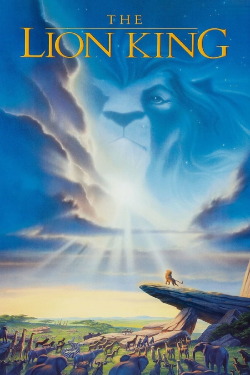
Review of The Lion King (1994) by Genaro C — 28 Jul 2013
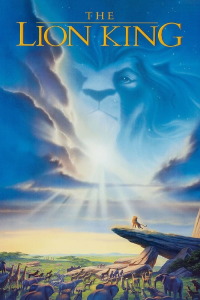
By 1992 the Disney Renaissance was well under way, seeing the production of some of the greatest examples of modern animation. Truly, this was a return to the classic style of the Disney films, albeit with more musical numbers, and at a certain point it was decided to take things into the wild, the Serengeti to be exact. The result of this was "The Lion King", a film that is noticeably different from its three predecessors, in both tone and subject matter.
Many, back then and now, have regarded "The Lion King" as a more modern take on "Bambi". This is a comparison that is usually made in reference to the big moment of parental sacrifice (I don't think I am spoiling anything by pointing this out). But what I bet most people don't notice is the many other similarities between the two stories. Both films follow the lives of the lead character from birth to the beginning of their leadership, both reduce the romance to a subplot that involves a childhood friend and, oddly enough, both even lead to a climax that involves a huge fire. Beyond that the inspiration from Hamlet is obvious, but in such things as a self-imposed exile and jealousy in the family we can see references to the stories of Moses and Joseph, the son of Israel.
This is, first and foremost, a coming of age story with a type of nature flair. By following the birth, early life and adulthood of the lead character it obtains the strength of telling a tale that feels complete, one that gives the sense that a lot has happened in the space of an hour and a half. Not only is this a characteristic virtually absent from the rest of the Second Golden Age (Tarzan is the only exception) but it also allows for more versatility regarding the themes of the movie. Accepting and overcoming mistakes, the contrast between childhood and adulthood and the effects of guilt are all part of the screenplay. However, more important than any of these, is the topic of being true to one's responsibilities, particularly when it is hardest. I'll get to that shortly.
While the title of the movie probably refers to the position rather than any specific character, most seem to believe it refers to Simba, who begins his life as an energetic and ambitious cub that also suffers from some pride problems. Even so, in this stage of his life he does show signs of nobility and bravery when the occasion calls for it; all that is missing is humility. In one of the film's best moments he accidently steps into the pawprint of his father, realizing that he has not measured up to the stature of a king. I will readily admit that Simba is not my favorite hero from these movies, but there is much that can be learned from his story. By the end of the first act we can assume he is at least committed to put aside recklessness. After tragedy strikes, he must gain the will to accept responsibility and move past his perceived mistakes. Surely, this all makes him into a more capable leader in the end, probably better than he would have become otherwise.
The villain Scar, played with a sinister flair by Jeremy Irons, is often cited as the most intriguing aspect of the film, but even though I once regarded him as one of the greatest Disney bad guys he ultimately comes across as being essentially on the same level as his "contemporaries". The difference with Scar is that, unlike those before him, he is very much a malicious personality. His apparent lack of qualms over murdering relatives, something that by principle overshadows the other villainous goals, emphasizes this. There is scarcely anything humorous about him aside from a few sly remarks. His final words to his brother and the wickedness exuded in his song allow him to leave a nearly indelible impression. The problem with Scar is that he is mostly absent from the second half of the film, which lessens his impact. In my eyes, the more interaction between the hero and villain, the better, or at least have a good number of separate scenes for them interspersed throughout. There really needed to be more scenes on the nature of Scar's rule and how it effected many of the characters. This leads to another noticeable weakness of "The Lion King": as good as the story is, it is too short. I can't help but feel that this tale is too big to tell in a mere 88 minutes. Even so, one thing I am quite impressed by is the hero/villain relationship. Scar does terrible thing to Simba, that is true, but he also provides a good idea of what the latter may have become had he retained his faults. Early in the film, Simba voices the notion that "a king can do whatever he wants". This matches the exclamation made by Scar right before the climax.
As befits the pertinent time period, the rest of the supporting cast is composed of colorful characters, possibly more so than before or since. James Earl Jones is naturally imposing as the lion Mufasa and there is an overall good effort at establishing the father/son relationship before the big turning point. The hyenas strike a good balance between zaniness and viciousness, and Rowan Atkinson does some understated voice work as the hornbill Zazu (who would have thought Mr. Bean could be so sophisticated). Timon and Pumbaa are prbably the most well-known. Nowadays, there seems to be much dispute over these two, but even though they admitedly do not have the best outlook they at least have good intentions. When they try to give the cub advice they do not do so for manipulation or some sense of self-righteousness, but out of kindness. They identify with him and believe that this stuff will help.
There are a slew of unforgettable moments. The opening sequence is often praised as possibly the most astounding one in all animated films and the wildebeest stampede, where the animals run down the walls with such ease as to appear like an army of ants, serves as a fine example of CGI enhanced animation. There is such detail and scope in this portrayal of the Serengeti that it rivals the enchantment of the castle in "Beauty and the Beast". Indeed, some of the best sights tend to go overlooked. The brief sequence where rain falls upon the land before we see Rafiki work on some drawings is unusually magnificent. My favorite chapter, though, is probably the one before and during the appearance in the clouds. The night time setting, starry skies, quiet soundtrack, James Earl Jones' booming voice, it all lends such a sense of mysticism and majesty. Not to mention, the interaction between Simba and Rafiki is both humorous and oddly informative. You can really tell that the latter possesses wisdom, despite his eccentricity.
Oddly enough, the main weakness is the soundtrack. Of course, I am referring to the songs only; the original scores are excellent and versatile. The primary score is given several renditions over the running length and is capable of complementing something as sober as the appearance in the clouds or as intense as the final conflict between the hero and villain. The songs are another story. While none are particularly bad, except maybe "I Just Can't Wait to be King" which I consider the second weakest of the time period, very few boast the same degree of invention and catchiness that pervaded those in the previous three films. "The Circle of Life" is really the only one that has gained a respectable reputation, although it's kind of neat that "Hakuna Matata" managed to catch on.
Finally, I feel that I must comment on one very important moment that unfortunately amounts to a mistep. The scene where Simba first confronts Scar but has the situation turned on him is a lost opportunity to have the former take control and show that he is no longer haunted by the past, even if everyone is against him for it. Having him cornered by his enemies only seems to serve to create a scenario where Scar can quietly reveal the truth to him. Frankly, a little more thought could have gone into that. But, maybe by accident, this does acknowledge something important: doing the right thing will not always win you support.
This is one of the better entries within the Second Golden Age, one that manages to easily meet the standards of the time. In truth, while I do not consider it the best in its own line it is my personal favorite. The animation is exquisite, the themes as big as the setting and the voice-work almost consistently strong. It is a wonderful viewing experience that, like any exceptional example of its genre, can be appreciated more with time.
This review of The Lion King (1994) was written by Genaro C on 28 Jul 2013.
The Lion King has generally received very positive reviews.
Was this review helpful?