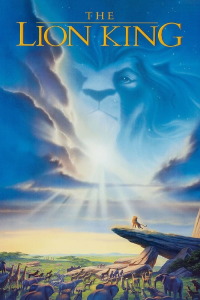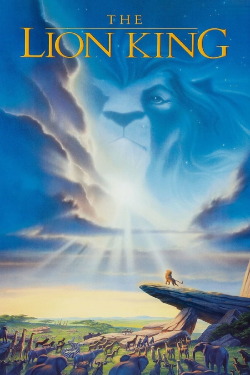
Review of The Lion King (1994) by Mitchell S — 12 Jul 2017
A much deeper allegorical film than people realize. A quirky animated meditation on life, death, religion and the parental inculcation of dreams and guilt in our children. As much a Prodigal Son metaphor as a vague retelling of Hamlet.
I still get a lot of flack for including The Lion King in serious conversation. However, I stand by my view that allegorical stories are the most emotionally affecting. To me, The Lion King wasn't about lions, pride kingdoms or even Mufasa roaring in heaven.
It was a movie about lost faith, self-discovery and manufactured destiny. The story of Simba running away from his parent-chosen destiny (The Circle of Life, a Christian-esque view of life amalgamated with Eastern philosophies) wasn't just comparable to Shakespeare; this was Portrait of the Artist as a Young Man and James Joyce! One could easily draw comparisons of Hakuna Matata to atheism, hedonism or Bohemian independence. Therefore, the very idea of Simba returning to his "destiny" and re-embracing his childhood faith is a very bold thought. Of course, since his heavenly bound father, his lioness-friend and that creepy little monkey constantly harass him about avoiding responsibility, this suggests that Simba never really had a choice but to return to his destiny.
What choice do we have in life, but to accept our family, our religion and the principles we learn in our childhood? Was it really Simba's destiny? Was it really a happy ending? Of course, Disney disowns any deep interpretations of their movie, it being the politically correct mouse who never judges anyone. (Except of course, child daycares that break copyright laws) To me, The Lion King symbolizes the life story of every human being-you can run away from your problems and your quibbles, but in the end, the lion in the sky always comes back to haunt you.
What I Learned: Really helped me to believe, as a child, in religion, in God, and in the optimistic view of life. That everything must be connected. That coming of age is a reality of life and what you retain from your youth really defines your value in life. What you learn in childhood defines who you are and what you do with your gift of life. Even though I've grown up a lot since I first saw it, I still think of this as the definitive optimistic film. And every so often, once in a while, I do write a happy ending myself.
Here is an in depth analysis of the film's symbolism that I first wrote in 2004.
I've been watching The Lion King obsessively for quite a while now for my own personal reasons. However, it wasn't until reading an article online (from...D'oh, forgot--obscure news journal) that I really started to understand why the movie affected me on such a subliminal level then and now. Of course it's subliminal and self-revealing, that is why we obsessively watch anything.
The article went on to explore Disney as a "moral educator"; that it had surpassed the simple role of Guardian and had stepped into the shoes of a full-fledged parent for movie going children. How so? Because of the moralizing shown in its family flicks. When Disney presents a movie like Beauty & The Beast, in which man and woman fall in love, or Aladdin in which Robin Williams goofs off on B material while a man and woman fall in love, they are entertaining our children. .
But when they crossover into morality, religion and existentialism, they take on the role of moral educator and begin indoctrinating into our children. Should they be doing this when children who watch Disney films are at an especially impressionable age and might possibly be incapable of fully accepting the concept of faith or morals from someone other than mom or dad? After all, would you allow your toddler aged son or daughter to listen to a full grown man explain his view of God, the bible and evolutionary theory?
I was more or less a kid when I first saw The Lion King in 1994 and these are the lessons I believe I was taught at a somewhat impressionable age of 17. (Keep in mind, preaching to a kid any younger than a teen is almost inculcating).
The simple (and possibly alarming) fact is that the Lion King borrows heavily from the Bible. And Shakespeare. And ancient mythology. Everyone knows that LK is loosely based on Hamlet and other works but it adds a bit more trepidation when you learn that the supposed word of God is being drawn in funny shapes and expressions--and in an alternative universe. .
Consider well known biblical story lines and Disney's caricaturized interpretation of them. Paradise that a man rules over, given to him by God. Mufasa tells Simba everything the light touches is your kingdom. But God commands Adam not to partake of the forbidden tree. But that shadowy place is "beyond" Simba's borders, a place which he may never go. Adam breaks the law. Simba defies his Father's order and walks on the wild side of danger. Instead of Adam going along with Eve and finding death, Nahla follows Simba and they are met with disaster.
Fast forward to the halfway mark: Simba becomes the Prodigal Son and leaves his "spiritual" responsibilities behind. Meanwhile the monkey sees that a promised Lion-ssiah will return to the kingdom, that has been lost in spiritual/literal darkness, and reclaim his rightful kingship and restore the desolate wasteland to paradise once again. Parallels to Revelation and the Gospels abound--and paradoxically, traditional.
Christianity is pushed here, which is in sharp contrast to the next point I learned...
""We Are All Connected in the Circle of Life" - Darwinism now contrasts the teaching of traditional Christianity, teaching us that we are all connected in a never-ending chain of life and death. Our bodies become the dirt, the grass as Mufasa tells Simba, and we must respect the life in everything. Fascinating how in one animated film Christianity, Hinduism and Darwinism have been amalgamated into one unquestionable Lion Religion.
But speaking of religion, is the Lion King a religious movie? I think the answer is surely Yes, although again, it combines many other religions into a caricature "true religion". .
During one of the best moments of the whole movie, Simba and his new friends Timone and Puumba speculate what exists above the sky and into the stars. Simba recalls his "religious" upbringing in which he was told by his father was DOES lie above the stars--the great kings of the past. .
However, Timone and Puuma here take on the roles of agnostics, laughing at Simba's explanation, and pushing their worldly wisdom of Hakuna Matata and the cynic's view of spirituality. Timone says the stars are fireflies--he sees the stars as a poet would, having no real concept of a Godlike being, but only of what he has observed in his very limited perspective. Puumba sees the stars in a purely scientific manner, believing them to be balls of gas burning billions of miles away. Of course, he being a very flatulent creature, he explains only according to what he knows.
The ultimate moral lesson of course, is that every creature has his own way of viewing the world. And everyone has their own unique brand of faith. There's more to see (about faith) in this movie than can ever been seen...more to do than can ever be done...(at least in this post). .
Mufasa's death was graphic and took place on screen--far surpassing the unseen death of Bambi's mother years ago. Was it wrong to teach children about cold blooded murder and to depict the violence in such a beautifully drawn scene as the wildebeest stampede? .
I don't think so because children need to learn about death, about injustice, and about the fact that "Life's not fair is it?" It does take away some of their innocence but given the message of the movie and the hope it restores, to depict a death early on in the film is a necessary evil. It was also a good move to show Scar's death, as it teaches that criminal scheming and deception will always result in punishment. Disney should be "respected, saluted" for being this daring. .
"You Are More Than What You Have Become", An angry Mufasa explains to Simba from beyond the grass. Haunting words, when thinking about the implications it gives us as an audience. What do we owe anyone, besides that we live and breathe and try not to eat each other? While I think there is a religious subtext here, pushing people to faith & religion of some sort, I also think that this scene is just as much about guilt and redemption. .
We all suffer from trauma in our lives, mistakes of the past or unrequited ambitions that we never fulfilled. Analyzing it from a nonreligious standpoint, if there is something that we yearn to do, and yet hold back from accomplishing out of fear, resentment or guilt, then we are being a Simba--we are running away from what calls to us. Is it belief in God? .
It can't be absolute preaching here, since Disney is also advocating Darwin's philosophy that life is a never ending chain of circular events, life and death, decomposition and conception. So we have to take it that Disney is painting a surreal picture of "faith" open to our own interpretation as unique and varied human beings--it is whatever we make it out to be. Are we running away from our self-granted destiny or do we have the strength of a lion to face our greatest challenge and conquer the demons of the past?
But the biggest lesson to learn here is a tough one: "I know who you are. You're Mufasa's boy," says Rafiki, teasing a brooding Simba late one night. .
Speaking again of destiny and of quasireligious undertones, when you really get down to it--what more can we expect of a child, but that he grows up to be who his parents want him to be? Children are mostly the product of their upbringing. Bad children grow up into bad adults as a result of a bad household. That leaves all the good children, all well behaved and with loving parents, who each go their separate way because of the subtle but solid parental examples that were left behind for them. .
It wasn't Simba's obligation that he become king. His father could have looked down on him and wished him well, living with a warthog and eating bugs all day. But it was Mufasa's will for his son that he become king, as his father did, and his father did, and etc. .
The example parents set for their young ones leave a definite mark and becomes a burned image of grown up success in the mind's eyes of a young person. There is a good chance that if a boy was taught by father to put work ahead of family that he will grow up to be a wealthy workaholic. (ala "Cats In The Cradle") .
On the other hand, if a girl was taught by her mother to be strong-minded, industrious and proactive in the community, you can bet this girl won't be sitting at home content to be just another housewife. Lastly, if a young man is raised by parents to believe in a particular faith or an understanding of God, though he might go soul searching in his rebellious youth, it's likely he will follow in their "pawprints" when he settles down in life. On the other hand, a little boy, raised in a household with no specific religious study, will have no specific "faith" to turn to, and may even find the thought of a "religious" discussion about The Lion King out of place and nonsensical. .
We cannot escape our destiny. We all do have a destiny, you know. And whatever that destiny is, is determined when we are young and as we spend time with our moral educators who teach us the circle of life--as they see it.
Coming from an extreme religious background myself, I do see a lot of faith discussion in the movie, whereas others only read the more general faith-healing message of Live & Let Live. Remember, all are agreed as they join the stampede you can never take more than you give. Meaning, no matter your faith or belief, be good to one another! (A nice safe message worthy of Jerry Springer...the only clear message Disney would be allowed to give in a press release, but certainly not the only one they implied) .
The Lion King is a great film because while it entertains and educates our children, it also provokes deep discussion on all things symbolic, literal and interpretive for adults who are willing to pay close attention to its allegory.
This review of The Lion King (1994) was written by Mitchell S on 12 Jul 2017.
The Lion King has generally received very positive reviews.
Was this review helpful?