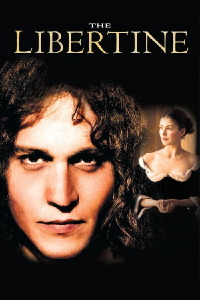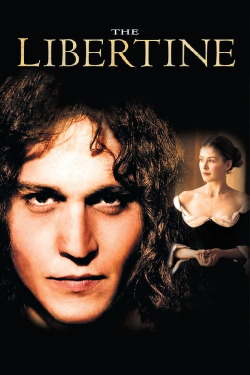
Review of The Libertine (2004) by David P — 14 Jun 2010
This is one of the best films I've seen in awhile. "The Libertine" concerns itself with the story of John Wilmot, the second Earl of Rochester, a fascinating character who comes across as a 16'th century combination of Hunter S.
Thompson, Aleister Crowley, Jim Morrison and Tiger Woods. When Charles the Second was re-installed as King a period of relative hedonism returned to England which had been chafing under the restrictive rule of Oliver Cromwell's Puritans.
Unfortunately, this also coincided with a period of political and economic strife in England and the film begins with Charles (John Malkovich) pulling Wilmot out of exile in an effort to turn his ample but misguided intellect to the role of trusted adviser.
The Earl (Johnny Depp), however, is certainly a product of his time, and seems much more concerned with drinking incessantly, carousing and, being "up for it, all the time." Indeed we're witness to plenty of examples of this as the film progresses.
Despite being married to a beautiful, clever and strong-willed heiress named Elizabeth Malet (Rosamund Pike) Wilmot seems incessantly drawn to self-destructive behavior. Charles contracts Wilmot to craft a play designed to impress the rival French and during this time he strikes up a wager amongst his cohorts that he can take a plain-looking, unrefined ingenue named Elizabeth Barry (Samantha Morton) and turn her into the greatest actress of the Restoration period.
He succeeds beyond all expectations and, in spite of himself, falls in love with the girl. It still isn't enough to tame Wilmot's ferocious appetites for debauchery. Things get worse when the profane and incendiary play he produces for Charles sends him back into exile and eventually his bacchanalian lifestyle catches up to him.
The film is a triumph on several fronts. The dialogue, beautifully rendered by masterful performances all around, is infused with relevance and wisdom. Johnny Depp does his usual masterful job seizing the attentions of the audience right from the beginning when he's granted a tremendous opening monologue and tells the audience directly: "Allow me to be frank at the commencement.
You will not like me. The gentlemen will be envious and the ladies will be repelled. You will not like me now and you will like me a good deal less as we go on." It's almost like he's throwing down a gauntlet, daring the audience to come along for the ride in an attempt to prove him wrong.
Despite his best efforts to the contrary, we actually begin to understand and even sympathize somewhat with his progressive mindset as the film unspools. When Rochester spits out honest dialogue like "I don't mean to upset people, but I must speak my mind.
For what's in my mind is far more interesting than what's outside my mind", he expresses the sort of contempt many of us often feel about small talk and banality. His scenes with Samantha Morton are golden and I love the fact that she ends up using him just as much as he uses her.
She does indeed become a successful actress partly by his his council but never allows herself to become his plaything. "I will not swap my certain glory for your undependable love," she tells him, going on to say: "May I always be in your heart, sometimes in your thoughts, but never in your debt.
" John Malkovich is also coolly effective as Charles the Second and you can see his palpable frustration with Rochester's willful desire to squander his ample talents. First time director Laurence Dunmore makes a deliberately murky-looking film to good effect here.
Occasionally the oppressive gloom feels as if the film-makers are trying to conceal budgetary lapses in the background which sometimes results in the film feeling a bit stagy. Having said that, the ever-present rain, dirt and mist makes the experience completely immersive, as if you can actually smell the dank pubs and filthy streets the characters inhabit.
The film's unique soft-focus illumination is primarily accomplished with candle-light, an effective technique that Stanley Kubrick also used to great effect on "Barry Lyndon" to ramp up the authenticity.
The costumes and sets are also all top-notch. "The Libertine" has been savaged somewhat by critics and viewers that feel as if you can't build an entire film around such an unlikable main character.
I beg to differ. The world is filled with flawed and sometimes repugnant characters, so rare is the film that has the bravery to shine a spotlight on just such a protagonist. Despite his peccadilloes, Wilmot is still an important figure in British history since his eleventh-hour, uncharacteristic intervention on the behalf of King Charles actually helped stabilize the monarchy for many years after.
"The Libertine" continues to give us reasons why Rochester was such a progressive figure. When he challenges the tropes of society by declaring: "Life is not a succession of urgent 'nows'.
It's a listless trickle of 'why should I's?'" then we realize anyone capable of such insight deserves some attention. The film is book-ended by a second arresting epilogue in which Depp as Wilmot beseeches us "Well? Do you like me now?" over and over again.
The effect is pretty powerful. Have we seen qualities in this man that allows us to look past all the crudities, nihilism and cynicism? Frankly I found the exploration to be daring, revelatory and unconventional.
Tilt: up.
This review of The Libertine (2004) was written by David P on 14 Jun 2010.
The Libertine has generally received mixed reviews.
Was this review helpful?