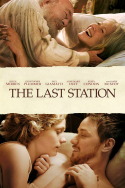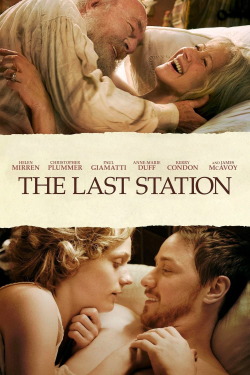
Review of The Last Station (2009) by Linda F — 24 Mar 2010
3 Stars out of 5.
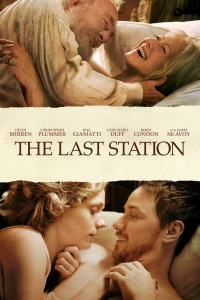
Strong performances can never be a disadvantage for a film. The Last Station is one inundated with strong, magnificently complex roles. Based on the story of the famous Russian author Leo Tolstoy (played here by the renowned Christopher Plummer), The Last Station bites hard at the sentiment and sometimes loses a grip of it. The plot wavers often but often settles into controlled intricacies, and the actors fervently perform, almost grazing the chewed scenery but not quite. The Last Station doesn't necessarily have a definite meaning to it, but it poses several dilemmatic conflicts. It is full of interesting parallels that make The Last Station a well-woven character practice under a meandered thematic narrative. I don't think the plot does this film justice, but the performances certainly do.
The film begins on endearing parallels. The ailing Leo Tolstoy lurches around his manor while his wife Sofya (the brilliant Helen Mirren) doesn't know whether to comfort him or to yell at him. These two are at two unique stages of their life: Leo is dying and he tries to have a faithful worshipping of God, while Sofya is confused. She is losing the one thing she loves most and thus resorts to cynicism. She's had enough with the religious quirks and meaningful appraisals by Leo that she can no longer control her own temperament. Soon enough, Valentin Bulgakov (James McAvoy) comes to the estate to work for Leo. He seems like Leo's youthful counterpart: wise, precocious, and in love. Valentin falls for a female wood chopper Masha (Kerry Condon), but Valentin becomes reticent because she slept with an older man and he is still a virgin. These people just aren't who they claim they are. Valentin comes off very asexual, but loses his virginity quick in the film. Masha seems hard nosed, but is really a benign yet robust femme. Sofya seems stern but is actually neurotic. Leo seems content and accepting with this aging, but eventually degenerates quickly into senility.
The Last Station it very good at this: creating characters that represent more than the fictitious. They always change. Some love each other, some use each other. Vladimir Chertkov (Paul Giamatti) manipulates the confused Leo to form a new will that strays away from his wife's benefits. Sofya becomes furious and for good reason: the love of her life is being taking away from her and there is nothing she can do. Little does Sofya realize she is getting older too. Valentin barely recognizes his own youth hood when he gets love stricken and Masha and Valentin's relationship becomes an obvious reincarnation of Leo and Sofya's becoming together.
But The Last Station falters in that it is not as tenacious as it should. The film feels more like an emotional experience than an epical recount of a famous life lost. Director Michael Hoffman is keen on incorporating the media amongst the scene. They write down every word of the Tolstoy's by scratching away at their pads. They take pictures of them at their most degraded and dejected moments. But the media's purpose is too distant, more of a superfluous screen filler, than an interesting focalization. Why is the media in this film? We get Tolstoy was scrutinized upon by these people but Hoffman fails to reiterate Tolstoy's omnipotence in literature through the eyes of the media. This is how we know Tolstoy, so we need that perspective. It doesn't have to play as the only one but it has to be there.
Helen Mirren though is electrifying. Her emotions are delivered at pitch-perfect moments. She loves her husband and the fact that she cannot be with him disturbs her. What does she do? She does not know if she believes in God or if she has purpose. Her reactions are so arbitrary that she runs and dives into the estate's pond to drown herself upon hearing of Leo's senile decision to leave her.
But The Last Station still comes off a little too convoluted. The film concludes under an aerial shot of the media. More distant from the Tolstoy's. So who is this film really about? Everything, everyone, or the Tolstoy's. Because the narrative mostly played out as an emotional telltale of the Tolstoy's and their confusing feelings at a time when death knocks at the door.
The Last Station may feel a little shallow and even too slow in parts (especially the first twenty minutes). Even the cinematography is surprisingly pedestrian. The lush environments are muddled under deep character conversations and profuse pan shots. It doesn't look as beautiful as it should but the emotions are still there. Due to the crafty pen and the performances, The Last Station makes this story of the Tolstoy more about the emotions within, not a reactionary time piece. For better or for worse, Hoffman's sentimental build still lasted.
I SAY--See It.
This review of The Last Station (2009) was written by Linda F on 24 Mar 2010.
The Last Station has generally received positive reviews.
Was this review helpful?