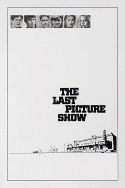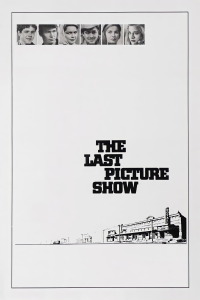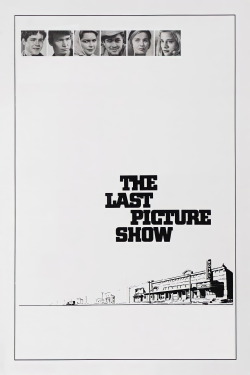
Review of The Last Picture Show (1971) by Jake R — 12 Aug 2009
1971 was the year the movie-going public, it's self-appointed guardians, the media and even critics themselves cried out at the seemingly excessive sex, violence and general anarchy that was raging across cinema screens. From the questionable morality of police dramas 'The French Connection' and 'Dirty Harry', to the extremeties of 'Straw Dogs' and 'A Clockwork Orange' it seemed all cinema was good for was to take the lurid, disgusting truths of modern life and poetically, savagely parade them for the world to see as a mirror image of itself. It was an excessive, volatile age, but one picture was made that connected to the anger and disillusionment of youth on a more uncomfortably close scale.
'The Last Picture Show' is a classic coming of age story, showing youngsters exploring their bodies and experimenting with 'grown up' things like relationships and responsibilities, but that's only a sub-plot in terms of its true nature. Instead the film is more a comment on a more eternal issue for young people: the inability to successfully change from a young person into an adult. All those things that seem great when you don't have to worry about surviving, like sex and football and hanging out inevitably disappear, drained of their special, enchanting qualities to be replaced with a much emptier, more boring adult life. It might feel cliched now, since these themes have sprouted up in countless teen movies and family dramas since, but here it also feels fresh and stark, all these elements and observations together in a succinct and steady train to despair.
Really, that's an emotion that takes over the giddy irreverence at the beginning. There's the usual establishment of the frat boys being immature, girls being hussies, middle-aged people acting younger than their children and the slightly older generation a million miles away from what's happening on their doorstep. But gradually these conventions fade away as the characters themselves become drawn more strongly. Jacy, for example, mostly appears like the token slut but she's more misguided and hungry for change rather than simply sleeping around for the fun of it (well, more the former than the latter anyway.) Duane isn't the typical jock; he's almost too sensitive for his own good, letting his macho quality seep through inappropriately and making him freeze. At the centre of it all is the gangly Sonny, a wonderfully charming person who is seduced by easy pleasures and the breif attention meted out to him.
The catalyst for such damaging change is the death of Sam the Lion, the youngest of the 'old people', who keeps alive his own humanity with the memory of his true love, something he believes is worth doing even though it's painful. Sam's character is heartbreaking because he's managed to be his own person through all these years of loneliness and disappointment because of this powerful feeling he used to have, undiluted after decades, and as a result he isn't like the faceless, soulless locals. The town is full of old men and women totally absorbed in the throes of a traditional way of life, one where emotion doesn't come into life and ritual and custom dominate anything controversial. It's the perfect enviroment to crush dreams, and so many relics of this effect are clear: Burstyn's frustrated housefrau, Leachman's isolated matriarch, almost a widow considering how neglectful her husband is. Once Sam is gone, the fragile fabric of harmony between young and old is destroyed and as such the young flounder, completely confused without any form of help. This is the subject James Dean tried to tackle in the real '50s, one of utter contempt at this ultra-conservative repression by the war generation, though of course in those times it had to be in the form of tempestuous melodrama; now that we're in 1971 we can afford to be a bit quieter and more grounded in the mundanity rather than the hyperbole.
But this is not a depressing movie. It may culminate in a string of emotional blows and end on an intensely bleak note but the proceedings have been far from unpleasant. Along the way we've seen tender romances blossom richly, and the characters never fall flat on their faces and stay there, they rise up and forge ahead with their lives to try and find a meaning in doing it all. There's also a warm well of humour where many, tiny, jokes bloom unexpectedly, mimicing the spontaneous surrealism of modern life. And on top of it all is one of the best casts of the whole New Wave period.
Each of the main players is a joy, capable and innovative, and poignantly truthful. A very young Jeff Bridges wrings real sympathy from his big dope Duane, while Timothy Bottoms excels at giving his pretty boy a streak of memorable personality and a tremendous sense of pathos. Ben Johnson is loveable and heart-warming as the generous Sam, but it's the women that make the most impression. Leachman exudes a breathless melancholy from her abused wife, a bravura moment being her painful rage at being used so carelessly. Burstyn plays a delectable milf figure, who at first seems like a clean cut adultress but actually is just as damaged and angry as everyone else. The star of the show is of course Cybill Shepherd, making her movie debut as Monroe-voiced teenage temptress Jacy, echoing her mother's frustration at a rigid way of life but also understanding how free she is compared to her. Jacy never quite escapes her man-eater status, but those vulnerable qualities are indeed there, and Shepherd is graceful enough to provide her character with some of the film's most humorous moments. And she has to be one of sexiest fantasies in the history of cinema itself, never mind for teen movies.
Filmed in crisp monochrome and robbed of a conventional score - relying on whiter-than-whitebread personification-of-Texas Hank Williams - this is anything but a playful romp through a fantasy version of the '50s as made up by dozens of movies in the '80s; this 1952 is barren, decrepit, boring and feeling the fallout of the Korean War. This being 1971 of course all of these features resonate heavily, particularly the allusion to the conflict in Vietnam, but it is also a product of the early '70s: gloss is traded in favour of all-consuming bleakness, the attitude to sex is very conscious and brazen, and the general feeling that life is so hard to make worthwhile, all these conventions are unique to an America emotionally exhausted from the tsunami of revolutions that had come in the '60s, though the film's warmth and sincere hopefulness is something that would be extinguished completely after Watergate. At times the '70s method can get irritating, particularly in the sound recording which makes you have to listen very carefully indeed, but most of the time any irks can easily be ignored.
Overall, this is a sombre, quietly sad but gentle masterpiece, one of powerful truths spoken from all angles of this ugly war between the ages. At oncea classic teen movie with an explicit attitude to sex those 'American Pie' guys could never even dream of, it's also as impactful and soulful in its ruminations on identity as any of the best Bergman, and just as beautiful too.
This review of The Last Picture Show (1971) was written by Jake R on 12 Aug 2009.
The Last Picture Show has generally received very positive reviews.
Was this review helpful?