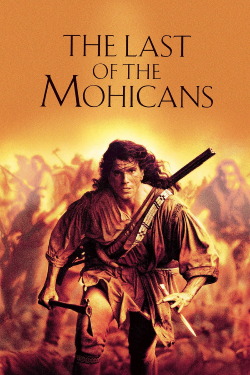
Review of The Last of the Mohicans (1992) by Edward A — 03 Sep 2014
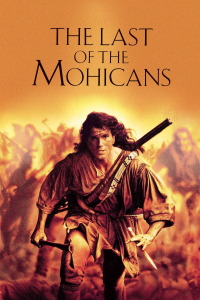
For those of you who've studied up on your history and researched the French and Indian War, you would know that it was a disastrously bloody war between two supreme powers, chaotically pitting the native people of America against each other-some tribes siding with the English and others with the French, each promised notable benefits. The Last of the Mohicans places us into the center of this conflict as a white man, raised by Indians, named Hawkeye/Nathaniel (Daniel Day-Lewis) guides a British group through corybantic rivers and the unpredictable wilderness to their ultimate destination. First of all-to begin on a positive note-the elaborate, fitting production design is certainly appreciated, as well as some satisfyingly epic battle sequences that wondrously visualize my imaginings of the grandiose battles within the book.
Now, I'm going to approach my criticism of this film from the perspective of a literature fan who has recently read the actual 19th-century work. With that in mind, I can say that monumental disappointment struck me not only because of the failed text-to-film adaptation itself but also because it was directed by an otherwise incredibly talented filmmaker (Michael Mann) who has proven time and time again he's leagues above this; I sense this was a director-for-hire sort of project though. What the audience gets is essentially a classic, important, and spectacular story that's boggled down by safe Hollywood conventions. The depth and sheer intricacy of the source material is completely lost on this unfortunate Mann production that is so conspicuously influenced by studio restraints. Considering that this is a nearly 25-year-old film, the remainder of my review will feature major, major spoilers.
So, let's look at my first example of the movie's insufficiency: the Huron ambush after the surrender in the novel sees men, women, and children as a part of the English evacuation. The writing brutally illustrates the initiation of the massacre by a Huron bashing a mother's baby against a rock and then driving a tomahawk into the woman's skull. Since Hollywood decided to censor this horrific scene from your oh-so-innocent eyes, allow me to rebel and inform you of its existence myself. Where are all the women and children here? Why wasn't this prized British fort housing anyone other than the male soldiers? Obviously, killing a multitude of armed, fully competent men lessens the impact of the ambush and understates the unfair brutality and utter hostility that came with the French and Indian War.
In addition, we get-of course-a forced romance subplot that drastically alters relationships and makes very little sense, forcing me to question its exact necessity other than stereotypically pairing the lead with a romantic interest. Duncan (portrayed by Steven Waddington in this rendition) was involved with the two young women (Cora and Alice) in the novel, establishing an interesting dynamic between the three-an interconnection of confused love. Duncan in the book was also actually a crucial character who bridged the cultural gap between the Native Americans and white folk-certainly a significant theme of the story. In this case, that type of complex thematic material is lazily substituted with archetypal white folk who merely desire their land and act with vapidity.
Another one of considerable flaws is the motion picture's abhorrently short runtime (under two hours) for such a grandly-scaled tale that not only initially consisted of far more complex relationships and characters but also a superior build-up in the various one-on-one Indian combats and general clashes. The utter potential is immediately squandered by such a brief duration that cuts plenty of the bulk out, leaving in its stead the Hollywood conventions (of an action film) heretofore mentioned. Aside from cutting out copious pivotal segments, the film also daringly alters some events and puts a new twist on the narrative such as killing off different characters, filling the viewers with intrigue in regards to how this particular cinematic adaptation can pan out differently. Alas, the deaths don't exactly lead into a brand-new direction for the story--.
No consequences whatsoever-therefore deeming the disparate decisions a little pointless.
The last act takes a surprisingly dark turn, killing off even more significant characters than James Fenimore Cooper did. However, the difference is that the impact of theses deaths isn't genuinely felt, regardless of the body count, since barely anyone in this film is adequately developed in the first place. Uncas (Eric Schweig) is an absolutely major presence in the book as we see his deliberate evolution from a submissive, diffident son to an intrepid warrior who manages to rescue the daughters and formidably face off against Magua (Wes Studi). In this case-on the other hand-we rarely hear so much as an utterance from him, and the camera is only occasionally placed on his whereabouts. This fascinating growth of a character is painfully sacrificed for the sake of a climax that's translated through an indolent montage-little to no dialogue; simply following every plot point from the last part of the book to its definitive finish as quickly as the filmmakers possibly can.
A sweeping score plays as apparently principal people are abruptly (or rather anti-climactically) killed. Duncan-the vital cultural bridge in the original story, without so much as a discernable personality here-is burned at the stake very quickly. Alice (Jodhi May)-with very little to do throughout the picture-suicidally leaps off a cliff with a strangely calm demeanor. Even if this adaptation is substantially unfaithful, it could've at least found other compelling alternatives to explore the setting and relationships, but instead, this turns out to be an obviously rushed and poorly executed action flick that has so much thoughtful source material distantly behind it.
This review of The Last of the Mohicans (1992) was written by Edward A on 03 Sep 2014.
The Last of the Mohicans has generally received very positive reviews.
Was this review helpful?