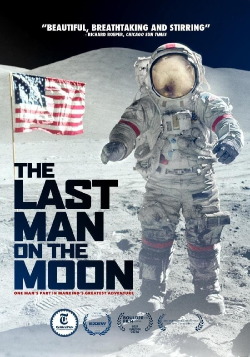
Review of The Last Man on the Moon (2016) by Archon L — 08 Apr 2016
It has become commonplace for people to say that we live in a world filed with technology but lacking imagination and wonder. Instead of technology being feats of imagination, it is now a cold, commercially driven beast that seems out of control. We've lost our sense of wonder -- of being a part of something much bigger -- bigger than anything we can imagine or possibly experience. It seems that the things left that still could stir our imagination have been relegated to box office cash cows stripped of all wonder and imagination, or worse to silly talk by dreamers.
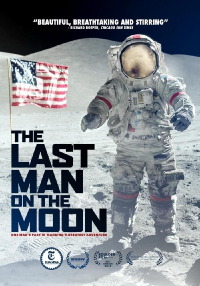
Mark Craig's 2015 documentary, The Last Man on the Moon, about Apollo astronaut Eugene Cernan (and based on his book of the same title) takes you as close as is possible to that sense of awe and wonder that we so lack today. The film does this in a low key "non-hypey" way through anecdotes and commentary by Cernan and people in his life, but it also does this with an uncanny ability to show grandeur through cinematography and silence; it's a beautifully filmed movie filled not only with breathtaking stills of the moon, but scenes such as this...
The film starts at a Houston rodeo arena, and we see Cernan watching a bull riding contest. He watches a rider struggle to control a bull, and then the film abruptly cuts to archive footage of a test pilot inside a NASA centrifuge. The film could have started by showing Cernan in his space suit frolicking on the moon, or giving an important speech, but it starts with a man -- a simple man in the world surrounded at a rodeo by people who don't know him. This is the film's genius -- it depicts a man who tells us "Never shortchange yourself; you never know what fate has in store for you." and doesn't make him into a god. The film follows Cernan through the years as he was recruited by NASA to train to be an astronaut, his Gemini spacewalk, and his Apollo 10 and 17 missions. It chronicles his personal life, and gives a sense of what the man is doing now.
Making any kind of movie about the space program is difficult. There is so much material it's easy to get lost in a sea of archival footage, documents, and relics. It is hard to focus. As a filmaker you have to make decisions, and when faced with such a wealth of material those decisions can either make or break the project. If you focus on something, you miss out on other material, and with great people it is so very hard to encapsulate their lives in a 90 minute span of time. However, Craig strikes a nice balance between Cernan the man, his role in the Space Program, and the sense of gee whiz wonder of it all. After watching this film twice, I have a better sense of Cernan the man, and a better sense of the men and women involved in the era-defining dream that was going to the moon.
The astronauts are special individuals, but they're also people. Craig does an excellent job of not idolizing his subject; yet, he's respectful. Cernan and his first wife divorced, and I think a lesser filmmaker might have wanted to do some digging in an attempt to reveal more of his subject. Craig wisely avoids this kind of tabloid trap that has become all too common now. He approaches his subject with the respect and admiration he deserves, and it is clear that his purpose in this film is not only to document Cernan's accomplishments but to also inspire a new generation. Is that possible? Can a film, in a world filled with video game story telling and an ADD attention span do this? In a 2011 interview on Fox with Megan Kelly about the Chinese space program, Cernan asks "What is there to inspire your generation? We knocked on the door of the future...and we just backed down. What does that 13 years of my life mean to future generations? I haven't been able to answer that yet." I'm not sure the film has answers to those questions. I don't know if it's supposed to.
For much of history, the earth was largely unknown and unexplored. Most people never traveled beyond their village and what they knew of the world came from stories. What must it have been like to meet Sir Walter Raleigh, Columbus, Edmund Wilson, or Amundson? In Columbus' day, there was no internet, magazines, TV, films, etc. There were only people and the stories they could share. How amazing must it have been to hear tales of lands filled with bizarre creatures, new foods, and completely foreign landscapes? What must it have been like to listen to Raleigh tell tales of Indians, hurricanes, mountains, and a seemingly endless ocean? I'll never know, but listening to Cernan recount a brush with death while holding a charred helmet, or talk about drawing his daughter's initials near the lunar rover gave me that sense of human experience -- of the unknown being transmitted. I've never met Cernan or any other astronaut, but watching The Last Man on the Moon made me feel like I'd been there. I could see how the experience changed Cernan and gave him a deeper sense of appreciation for the Earth. For the 90 minutes I watched, I went from sympathy to empathy -- from a consumer of space images to someone with a deeper understanding of the stories behind the images.
At the end of Blade Runner, Roy Batty tells Deckard "I've seen things you wouldn't believe." In a world filled with the ability to create anything with CGI images that can't be true. But it's not about the things he saw, it's about his experience and being able to transmit that to another generation. We get it, when he dies, that what is dying is the narrator of those "things you wouldn't believe." Without the original narrator they are just dead images. We've all seen the images from the moon, especially the younger generation who sees those images manipulated in music videos or declared hoaxes crafted by Stanley Kubrick To demoralize the Russians. What we need is the person who was really there to tell us how being there affected him. That's what makes the images mean something. In the interview with Megan Kelly, Cernan says that sometimes it's hard for him to believe he was really there. "It was forty years ago, almost half a century." If it's hard for him now, just wait till he's long gone...how many people will believe that really happened? I believe it because I heard him talk about it and saw how it affected him.
Much of the footage used in the film will be recognized by many. The images have become so commonplace that they are now "stock" photography. They have lost something and became "Oh, yeah, I've seen those" kind of pictures. However, to hear Cernan narrate the images brings them back to life and returns them to the sacred instead of the profane.
It's tempting to think that this is a film for space program fanatics, and I'm sure many people will think it's just another documentary about a bygone era -- a "been-there-done-that" kind of film. It's not. It's a film for anyone who wants to regain that sense of wonder they had when they were a kid, and treats that sense of wonder with respect. At the end of the film, Cernan says "I walked on the moon. What can't you do?" We need more of that kind of thinking now, and we need more films that inspire us to think that way.
This review of The Last Man on the Moon (2016) was written by Archon L on 08 Apr 2016.
The Last Man on the Moon has generally received positive reviews.
Was this review helpful?