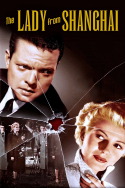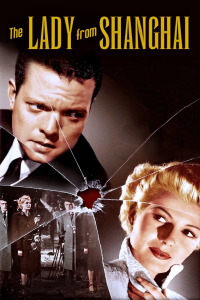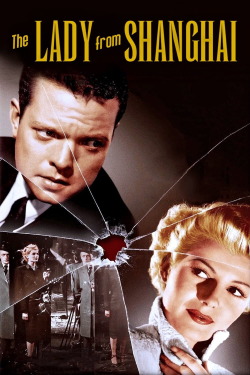
Review of The Lady from Shanghai (1947) by Curtis M — 28 Jun 2010
The Lady Not Actually From Shanghai Goes to San Francisco Instead.
I am intrigued by the decision made, presumably by Welles himself, to have Orson Welles speak in an Irish accent throughout the film. It's true that his character is referred to as Black Irish, but you don't actually have to be from Ireland to be called that. My brain is attempting to summon details of something wherein a character is called "Irish" for being of Irish descent and having an Irish name. Still, at least the accent isn't grating. It isn't great, either, of course, but Welles was a good enough actor to just let it flavour the character, not hit us over the head with it. I mean, I'm also sure the original character was from Ireland--probably the book the movie's based on included all sorts of character details. When he left home and that. It's just that they don't really matter here, though throwing them in might have let them take out some of the padding.
Welles is, as I said, Michael "Black Irish" O'Hara. One day, in the most remarkable setup, he encounters Mrs. Elsa Bannister (an inexplicably blonde Rita Hayworth), who invites him to crew her husband's yacht as they sail through the Panama Canal on a trip from New York to San Francisco. He knows better than to trust this, but ends up going along anyway, because if he didn't, there wouldn't be much plot. So he climbs aboard, and he travels with Elsa and her husband, fabulously successful defense attorney Arthur Bannister (Everett Sloane). Appearing midway through the voyage, having flown down to meet them, is Bannister's partner, George Grisby (Glenn Anders), who comes up with the most extraordinary idea. O'Hara is to write out a confession to shooting Grisby, who will then take his money and vanish. And O'Hara won't be convictable, because there won't be a body. No body, no murder!
Except I wouldn't particularly want a defense attorney who believed that. It is true that it is difficult to prosecute for a murder if you don't have a body. People have been known to take the legal term "corpus delicti" as, ha, evidence of this, but it refers to the body of the crime, not of the victim. It is true that a mere written confession certainly would not be enough to convict someone of murder were a body not found, but I'm not sure it would be enough for a declaration of death, either, which rather defeats the purpose of the whole gambit. One of my favourite mystery novels, in fact, involves a corpse which is found but then washed away by the tide before it can be retrieved. The quick-thinking discoverer manages to provide enough evidence to prove there had been a body there. Fortunately, she had film left in her camera! It is doubtful so much evidence could have been left to show that a body thrown into a bay really had been, but again, that works both ways against the plan.
Of course, the inevitable trial sequence decays into farce. It seems to be a high-profile case, which I guess isn't surprising, but the courtroom itself looks pretty fake, and the spectators seem more out of a rural trial-watching crowd than the sort reasonably expected to fight for places in a society crime in a cosmopolitan city. Not only that, but it seems to be both swarming with reporters and half-empty. There are quite visibly empty seats in the gallery, even though someone makes a fuss about having saved Elsa a seat. It also seems as though every window in the city has the same view of the Bay, including the large picture window in the courtroom. In case we forget what city we're in, I guess, and confuse it with nondescript New York from the beginning of the movie.
Really, the whole thing is kind of a mess. Rita Hayworth seems to be a blonde because it makes her more glamorous, but then why bother casting Rita Hayworth? O'Hara spends thousands of miles telling everyone who'll listen that he's going to quit and walk off the boat as soon as it hits San Francisco, but he's never able to make a satisfactory explanation of his reasons for walking on the boat in the first place. The opening is so obviously staged that it's a wonder anyone over two could fall for it, but anyone could be caught in the trap, including someone who wouldn't be helpful for the various over-complicated plans at all. When, inevitably, O'Hara ends up on trial for murder (spoiler!), no one seems to worry about conflict of interest when he's defended by the partner of the man he supposedly killed. And in a minor but extremely perplexing twist, O'Hara offers Elsa a cigarette at the beginning of the movie in some pickup line I don't get, and she tells him she doesn't smoke. She wraps the cigarette in her handkerchief and puts it in her purse. But then she spends large amounts of the rest of the movie smoking. Huh?
This review of The Lady from Shanghai (1947) was written by Curtis M on 28 Jun 2010.
The Lady from Shanghai has generally received very positive reviews.
Was this review helpful?