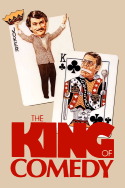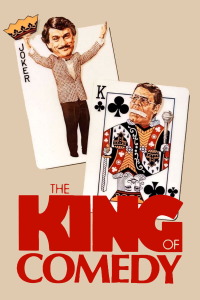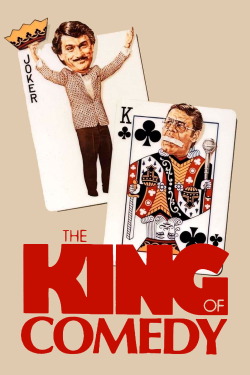
Review of The King of Comedy (1982) by Matt H — 28 May 2008
America has always been fascinated with fame and the beholder. From actors and actresses to football stars and singers, the American people have always looked up to and worshipped these people as larger-than-life beings. The whole premise of talk shows is to fulfill the curiosity of the general audience through conversation and exploration into the daily lives of our idols. Most Americans are content watching their favorite stars from the comfort of their sofa or seat at a stadium or movie theatre. However, there are a select few that long for more than this; they actually want to be the people they idolize.
This brings us to the story of Rupert Pumpkin in Martin Scorsese's satrical piece [i]The King of Comedy. [/i]Rupert is an amateur comedian trying to break into showbusiness. An avid fan of Jerry Langford, Jerry Lewis in a perfect casting, and his late-night talk show. One unexpected night, Rupert seizes an opportunity to catch a ride with his idol. He tells Jerry about his comedic aspirations and persuades the talk show host to set up a meeting.
Rupert attempts to follow through with this, but is met with great opposition by the front office at Jerry's show. Naive and unable to take a hint, Rupert adamantly persues Jerry's offer, eventually forcing someone to accept his tape. As Rupert slowly inches closer to his dream, his illusions of grandeur grow greater as well. He invisions his journey to the top and life as a star to the point of believing it himself. While the key theme of the film is obessesion with fame, Rupert's self obsession is also a strong underlying theme in the film. He feels with all his being that his comic act is destined for fame and greatness, to the point of becoming an entirely different person at times. Someone who feels they are of great importance, when in reality they aren't.
Rupert makes one final attempt to get through to Jerry by paying a visit to the star's home with a lovely lady by his side. Unfortunately, his relationship with Jerry is only worsened by this act of idiocracy. Jerry angrily forces Rupert and the woman out of his house, and finally forces the central character to see the truth: he doesn't care. No one does in fact; even to the point of constantly mispronouncing Rupert's odd last name. Jerry thought the house visit was the peak of Rupert's outlandish scemes, but he would end up being very wrong.
Rupert, along with another obsessed Langford fan, decides to kidnap the star in order to get time on the show. They are successfully able to aprehend Jerry and get in touch with his superiors about Rupert's guest appearance as "The King". The FBI makes matters difficult for Rupert, but he is eventually able to make his appearance. When the moment finally comes, Rupert steps up the plate with confidence and swagger of a ture "king of comedy" and kills the crowd with his routine. Afterwards, he convinces the cops to let him watch the taped show at anothe site: the bar where he picked up the lady.
She is immediately embarrased at his presence; that is, until he turns on the television. The routine is shown and the police take him away, but not before making quite the impression on those watching. He is sentenced to 6 years imprisonment. Come to find out, the American people ate up his act and the media is flooded with Rupert related material. When he is released after served just under half of his sentence, the comic is welcomed home as a star. The film ends with Rupert walking onstage to the applause of the crowd, realizing the life he dreamed for was finally his.
The film is a humorous and profound look at our obsession with fame and self-obsession to the point of disillusionment. Robert DeNiro is excellent as Rupert, showcasing his ability as more than just a tough guy character. Scorsese's direction is good, capturing the emotions of each character and the obsession over Jerry with expert skill. The themes involved in the film are explored in-depth and to fulfillment for the viewer, giving us a haunting look at the nature of our idolization of fame and even ourselves. The final minutes of the film strike an even greater cord. Even though he kidnapped star talk show host and comedian Jerry Langfor, Rupert's ten minutes of fame launched him to stardom in the eyes of Americans everywhere. It's too bad Rupert had to go to all that trouble to fulfill his dream. With the cheap price of fame in this country, it shouldn't take a kidnapping to become a star.
This review of The King of Comedy (1982) was written by Matt H on 28 May 2008.
The King of Comedy has generally received very positive reviews.
Was this review helpful?