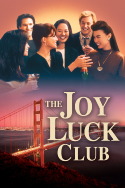
Review of The Joy Luck Club (1993) by Eric H — 27 Jul 2009
I haven't seen the Joy Luck Club since college, and when last I saw it, I had written it off as annoyingly melodramatic. But my wife, having recently married into my Taiwanese family with 3 new sisters-in-law and growing ever so much closer to our Japanese American friend Aiko, felt that she wanted to watch this film. With all the flood of Asian-ness around her Alissa felt like myself, my sisters, and our friend Aiko have casually made reference to the Joy Luck Club so many times that she really needed to watch the film.
And of course, I can't deny the frequency with which Asian Americans in general refer to this film as a sort of touchstone of experience. But as I said, my last viewing of the film in college left me with a manipulated sense of maudlin sentimentality and melodrama, and in general I didn't enjoy it, even though when I had first seen the film in high school, I felt quite emotionally connected to the film and its many dramas. But I can't deny that the influence and relevance of this film has persisted in the Asian American community over the years. Also, I have changed a great deal since college, and I have found that a great number of films I loved in college aren't as fun for me anymore, and a number of films I was totally uninterested in then are riveting to me now. so I decided to give Joy Luck Club another look from my new perspective as a married Asian American man.
And I still found the film uncommonly emotionally manipulative with a maudlin sense of sentimentality and melodrama. However, here's the new perspective (and I'm pretty sure it's going to get me in a LOT of trouble to say this): over the past years since college, I think I have realized that Asian American women are actually, in general, uncommonly emotionally manipulative with a maudlin sense of sentimentality and melodrama, so this time around, I felt like the movie is simply being true to its subject.
Now, I'm sure that's an incredibly controversial thing to say, and I don't want to make any racist generalizations (even though I feel like it's ironic that I've found a way to honestly make a remark that might get me accused of bigotry against Asians). So let me limit my argument to say that the melodrama of the movie appropriately matches the melodrama of my mother and her relationship to my sisters. Of course, even if I do limit it to that, I'm sure that will still get me in plenty of trouble.
But I maintain that my mother and my sisters do indeed talk about things with an air of tragedy, and a flair for drama, much like the women in The Joy Luck Club do. And while I was a bit more annoyed at that in college, at this point now, I feel like it's familiar. The women in my family do have a tendency to paint events in a very grand, almost operatic light. It's hard to really get across exactly what I mean by that. For instance, it's never that "my mother is a little mad at me." It's that "the family is teetering on the brink of disaster." And I don't mean that to say that in a disparaging way. It's not necessarily untrue that the family is "teetering on the brink of disaster," it's just that that's the more dramatic way to put it.
And in essence, Joy Luck Club gives a relatively comprehensive argument for why Asian and Asian American women might be so given to melodrama. The thing is that the melodrama comes from a deep and abiding concern for the consequences of things. Joy Luck Club shows a cultural history of emotional repression, which leads to very dramatic explosions of emotion. And all of that is actually portrayed relatively accurately here in context with the emotional repression. This is not to say that Asian women have a habit of murdering their babies as they seem to in this film. But the grandiose dramatic events such as all the dead baby stuff is very emotionally true at least.
One scene in particular hit me hard on this viewing. I was struck by the effectiveness of the scene where Rosalind Chao and Andrew McCarthy try to sort out what they're going to eat for dinner. It's a mundane scene but it hints at so much conflict underneath the surface and repressed emotions. I had forgotten how beautifully ambiguously the scene is written. It reminded me of the phone call between Heath Ledger and Anne Hathaway toward the end of Brokeback Mountain, or the breakfast the morning after DiCaprio and Winslet fight toward the end of Revolutionary Road. It's that wonderful brand of writing that takes a thoroughly mundane conversation and imbues it with meaning through context and performance. There's so many ways to read the emotions of the scene and so many ways in which they're communicating but not communicating. It's really quite a brilliant scene.
Another thing that my wife pointed out to me was that the movie gives a very strong feeling of community between families. When she pointed that out, I found that the central party scene in the film did remind me of the way the same sort of long-standing relationships were set up and suggested in the wedding sequence in the Deer Hunter.
On the opposite tip, however, one thing that has long been an annoyance in the Joy Luck Club for me, and continues to be with this viewing is that the image that the film paints of Asian and Asian American men is quite uncomplimentary. Men in general don't really come out positively here, but Asian men in particular are either evil or just really really doofusy. And that seems to actually be even one of the root causes to the Asian American female neuroses that are mapped out in this movie. And while I understand that the movie made huge strides in both the public eye and the entertainment industry for Asian women, I can't help but protest that this progress was made at the expense of the Asian man.
But all in all, I was much more entertained and moved by this particular visit to the film than I was expecting, and for all it's faults, even I have to respect that it is a watershed moment for Asians and Asian Americans in the history of cinema.
This review of The Joy Luck Club (1993) was written by Eric H on 27 Jul 2009.
The Joy Luck Club has generally received very positive reviews.
Was this review helpful?