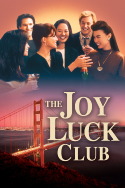
Review of The Joy Luck Club (1993) by Leela R — 27 Mar 2010
The Mothers We Expect, the Daughters We Want.
When this movie came out, back in '93, I went to a school full of immigrants, many of them Asian. Most of them had come to the United States so young that they didn't remember their native countries, and even those who had not were assimilated in a way anti-immigration types don't think possible. They were the American dream; I have a photo from prom around here somewhere which looks like a poster for the United Nations, or at very least a Benneton ad. And a lot of my Asian immigrant friends went and saw this movie, several of them together. I didn't go with them. The dividing lines were too complicated to allow it, though they had nothing to do with race or country of origin, just differences in who we were. (In part, I think, because they were more normal than I was.) I was, however, there when we were waiting around the classroom door before fifth period and they were talking about seeing the movie. Most of the conversation involved comparing their own mothers to the mothers in the movie, and there was not a one of them who found the movie mothers' behaviour toward their American daughters improbable. Some of them had perversely similar stories about their own upbringing. A few generations earlier, it would have been my own ancestors and their European parents. Some things don't change.
Suyuan Woo (Kieu Chinh) was dead, to begin with. She had been planning a trip to China, the land of her birth, the land where, many years before, she had left twin infant daughters on the side of the road during her flight from Shanghai during the Japanese invasion. She had been haunted by that action all her life, and now, she was coming to make amends. Her daughter, June (Ming-Na), is now to take that trip in her stead, to meet her long-lost half-sisters, presumed dead these many years and now found to be alive. Her three "aunties," her mother's best friends, are having a going-away party for June, also known as Jing-mei, and over the course of the movie, each woman--Lindo Jong (Tsai Chin), Ying-Ying St. Clair (France Nuyen), and An-Mei Hsu (Lisa Lu)--tells a story of her life, as do their daughters--June, Waverly Jong (Tamlyn Tomita), Lena St. Clair (Lauren Tom), and Rose Hsu Jordan (Rosalind Chao). The mothers' stories are stories of hardship, of duties to family they cannot bear, of pain. Ying-Ying's story is actively horrifying, and she knows it as much as we do. On the other hand, the daughters' stories are all about trying to be good Americans despite mothers unable to prevent themselves from acting like, well, Chinese mothers. The girls make American mistakes, perhaps compounded by the fact that they must face their mothers' Chinese disapproval.
Some people I know online and I have had a discussion about whether people should only play characters of their own national origin, and I argued passionately that they should not. (Vexingly, the person who started the thread also praised, elsewhere, Brando's performance as Don Vito Corleone. Brando was from Omaha and had not a drop of Italian blood.) However, it still really bothers me when I read of Asians playing outside their national origin. Most of the women here are actually of Chinese descent, but of course Tamlyn Tomita is Japanese and is as likely to play a Chinese woman. Rosalind Chao, from Anaheim but of Chinese descent, played both Keiko O'Brien on two [i]Star Trek[/i] shows and Soon-Lee on [i]M*A*S*H[/i] (and [i]AfterMASH[/i], but who cares?), Japanese and Korean respectively. Likewise, when we did [i]Dances With Wolves[/i], I made an effort to find out the origin of its supposedly-Sioux characters, very few of whom were actually Sioux. I think the reason I care, here and there, is that it reminds me of the leftover "they all look alike" mentality. I mean, I knew without looking that Tomita is a Japanese name, and she turned out to be born in Okinawa. However, it seemed as though every Asian in Hollywood played a Korean on [i]M*A*S*H[/i] some of them repeatedly. Even if they were famously Japanese, such as Mako--born in Kobe, and appeared on four episodes playing characters from two different countries.
Parents have a lot of expectations of their children. I am a parent, and I tell you that this is so. We couch it in terms such as "hopes," but we do expect things. Most difficult to live with is probably "your life will be better than mine." My daughter will almost certainly have that; she's older than I was when my father died and still has two living parents, and she does not, from what I can tell, show signs of being bipolar. So lucky her. She also does not have to watch her life in the mirror of my eyes. I can't speak to her mom; she and I didn't talk much about hopes and dreams for our daughter--and she is theirs, too--when we talked regularly. I know, though, that there are things I want very much from her, and one of them is that she never need know when I am disappointed in her. On the other hand, any disappointment is as much for lost opportunities as for how she has failed. She, too, will know that, I think, when she is a mother herself.
I have listed eight actresses, really. However, most of the eight main characters are played by at least two actresses. We see mothers and daughters as children and as adults--or at least as young women. Each actress playing the various roles contributes to the story in ways this short of a review cannot really express. Most of our immigrant stories in the United States--and we are built on immigrant stories here--are seen through the eyes of men. I mentioned Don Vito above, and his is one of the most famous in modern fiction. The women here are kind of doomed by the notion that all movies with female main characters are "chick flicks," and it is true that these are stories of women. On the other hand, it has always greatly irritated me that movies about men are universal and movies about women are just for women. Every American, more or less, has stories like these in their backgrounds. My own great-grandmother had a whole other family which got sent back from Ellis Island, one we didn't know about until quite recently. (Seeking them out would be difficult now, and given World War II, that whole branch is as likely as not dead.) Women's stories are as much a part of our history as men's, and it would be worth our while to learn them.
This review of The Joy Luck Club (1993) was written by Leela R on 27 Mar 2010.
The Joy Luck Club has generally received very positive reviews.
Was this review helpful?