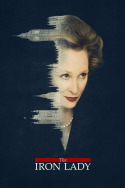
Review of The Iron Lady (2011) by Simon M — 04 Jun 2013
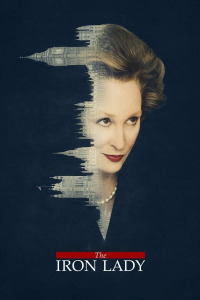
Following her death on April 8th, much has been said about Margaret Thatcher's legacy; certain conservatives praised her strong-willed nationalist diligence, while the majority of people remember her for her obliteration of unions, homophobic social proposals and possible vulgarity in quashing Argentinian aggressors in the Falklands. What better time to have a look at The Iron Lady, Phyllida Lloyd's dramatic retelling of a then-ageing baroness. Leaving my repulsively liberal political views at the door for a minute, I thought I'd take a look at the movie for its own sake, and not for any anti-conservative agenda... And what do you know! It's a little bit shit.
This is essentially two completely different films sewn together rather awkwardly: on the one hand, there's this cute little drama about a little old lady (Meryl Streep), whose combination of grief for her dead husband (Jim Broadbent) and early symptoms of dementia result in her seeing apparitions of the man who generously butters his toast. The semi-deformed conjoined twin to this Amour-ish tale is the biographical story which chronicles the rise of the young "Iron Lady", initially played by Alexandra Roach who eventually morphs into a less wrinkly Streep, as well as her eventual fall from Parliament.
The Iron Lady can't seem to decide if it wants to make a sentimental tale of fallen leader struggling with loss, or if it wants to glamorise the story of one of the West's most controversial leaders of all time. It wants to have both, but can't because the sweetness and dainty demeanour of the elderly lady is totally at odds with the unbending malice espoused by her younger self. Of course, softening with age isn't unheard of, but in the same film both versions of the former Prime Minister clash and ultimately undermine one another. The movie tries to paint a picture of both steely resolution and darling sentimentality, but together all that results is a grey blur of potential.
Meryl Streep, in typical Meryl Streep fashion, steals the show and makes the whole thing watchable. Who remembers any of the cast of Mamma Mia! aside from Streep and Pierce Brosnan's tone-deaf face? Certainly not I, and I'd wager not you either. Her bulldozing persona at Westminster shows how much of a commanding presence she can be; a true force of nature who consistently shuts up opponents with relative ease. Streep's method of dealing with the array of misogynists in the movie is to point out their ad hominums and swiftly floor them like a wrecking ball - an interesting feminist analysis could be made of this film.
Now of course, any film which documents a political figure's life is going to be biased, much like most historical films in general. But what separates this film from the likes of Lincoln, which also no doubt cast the man in question in as agreeable a light as possible, is how deftly they approach both the supporters and the detractors of the title star. Now it must be said that Abraham Lincoln has many more fans than Thatcher does (he did end slavery, after all), but unlike in Spielberg's masterpiece the criticisms levelled against her are ignored and seemingly brushed under the carpet in The Iron Lady. Sure they couldn't tackle every problem attributed to the woman, but the almost complete exclusion of the issues in Northern Ireland (aside from the assassination attempt at her life) seems more than a little convenient.
As the sort of lefty neo-Socialist liberal she probably would have hated, I was more than prepared to judge this movie on its own merits. While the 'dithering old lady' half of the film is decent if a little shallow in our post-Amour world, the remainder which depicts her fluctuating stranglehold on power is overly self-congratulatory, choosy with its history and, above all, not particularly entertaining. This would have been abysmal without Streep's godly presence, and remains a clumsy work of bias.
This review of The Iron Lady (2011) was written by Simon M on 04 Jun 2013.
The Iron Lady has generally received mixed reviews.
Was this review helpful?