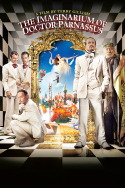
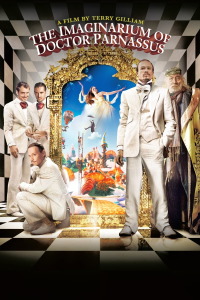
Review of The Imaginarium of Doctor Parnassus (2009) by Spangle — 10 Sep 2017
Calling a Terry Gilliam film weird and imaginative may be a bit obvious, but it is perhaps never been more true in recent years than in The Imaginarium of Doctor Parnassus. Hearkening back to his 1980s science fiction adventure fantasy work in Time Bandits, Brazil, or the Adventures of Baron Munchausen, The Imaginarium of Doctor Parnassus takes audiences on a magical adventure to a world never quite seen before. Guided by an old man, his daughter, little person assistant, and a young guy, this journey is one that has all the right moments of Gilliam's classics and touches on very similar themes to those films from his "Trilogy of Imagination", but never really comes together. The film lacks that "it" factor and a sense of cohesion to make it all come together as a strong work that brings Gilliam's career back to the quality of his peak and not just the same feeling of whimsy. In essence, The Imaginarium of Doctor Parnassus looks, sounds, and acts like a Terry Gilliam film directed by somebody inspired by Gilliam, not the director himself.
In a similar fashion to Time Bandits, The Imaginarium of Doctor Parnassus is consistently focused upon the concept of good and evil. Depicting Satan via the three-piece suit wearing Mr. Nick (Tom Waits) and positioning Doctor Parnassus as a monk committed to saving people, the film shows the two competing for souls throughout the film that has led to many bets. One such bet resulted in Parnassus' daughter Valentina (Lily Cole) being given to Mr. Nick when she turns 16 and with her birthday a few days away, Doctor Parnassus is in his final hours of trying to save her. When a mysterious stranger, Tony (Heath Ledger), is found hanging on a bridge that Parnassus and his gang were passing over, the opportunity to win back Valentina arises. Given a final bet - first to five souls gets Valentina - and having to rely on Tony to help win over the five he needs, Doctor Parnassus must change his show to win over the five souls and rely upon Tony far more than he should to be able to do so.
Inside the Imaginarium, visitors and possible souls are given a choice between good and evil, essentially. Operating with similar themes to Gilliam's Trilogy of Imagination, these choices can often be represented via materialism, promiscuity, or any other temptations. For example, a group of women enter the Imaginarium and to be able to receive self-fulfillment - which is the good path offered by Parnassus - they must shed their wealthy jewelry and accessories. Yet, the path to self-fulfillment is a challenging one. Visualized by having participants climb an incredibly tall set of stone stairs, the option is not one for the weak hearted. Given the challenge, the possibility of "easy ignorance" and fleeting fulfillment offered by Mr. Nick - in one trip, it is visualized as a motel run by Mr. Nick called the "One Nite Stand Motel" - can become impeccably appealing to those unwilling to make the arduous journey to fulfillment. The path chooses ultimately decides who gets their soul for the rest of eternity and, as a result, is a vital decision one must make when they enter the Imaginarium.
With this temptation taking center stage in this battle for souls, The Imaginarium of Doctor Parnassus shows the dangers of giving into temptation and earthly pleasures instead of seeking fulfillment through some benevolent being. Imaginative in this pursuit, Gilliam never really innovates on ideas he previously presented, but nonetheless, The Imaginarium of Doctor Parnassus is a film so outside of the box in conception that it is hard to find fault. The film's commitment to showing the perils of choosing riches and spoils on Earth is one that even impacts its protagonist and is a strong message, no matter how prevalent of an idea it is in Gilliam's work. The different approach offered in this film and the film's refusal to let anybody off the hook or to avoid their true nature is admirable, demonstrating Gilliam's dedication to show how to find some measure of morality in an inherently immoral - demonstrated via the bars and seedy clubs the troupe operates in - world.
However, where the film slips up is in the creation of its world and its themes. It has the beats, the feeling, and imagination, of all of Gilliam's films, but lacks the soul and the heart. It feels too haphazardly slapped together and clearly bore the brunt of its production problems regarding Ledger's death. It never feels like a cohesive work, instead operating as a film that has a set idea on what it wants to be and how it wants to look, but never really figured out how to make either work or how to make it all come together as an enjoyable film. Rather, it often feels incessantly frantic.
This review of The Imaginarium of Doctor Parnassus (2009) was written by Spangle on 10 Sep 2017.
The Imaginarium of Doctor Parnassus has generally received positive reviews.
Was this review helpful?