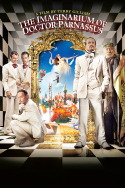
Review of The Imaginarium of Doctor Parnassus (2009) by Vianni S — 27 May 2011
Each Terry Gilliam film makes me feel just slightly more depressed. Sure, his films are often whimsical, enlightened triumphs of imagination over adversity, and beauty over monotony. But where there once was, in Time Bandits or Jabberwocky or Adventures of Baron Muchausen or Fischer King, joy ultimately conquering despair, no longer. Even the singularly unsettling Brazil could at least be said to represent a de Sade-ish besting of social dogma with the self-empowerment of the human mind. But from the aptly named Brothers Grimm to Tideland to ...Parnassus, whatever joy his films tread on the surface hides a new cynicism: an acknowledgment of inescapable failure and an inability to truly change the world with the limitless power of his images. I wish he continued to embrace Something Completely Different.
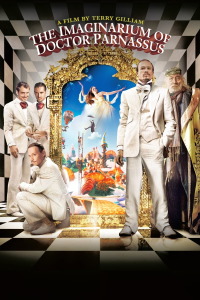
The opening scenes of Parnassus tell us as much. A medieval rickshaw pulls up besides a too-modern bar and out on the stage come our cast of characters: the young Anton, a silver, naive Mercury; the Good Doctor Parnassus, dressed like a second-hand Lama (who can't reincarnate!); Percy, a Mini Me with character depth; and Valentina, Parnassus' daughter and toddler-faced Aphrodite. Of course the bar patrons, stumbling in a drunken, ignorant haze, don't appreciate the old-school showmanship on display. One of them ruins the show and stumbles into Parnassus' sideshow mirror, but this is one that reveals Parnassus' vast inner mind. In this world, one has to choose to appreciate the joy of Parnassus' narrative and achieve a kind of emotional nirvana, or choose a damning ignorance to beauty, which leads straight to the Devil himself (a too-cool Tom Waits), and typically ends in an explosion. Guess what the drunk chooses.
You see, Parnassus has made a deal with the Devil: he has eternal life and has achieved the clairvoyance to materialize his whimsy, but when any of his children reach age 16, they become hell's property. Valentina remains ignorant, believing her father is a blowhard and his stories at most a pleasant diversion, at worst a product of his failed storytelling and boozing. It's a few days until Valentina turns 16: she hopes to run away, Parnassus hopes to tell her the truth and find a loophole in the bet, and Anton hopes to profess his love. Into this "calm" arrives Heath Ledger, who they find hanging by his neck - his name may be Tony, or it may not. He has amnesia, a penchant for theatrics, and (with Gilliam probably realizing this) like the Devil in Teorema, throws a wrench into it all.
It's well-known that Gilliam was almost lost in la Mancha all over again when Ledger died halfway through filming. Seeing the film, it's clear that far too much was filmed for them to start over, and footage of too much importance needed to be shot. Ledger is brilliant in what he is in. Having Johnny Depp, Jude Law and Colin Ferrell represent the many faces of the late Ledger simply works because being a Giliam film, it's not too much of a stretch to do it. And this time, it actually adds something to the narrative, saying something about the character's quadruple-faced nature. It helps that each actor has a blast channeling the great acting already done. The visual design is top notch, although the cinematography has lost some of that idiosyncratic Gilliam flair, like his manic reliance on wide angle lenses. Thankfully, and I would come to expect this from any Python, we do get plenty of drag.
But how can this possibly be so depressing? Sure, it ends happily, in a broad sense of the term. Everyone lives, and the Devil does not claim his prize. Although he does, in a way. Parnassus is still cursed with eternal life, and his brilliance and sense of story and beauty is lost in a homeless man's paper marionettes. The people he loves, don't. It is far too easy to see Gilliam in this depressed, cursed, lost blowhard, and therefore far too easy to take it all too seriously. It becomes too hard to let the darkness go, because that is where Gilliam seems to be wallowing. His themes are now in contradiction. It is too difficult to have the truly fun, lighthearted experience he wants me to have when it is so easy to sense his pain.
This review of The Imaginarium of Doctor Parnassus (2009) was written by Vianni S on 27 May 2011.
The Imaginarium of Doctor Parnassus has generally received positive reviews.
Was this review helpful?