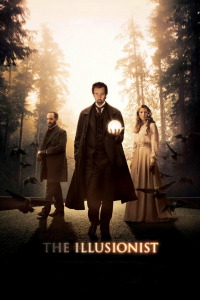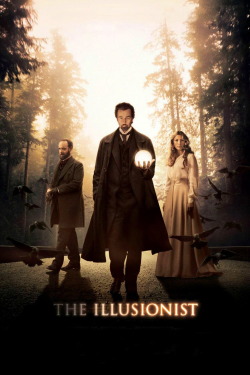
Review of The Illusionist (2006) by Tomas H — 14 Mar 2011
(SPOILERS).
I watched this movie by accident tonight.
But I'm glad I did. It's a gem I overlooked in 2006, much like the actual gems Paul Giamatti's character overlooks within the film itself. But I totally watched this by accident because I was looking for the other The Illusionist - more specifically, L'Illusioniste (2010) - from Sylvian Chomet, who is best known for his French animated film masterpiece, The Triplets of Belleville (2002). Beyond just wanting to see any new work by Chomet, my pursuit of L'Illusioniste was further driven by an unhealthy obsession with the late Jacques Tati, the man who co-wrote the script for L'Illusioniste back int he 60s - a script that went unmade until Chomet resurrected it in most recently and produced it as an animated feature. Too cool.
But I'll write more about Chomet's film after I actually watch it.
In the meantime, my serendipitous viewing of The Illusionist from 2006 was most fortunate, and it made my Sunday night. It focuses on a cinematic phenomenon that I've been obsessing over since experiencing watching a recent anime series out of Japan called "Eden of the East" by anime filmmaker, Kenji Kamiyama. Kenji does something that I've never quite experienced before in an animated film - he evoked a sense of anxiety in me because the reality-threshold of his show was threatening to be visually berayed.
That probably doesn't make a lot of sense - so let me explain - and I promise this ties back to The Illusionist as I am clearly drifting from talking about a French animated film onto a Japanese animated TV show - what the F does that have to do with Ed Norton and Jessica Biel???
Patience.
In Eden of the East, this animated series is produced in a very "realistic" fashion - meaning the scripts could have been shot with real people and camera at real locations - there is no obvious reason initially on why one would choose to even animate it. One of the cardinal rules that formally trained animators will tell you is, don't animate anything that can be done in live action. Many of the best animations of all time live and die by this rule, from Heavy Metal (1981), to Thundercats, to Pixar movies - animation lets us do and see things that we couldn't previously see and do in real life.
But suddenly the 90s changed the game and animation got REALLY realistic looking, and digital editing systems make it way easier to mix photo realistic 3D graphics with live action footage show with cameras. Now CGI animation is relatively seamless with live action filmmaking. I feel like stuntmen are out of the job post 2001, enough that Tarantino made a whole movie about it with his brilliant flick, Death Proof (2007). MoCap studios litter L.A. with actors running around little green stages speaking to cardboard stand-ins, and the words, "fix it in post" have never been uttered more in Hollywood.
So Hollywood has been breaking the reality barrier borrowing more and more reality-bending techniques from animation SEAMLESSLY for more than a decade now. Well, what about animation? Where's the correlative paradigm shift in their meduim? Kenji Kamiyama's Eden of the East does this, and he flips the rules (as does The Triplets of Belleville incidentally). Kenji makes an animation that keeps it real, mimicking live action techniques, locations, and themes like terrorism and unemployment. And then at unexpected moments he does something incredible and terrifying - he breaks the reality threshold he has worked so hard to ground. In an animated world that feels so real, he suddenly brings in ghosts, or allows a character to fly - and it's an absolutely awful feeling that makes the viewer say, "Really? Come on. Way to jump the shark, asshole." But thay're just momentary fake-outs. He brilliantly only spikes with brief moments like that to reveal a second or two later that it was just an illusion - don't worry, our precious reality threshold has not been broken - it was just a dream, or a hallucination or ... an illusion.
They do it all the time in live action movies. Neo's has a robot inserted into his belly button and his mouth is removed by Agent Smith in The Matrix. But just a moment ago he was at this cubicle at work and life was pretty ordinary. The rules of The Matrix are revealed over the rest of the film and all that odd reality stretching is explained and justified. And that's necessary. We need the justification in order to comprehend a thorough fictional world. When storytellers don't justify, they lose their audiences and it's ... well ... just bad writing.
And so in Kamiyama's Eden of the East, those sporadic reality-breaking moments have to be quickly justified as acceptable within the physics of the animated world he has created - and I stress quickly. This is amazing because we're too used to animation's ability to break the rules. And I have no doubt after watching The Illusionist that Kamiyama may have been influenced by this film. The very nature of illusion as a genre is given a character and a motivation in Ed Norton's Eisenheim. This film plays with the audience's grasp of what is supernatural and what is real, and an almost perverted and voyeuristic need to know and see the source of the illusion. The mystery of the trick trigger's our own anxieties at moments in frustration on what is the truth, much like Crown Prince Leopold in the film. Leopold is truly the best representative of us as the audience to magical things. Conscious illusion is entertainment - but elusive illusion renders the audience powerless. The idea of an illusionist turning an audience and public against a governing official is remarkable and familiar - I mean, what else is propaganda? This is a film that equates illusion with power - and rightly so.
That leads me to my only big problem with The Illusionist. The reveal at the end is a classic montage style twist of "There is no Tyler Durden" - which is fine - but I have moral beef with it. Beyond the Crown Prince being a bad guy, the techniques of Eisenheim and Sophie on him are psychologically akin to a clinical narcissism trait called "crazy making" - a borderline psychotic method of secretly baiting a victim over time to believe they are insane. It was hilarious in Ski Patrol (1990) when the pranked that short guy by giving him fake growth pills and slowly shrinking his clothes and furniture. But it's tough to root for this behavior when the Crown Prince's reactions to illusion is relatively natural. His ego and aggressive macho instinct to bully Eisenheim are obnoxious and bratty, and evidence and witness to his abusive, and oedipal anger are prevalent - but from a moral standpoint, Eisenheim gets away with murder and I simply want to point out that this could be argued that it makes him no better than his "deserving" victim. I mean, for what...to get his childhood crush and get revenge on the schoolyard bully? Is it justified from a class revolution standpoint? Any way you look at it, it's revenge - and as revenge films go, we can take a lesson from the works of Korean filmmaker, Park Chan-wook with Oldboy (2003) or Lady Vengeance (2005) - if you wanna do it right, it's not a black and white issue anymore in the cinema. This isn't the good old days of kung fu movies where you simply avenge the murder of your father by killing the mob boss and his toughest guards who have the blood of many innocents on their swords. In order to really justify itself morally, even a simple and straightforward revenge film needs to be stylized and self-conscious like Robert Rodriguez's Machete (2010).
But then again, that's the fun of The Illusionist. Even moral justification for revenge is riddled with, "How'd he do that?" And as a final point to all my animation yammering above - this film does a wonderful job with special effects and CGI to Eisenheim's performances. The recreation of a film camera projecting onto smoke is a brilliant scene to show us the technological limitations of the period, and thus thrust all of us into a deeper mystery. I mean as the audience with such good CGI effects, we could have walked away and said to ourselves, I'm sure he just developed his own film camera and projected it on smoke - but that demonstration throws us into deeper confusion.
The early sequence where Giamatti's character recaps Eisenheim's childhood is a wonderful narrated sequence exemplifying perception - that is, it is clear here that this recap of Eisenheim's life is from Giamatti's own "perception" - something critical to all illusion. The magic tricks are barely explained to US the film audience, nevertheless the audiences within. A cool choice on the part of the filmmakers.
Last thing to note is that the Philip Glass score hits us with that intense cello style that I love so much from his collaboration with Yo Yo Ma in his violently emotional Naqoyqatsi score from 2002. It's quite good. Good flick.
This review of The Illusionist (2006) was written by Tomas H on 14 Mar 2011.
The Illusionist has generally received very positive reviews.
Was this review helpful?