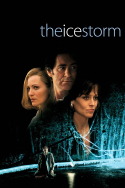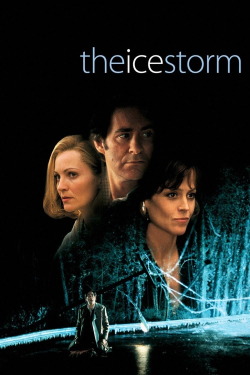
Review of The Ice Storm (1997) by Paul Z — 02 Mar 2009
The Ice Storm is framed by an early winter storm approaching Connecticut, accumulating a reflecting visage, like glass, in which the world rematerializes, and freezes so it can take a look at itself. Upscale suburban adults whisk tensely in their homes with the floor levels usually differing by approximately half a story, despondent not only with their lives but by their amusements, and even by their guilt. Their adolescent children are trying on the same evasions: booze, pot and sex.
Kevin Kline, unhappy with his marriage and with the meaninglessness of his job, is having an affair with his neighbor, Sigourney Weaver. His wife, Joan Allen, is dissatisfied with her life, looking to amplify her thinking, but is uncertain of how to do so. The children sip wine in the kitchen. When Kline sees Weaver for an adulterous frolic, he rambles into her rec room to find his own daughter, Christina Ricci, in flagrante delecto with Weaver's son Elijah Wood. Ricci, who is 14, has also played a curious game with Wood's kid brother. The father asks his daughter what she's doing there. The reason she doesn't ask him the same question is to make us conscious at the time of the irony, that she could as easily have asked him. But it's already come out in an interesting way when she says grace at Thanksgiving: "Dear Lord, thank you for this Thanksgiving holiday. And for all the material possessions we have and enjoy. And for letting us white people kill all the Indians and steal their tribal lands. And stuff ourselves like pigs, even though children in Asia are being napalmed." The early 1970s were a time when the social revolution of the 1960s had bled into the yuppie classes, who wanted to be hip and jazzed up their martinis with reefer.
Rick Moody, the writer of the original novel, from my experience reading his work, loves interconnectedness. I can see his underlying language in this successfully cinematic film adaptation, closely interweaving his narrative with the inflective inner monologues of all the key characters. The cultured, refined screenplay by James Schamus intercuts the children and their parents, inferring equivalent details. Most of the dialogue consists of characters talking about the same thing without saying it out loud. The pathetic scenario of parents following the trends of a generation closer to their children than them is reflected by the film's several intramural parallels. Kline and his son Tobey Maguire both hunt through other people's medicine cabinets, and neither of them have very fortunate sex lives. Yet father tries to explain the facts of life to son: "If you're worried about anything at all, just feel free to ask and we'll look it up." Joan Allen imitates her daughter Ricci's bike riding and shoplifting.
Paul takes the train into the city to visit the apartment of the girl he likes, played by a hot young Katie Holmes in her movie debut, only to realize his swinging friend is once again trying to steal his chance at losing his virginity. Sleeping pills seem a sort of quietly vindictive solution, though it doesn't work as intended. Meanwhile in New Canaan, the adults are having a key party. There is a feeling of congregating misfortune, epitomized in one scene where one of the kids balances on an icy diving board. By the end, an event releases destitute tears for one of the characters, and we think about how very many things about which he has to cry. Undeterred by its mordant undertones, this atmospheric social commentary finds heritage in caustic satire, and is often funny, and subtly clear-sighted in its performances. The whole cast pungently exudes the need for something.
What we realize as a result of the film is that natural, unfeigned comforts have been usurped by more fast-paced alternatives, which have exhausted the capacity to be happy. Going by the numbers of what once gave them joy, they feel oddly boxed in. I like the seeming contrariness of a music score evocative of Native Americans to call to consciousness that as the characters stroll through the woods to their swanky houses, the ground on which they walk once belonged to civilizations that are long disappeared. The film calls to mind the supremacy of nature, that it is so much bigger than us, one endless organism which was here before any one of us, and will be here when we're all gone. Humans have a weakness for insulating themselves as the center of nature, the world, the universe, but no matter with what we find ourselves consumed, something like this ice storm can come blanketing our illusory little world and cutting our electricity for up to a week.
It's not a memory lane film scored by radio music of the era it depicts. It has a cold detachment from itself. The sexual, social, and political revolutions had already erupted in the late 1960s. The characters are trying to hang on to it despite their rising doubts about it, while the country is already coasting the incline that would end that intense time. And its detachedness therein is augmented by Ang Lee, its Taiwanese director, an stranger imagining a period in American history with poetic realism and the ethereal quality of mood.
This review of The Ice Storm (1997) was written by Paul Z on 02 Mar 2009.
The Ice Storm has generally received very positive reviews.
Was this review helpful?