Review of The Holy Mountain (1973) by Paul Z — 02 Mar 2009
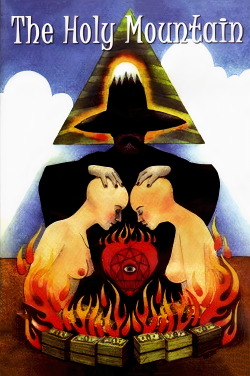
The Holy Mountain, from beginning to end, is unprecedented visual stream of consciousness. How to gather all the pieces of it together in order to describe it cohesively, I don't know, but that is not to say that it leads to nowhere. Though, that's not to say it doesn't either. There is a painting in the Cincinnati Art Museum that reminds me of its structure. It is apparently a portrait of the subconscious, colors, shapes and vectors seemingly exploding from an unassuming black dot in the middle. But what makes the film so astonishing is not simply its explosive, hyper-colorful, surprising, non-sequitary, often joyously sacrilegious juxtapositions, for it could hardly hold one's provocation throughout its entirety. The subject matter of which it's wildly composed is what ignites the spark.
The tarot card The Fool tends to depict a man stepping off a cliff. This movie is The Fool's continuing adventures in the world of the occult and metaphysical. He lies face down on the ground, and is soon befriended by a basket case dwarf. He goes into a city where his resemblance to Christ inspires some to use his likeness for the crucifixes which they sell. Sooner or later, after a psychedelic carnival of non-sequitary fellowships between time periods and other spatially incompatible creatures, objects and ideas, he notices a crowd gathered around a large tower, where a large hook with a bag of gold has been sent down in exchange for food. Wishing to find the source of the gold, he ascends the tower, finding an alchemist, played by director Jodorowsky himself.
The fool is introduced to seven people who are said to be the most powerful mortals in the solar system. They are related to the planets in astrological terms, each embodying the worst aspects of his or her planet's characteristics. The seven consist of: a Venusian cosmetics manufacturer, a Martian weapons manufacturer, a Jupiterian millionaire art dealer, a Saturnine war toy maker, a Uranian political financial adviser, a Neptunian police chief and a Plutonian architect. These segments are explosively hilarious depending on how acquainted one is with astrology; I happen to know quite a lot about it, and so these introductions are most of what make the movie for me. They are gathered together by the alchemist who instructs them to burn their money and wax images of themselves. Being a follower of astrology, this completely absorbed me. Never has there ever been a film that portrays the Zodiacal planetary alignments and influences, nor embellishing each configuration with such broad-brush satire.
After several scenes wherein the characters are led through several rituals, they all journey to gain the secret of immortality from nine immortal gurus who live on a holy mountain. What the film seems to ultimately be about is how we are mobilized by how fascinated we are with spectacle, with which the movie is overflowing. Early on, I was beginning to feel that I was going to have no way of connecting to the imagery I was seeing, how it was going to tell a story, or be cohesive at all, except that I admired its richness and vivid imagination, and huge involvement of all kinds of animals. But I was soon enraptured by the mystical subjects the film uniquely tackles, and Jodorowsky soon has me going on this curious journey with his abstract representational characters and being surprised and provoked till the very stunningly self-reflexive end.
This review of The Holy Mountain (1973) was written by Paul Z on 02 Mar 2009.
The Holy Mountain has generally received very positive reviews.
Was this review helpful?