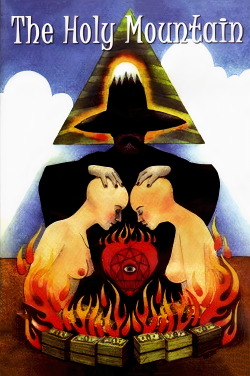
Review of The Holy Mountain (1973) by Harry W — 10 Nov 2014
After seeing Jodorowsky's Dune, I had to get a look into Alejandro Jodorowsky's film style. And with glowing recommendations from a friend to see The Holy Mountain, I figured it would be the right place to start it all.
I can honestly say that while I really did not know what to expect from The Holy Mountain, my highest hopes were that it would be some strange and artistic surrealist film full of unforgettable imagery.
For the first look I got into Alejandro Jodorowsky's style of filmmaking, I must say that I was quite an interesting experience. The narrative in the film is very ambiguous if there even is one at all, but the value of the film is hardly predicated on that and I was well aware of that before going in to the film. It is structured like a strange series of vignettes in the manner of a William S. Burroughs novel. It actually feels a lot like something he would have made if he was a film director for Mexican cinema. I once said that I didn't think a film could be built on pure surrealism as a reaction to David Lynch's Eraserhead, but Alejandro Jodorowsky made me change my mind on that. His surrealistic vision for the film is poetic, and even though its attempts at narrative are very convoluted, the versatile and colourful nature of the imagery in the film manage to craft an implied story out of the mysterious titular The Holy Mountain. It is particularly peculiar in the amount of psychosexual imagery that is present in the film. Ranging from sexually active cross-dressers to children with green penises, The Holy Mountain is mercilessly strange in a surreal and sexual manner. It is certainly an experience that is not meant for everybody because it is one of those films which has never heard of the word subtlety. And yet, it is far from exploitive.
Alejandro Jodorowsky didn't so much craft a film out of Holy Mountain, but rather a nonconventional collage of surreal imagery. His work is clearly artistic because it is a complex expression of the human body and the mysterious world we live in out on a strange religious location tentatively titled The Holy Mountain. I'll admit that there could have been more focus on the narrative though. While there is a promising beginning, the structure of the film begins to cut a bit loose when the main character is introduced to even people who will accompany him on his journey. The film loses sight of its story progression at this point in the film because it breaks away to focus on all of them as individuals. This becomes too much because while the film is full of surreal imagery, there is at least a main character for it to chronicle. When it loses sight of this and increases the amount of characters it tries to put emphatic focus on, it detracts from the loose narrative and essentially becomes a bit much to keep following on with. The film remains good because its magical surrealism is all there, and although the toll of the loosely structured narrative is taken, the general style and passion in the film still manages to transcend it all. As a piece of art, The Holy Mountain works as a strong collection of complex imagery and characters, an amalgamation of both the beauty and the insanity of Alejandro Jodorowsky's mind. The Holy Mountain is a film which is a lot of things. It is slow, yet beautiful. Scary, yet poetic. Confusing, and yet understanding. It is simultaneously a great film and a senseless one, but to put it in the context of being a Alejandro Jodorowsky film, it is a very defining film.
Alejandro Jodorowsky certainly gets his intended vision for the film perfect, for better and for worse. With a larger budget than his prior production El Topo, Holy Mountain has a lot more potential. And in his own way, Alejandra Jodorowsky is able to capitalise on that. It is such an interesting change from the more conventional films of the time because it comes from around the era that the counterculture movement was in its heyday. He tackles material reserved usually for the sick and twisted and manages to almost make it poetic. To add to this sense, the film is strong from an auditory perspective. As well as having well-edited sound effects, there is the subtle touch of a gentle and yet atmospheric musical score in the film. As the title suggests, there are religious elements in The Holy Mountain, and Alejandro Jodorowsky manages to ensure that the atmosphere is rich with religious spirit and an examination of the uplifting mystery of life. The Holy Mountain begs its viewers to ask a lot of questions about life by filling them with a sense of lively mystery, and even though the rate of it is inconsistent, it is all there. The film is a mystical and puzzling experience, but all in all it is just beautiful. The amount of scenery and production design put into the film is wonderful, and it is all captured with dead on cinematography which gives the film a large and surreal scale. There is so much visual passion put into the film without stepping out of his own mind for a second, and so it is an excellent glimpse into it. There is no way to ever fully understand what level of artistic mystery is in the mind of Alejandro Jodorowsky, but The Holy Mountain shows that he has the passion of a contemporary artist and the twisted pattern of thought only found in people like David Lynch.
So The Holy Mountain is an indulgent piece by director Alejandro Jodorowsky and is proud of it. It is packed with a lot of complex surrealism and beautiful imagery which largely helps to transcend the loosely structured story, although many may find that and the abundance of psychosexuality and such to be overwhelming.
This review of The Holy Mountain (1973) was written by Harry W on 10 Nov 2014.
The Holy Mountain has generally received very positive reviews.
Was this review helpful?