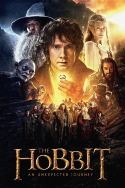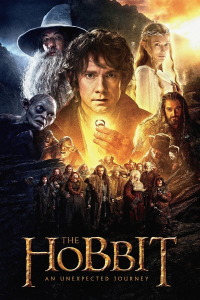
Review of The Hobbit: An Unexpected Journey (2012) by Henry P — 16 Feb 2017
It began in a train on the ground, in an extensive train ride, in the future Middle-Earth-on-our-Earth nation of New Zealand. On that train, during that ride, future director Peter Jackson read the entire Lord of the Rings trilogy.
Later in his life (1999-2003), he would direct a trilogy of movies based on that trilogy of books, earning near-universal appraisal for his efforts. Eight or so years after finishing that, he would start directing a trilogy of movies based on one book.
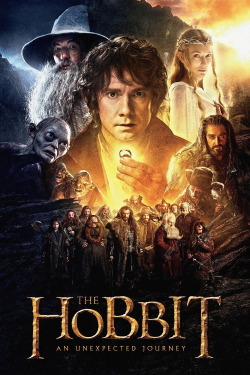
The results: different from, and inferior to, the Lord of the Rings. The plot is simpler than that, and simple enough to follow. Bilbo Baggins (Ian Holme as the elderly Bilbo at the start, Martin Freeman for the actual story sixty years before Lord of the Rings starts) is an ordinary hobbit, chosen by the wizard Gandalf the Grey (Ian McKellon) to be the burglar for a group of thirteen dwarves: Fili, Kili, Oin, Gloin, Dwalin, Balin, Bifur, Bofur, Bombur, Ori, Nori, Dori, and the king under the mountain, Thorin Oakenshield (Richard Armitage).
You'll notice I didn't specify the other actors, because the cast is simply too big. After a gathering in Bilbo's home, they set out on the adventure a solid 40+ minutes after the Warner Bros.
and New Line logos, slow even to the most patient. Bilbo is our main character: he is the eyes of the viewer in this case, and his homesickness is relatable to those of us who value a home. While the cast is vast, the only characters we need development of are Bilbo, Thorin, and Gandalf.
Fili (Dean Gormon), Kili (Aidan Turner), Dwalin (Graham McTaversh) and Balin (Ken Stott) provide the most support from the other twelve dwarves, the rest of whom are merely in the background most of the time, except for at least one stand-out moment each.
The Lord of the Rings broke ground in terms of visual effects: Massive CGI battles, but up close, practical effects were king, but CGI only returned to up-close with Andy Serkis' motion capture performance as Gollum.
You could see everything, but most of the up-closes on the villains were excessively CGI, some just straight-up repulsive: Trolls and goblins look like they walked right out of Narnia and into Middle-Earth, though Azog's CGI did not detract too much.
It was just more synthetic than Lord of the Rings. However, something that returns from the Lord of the Rings that we all can enjoy is Howard Shore's soundtrack, which provides new and hummable tunes along with old familiar Lord of the Rings music.
They're used long enough to evoke nostalgia, but not so long as to be an excessive call back. All in all, An Unexpected Journey is an expectedly good start to the first part of one story from one book: one book to take place before them all.
One book to bring this and the other two together, and in continuity, bind them.
This review of The Hobbit: An Unexpected Journey (2012) was written by Henry P on 16 Feb 2017.
The Hobbit: An Unexpected Journey has generally received positive reviews.
Was this review helpful?