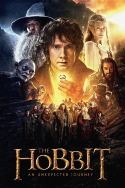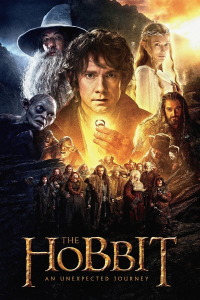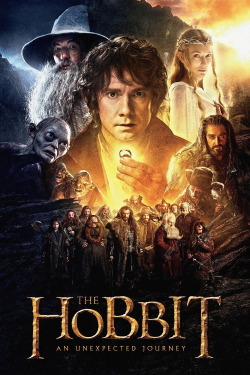
Review of The Hobbit: An Unexpected Journey (2012) by Total H — 10 Aug 2017
The Hobbit, An Unexpected Journey Is Unexpectedly Bad.
For those who loved the acclaimed The Lord of the Rings film trilogy directed by Peter Jackson, we are surprised at Jackson's disappointing production of The Hobbit: An Unexpected Journey (a prequel to LotR). This first installment is repetitive, unrealistic, and difficult to connect with.
A huge problem concerning The Hobbit trilogy is Jackson's decision to extend the short book into 3 long films, the first being 169 minutes. As a result, we have scenes that go on far too long. For example, Bilbo's (Martin Freeman) call to action takes 40 minutes, including a ridiculous, but unfunny, dinner scene with the dwarves. Afterwards, Bilbo rejects the dwarves' job offer of burglar, and it is truly unexpected when he wakes up the following morning and runs after them.
The rest of the movie follows Gandalf (Ian McKellen), Bilbo, and the dwarves as they travel partway to The Lonely Mountain, the dwarven home. There, the dwarves hope to slay the dragon Smaug and reclaim a large hoard of treasure. On their journey they encounter trolls, goblins, orcs, and the peculiar wizard Radagast who drives a sleigh pulled by bunnies. Yes, I said he drives a sleigh pulled by bunnies.
In LotR, there was a feeling of danger and suspense when unskilled hobbits encounter a single orc or evade galloping horses that could trample them in an instant. In The Hobbit, the adventurers fight hundreds of goblins, go careening down a deep cavern on a rickety, wooden bridge (without receiving any wounds), and the old wizard Gandalf hangs, with a single hand, from a tree branch above a fatal plummet, holding two dwarves, for two long minutes. Was this supposed to be dramatic? The music may indicate so, but these scenes, among others, were only silly.
The Hobbit's appearances are sometimes as unrealistic as its story. Although The Hobbit has high quality Computer Generated Imagery, the quantity of CGI makes the movie look unrealistic. In LotR, orcs look like an actual living species, whereas in The Hobbit they look like animation.
Additionally, in LotR, there was intra-party drama: Legolas and Gimli's progression from a hatred between elves and dwarves to competitive friendship, Boromir's duty to the fellowship versus his lust for the ring, and the ring's slow corruption of Frodo against his loyal friend Sam. Out of the 14 party members in The Hobbit, only Bilbo, Thorin (Richard Armitage), and Gandalf show depth of character, and their entire intra-party drama could be summarized as such:
Thorin: "You don't belong here, Bilbo. You are nothing but a burden.".
Bilbo: "You are right; I never should have come, but for some reason I did.".
Thorin: "I was wrong, Bilbo. After you saved my life, I realized that you are useful to the company.".
Bilbo: "Thanks, Thorin. I miss my home, but I realize that you don't have a home, and I want you to have a home, so I'll stay and help you fight a dragon.".
Now, there were a few good parts in The Hobbit. The visual scenery was incredible. Martin Freeman's portrayal of the reluctant yet courageous Bilbo was excellent. I loved the scene where Bilbo obtains the one ring and has a riddle match with Gollum (Andy Serkes). There I could focus on two fantastic characters without being distracted by the violent, noisy dwarves.
The Hobbit was far too extreme in graphics and in length, which did not make the film epic, but long winded. If you like ridiculous, pointless, and far fetched fight sequences, go ahead and watch The Hobbit; otherwise, stick to the book.
This review of The Hobbit: An Unexpected Journey (2012) was written by Total H on 10 Aug 2017.
The Hobbit: An Unexpected Journey has generally received positive reviews.
Was this review helpful?