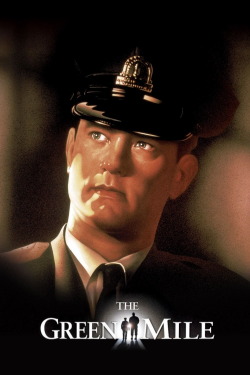
Review of The Green Mile (1999) by Moviemaniac83 — 22 Apr 2015
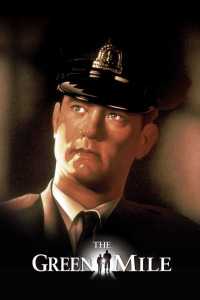
"We think of this place like an intensive care ward of a hospital." So says Paul Edgecomb, who is in charge of Death Row in a Louisiana penitentiary during the Depression. Paul (Tom Hanks) is a nice man, probably nicer than your average Louisiana Death Row guard, and his staff is competent and humane--all except for the loathsome Percy, whose aunt is married to the governor, and who could have any state job he wants, but likes it here because "he wants to see one cook up close." One day a new prisoner arrives. He is a gigantic black man, framed by the low-angle camera to loom over the guards and duck under doorways. This is John Coffey ("like the drink, only not spelled the same"), and he has been convicted of molesting and killing two little white girls. From the start it is clear he is not what he seems. He is afraid of the dark, for one thing. He is straightforward in shaking Paul's hand--not like a man with anything to be ashamed of.
"The Green Mile" (so-called because this Death Row has a green floor) is based on a novel by Stephen King, and has been written and directed by Frank Darabont. It is Darabont's first film since the great "The Shawshank Redemption" in 1994. That, too, was based on a King prison story, but this one is very different. It involves the supernatural, for one thing--in a spiritual, not creepy, way.
Both movies center on relationships between a white man and a black man. In "Shawshank" the black man was the witness to a white man's dogged determination, and here the black man's function is to absorb the pain of whites--to redeem and forgive them. By the end, when he is asked to forgive them for sending him to the electric chair, the story has so well prepared us that the key scenes play like drama, not metaphor, and that is not an easy thing to achieve.
I have started to suspect that when we talk about "good acting" in the movies, we are really discussing two other things: good casting and the creation of characters we react to strongly. Much of a performance is created in the filmmaking itself, in photography and editing and the emotional cues of music. But an actor must have the technical and emotional mastery to embody a character and evoke him persuasively, and the film must give him a character worth portraying. Tom Hanks is our movie Everyman, and his Paul is able to win our sympathy with his level eyes and calm, decent voice. We get a real sense of his efficient staff, of the vile natures of Percy and Wharton, and of the goodness of Coffey--who is embodied by Duncan in a performance that is both acting and being.
The movie is a shade over three hours long. I appreciated the extra time, which allows us to feel the passage of prison months and years. Stephen King, sometimes dismissed as merely a best-seller, has in his best novels some of the power of Dickens, who created worlds that enveloped us and populated them with colorful, peculiar, sharply seen characters. King in his strongest work is a storyteller likely to survive as Dickens has, despite the sniffs of the litcrit establishment.
By taking the extra time, Darabont has made King's "The Green Mile" into a story which develops and unfolds, which has detail and space. The movie would have been much diminished at two hours--it would have been a series of episodes without context. As Darabont directs it, it tells a story with beginning, middle, end, vivid characters, humor, outrage and emotional release. Dickensian.
This review of The Green Mile (1999) was written by Moviemaniac83 on 22 Apr 2015.
The Green Mile has generally received very positive reviews.
Was this review helpful?