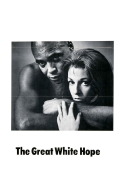
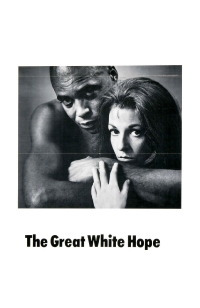
Review of The Great White Hope (1970) by Dominique A — 08 Aug 2007
For some reason, I got the impression that this movie was famous when I found it on my OnDemand menu. After checking on RT, I discovered that it wasn't. But I checked back anyhow to see what it was about, since its kill-by date was approaching and I like to see if I should catch any movies that are about to be erased. I decided this one sounded interesting enough, so I thought I may as well watch it. I always sort of did like movies about important people, because I get to learn about well-known people while still be entertained by a movie.
Right away I had doubts, though. I learned from the brief synopsis that this movie was about the attempts to separate Jefferson and his white mistress, since this movie took place in a time where racism was abundant. Obviously the movie's biggest endeavor should be to make the audience care about this problem, hope that Jefferson and his mistress aren't separated. But as I said, I was dubious at first. The two of them seemed kind of distant. They were nice enough to each other, but if it weren't for the occasional kiss here and there, you might not even know that Eleanor Bachman was his mistress. That's no way to establish a romance, and I figured this movie for a dud early on.
But in my opinion, I think it's foolish to dismiss a movie just because of certain misgivings. Or, at least, to stop watching it. I didn't let go of my doubts, I just buried them and continued watching the movie in hopes that it would prove me down. Closing one's mind to a movie straight away is usually an unwise thing to do. Unless you're watching Epic Movie or I Now Pronounce You Chuck and Larry, the movie at least deserves an unbiased viewing. That's my philosophy, anyhow.
And the movie did improve as it progressed. The boxing scenes were fluent and realistic. The romance was actually furthered, much to my surprise. Jack and Eleanor spent time bonding on their own, despite the public disapproval. The dialogue was, for the most part, well done. Jack's one-liners and witty remarks seemed a little too ubiquitous to be believable; hardly anyone is that clever all the time. But the movie was flowing nicely after a somewhat rocky start, and I didn't regret my decision to continue watching.
Of course, it wasn't a masterpiece. If it were, it would be as famous as I had somehow been led to believe. But it had a surprising amount of standout moments.
The opening shot was kind of subtlely clever. All you saw was a fixed-camera view of two men fighting. The camera was placed low, which meant all you could see was their legs, the arena, and the crowd behind them. This shot was pulled off excellently; the crowd was booing angrily as the pair of black legs advanced and the white legs faltered. Eventually the white legs buckled to show the white participant, and the black legs remain standing to a hail of boo's. There's not a lot to the scene, but it's a nice surprise and it was executed well.
The development in character was well done. At first, Jack is barely bothered at all by the opposition from his white audience. He just smiles and lets it bounce off him, even daring to toy with the hateful spectators. It starts to get to him, eventually, though. His confidence begins draining, and he no longer feels so safe goading the white folk. They're really out to get him and his mistress any way they can, and it begins to unnerve him.
Racism can be such a convenient veil to hide behind. It's so easy to evoke sympathy toward a black character, because all it takes is some hateful catcalls and violence to show racism. That sort of thing actually happened, and then it becomes an issue of humanity. The sympathy is sort of forced out of you. Here, though, it's in solitude, away from all the racism, where Jack starts to break down. It's his character that's crumbling here, not his pride in being black or whatever. It's him as an individual person who is despairing in the midst of it all. Now don't get me wrong; I hate racism as much as the next guy. But it's just such an easy card to play in movies, and I was glad to see that they didn't just toss a bunch of offensive words at him and attribute that to his misery.
The fight between Eleanor and Jack was half-and-half. I think the idea behind it was a lot better portrayed than the fight itself. Jane Alexander herself wasn't that good of an actress, and it showed a bit during their last fight. But you could feel their rage and frustration, at the world and at each other, hit its breaking point. They were both spiraling out of control, yelling at each other as both a means of breaking the other down and building themselves up. This isn't a revolutionary way of fighting or anything, mind you. That's how it happens a lot in real life, after all. But that's exactly the point. That battle of wills was pretty realistic.
The climax of the movie was pretty cool as well. Jack is about to accept defeat, bow down before his enemy, when he looks around and sees everyone sneering and chuckling as he lies on the ground at the feet of this giant white man. And he gets up and completely pummels him. His opponent suddenly became an outlet for all of his bitter and resentful emotions. He was like a manifestation of all the hopes of his audiences. He was this thing that they sent into the ring to knock him down once and for all, and I don't think Jack's pride, as a black man and as a human being, would let him accept that. There's no dialogue that expresses this, but you can see it in James Earl Jones's face as surveys the crowd. Great scene.
And then there's the very end. Injured and bleeding, Goldie and Tick support him as he leaves the ring. He talks with a reporter for a little, and then hears the crowd supporting his foe and tells his friends to keep going. The crowd swarms past, holding their champion on their shoulders, yelling and cheering. And as they clamor past, the camera focuses down a hall where Goldie, Tick, and Jack Jefferson are quietly walking away, supported by no one. No dialogue here either, and there was no need for it. The imagery alone sums up everything the movie tried to convey and it ties it up perfectly.
So overall, this is a pretty good movie. Most of the characters you're supposed to like are likeable, and the reverse is true for the antagonists. The reason I'm not rating this higher is the character [I]development[/I]. Jack Jefferson was done masterfully here. James Earl Jones was a great actor, and he was a good choice for the most dynamic character in the movie. But the rest of the characters were rather forgettable by the end of the movie. For all the drama in Eleanor Bachman's tale, her story ends rather hollowly. The other characters are all but inconsequential, even Jack's own mother. This story is about Jack, as well it should be, but all of the other characters were ignored to a degree. What you're given right away is what you get for the rest of the movie, and nothing more. The good thing is that all of the characters make a good impression on you right away, but still, that is a pretty glaring flaw, and that's why I can only give this movie a 6.
This review of The Great White Hope (1970) was written by Dominique A on 08 Aug 2007.
The Great White Hope has generally received positive reviews.
Was this review helpful?