Review of The Great Escape (1963) by Harry W — 28 Jan 2016
With a massive ensemble cast and a notorious legacy of references in popular culture, The Great Escape sounded like an utter war classic.
The Great Escape is a brilliant story. Based on the account of writer Paul Brickhill, it is a historical moment war history where prisoners took a notorious stand against German oppressors. The titular escape is one which required very extensive planning with intricate dedication to achieve, and John Sturges makes an effort to cover this in every detail. Of course there is no way to capture every last detail within a mere 165 minutes, but John Sturges uses the same dedication to detail that his characters do and ensures that his film is written with precision. The story makes a strong effort to capture every little contribution put towards structuring the escape without dragging itself on in the process. The pace is sensible enough to not rush itself, but it doesn't succumb to boredom either because there is always something happening.
Running at nearly three hours, it would be very easy for The Great Escape to end up dragging on. Structured in a similar manner as The Dirty Dozen (1967), The Great Escape spends its first two hours building up to its titular climax and the remaining 45 minutes unleashing it. There are surely times when things take a significant drop in pace, but the film is kept alive by the fact that the atmosphere is rich and the characters are entertaining.
The focus of The Great Escape is very much on the larger scale of events, and since there are so many characters and important stars to the film, it is a challenge to evenly focus on everyone. Most of the film is focused on escape itself, reducing the majority of the characters to a collection of different soldiers whose individuality largely comes from the star power of the actors portraying them. However, this does not neglect the human tragedy of the story. Although it is rather sporadic amid the spectacle, there are some powerful moments that remind us of the individuals who put together the escape and the challenges they faced. Even though The Great Escape has to take certain liberties with facts and characters so that the film can offer more drama and star power, there is no denying that what The Great Escape captures is nothing short of brilliant. It is a powerful tale of men working as a team for each other, for themselves and for country which reminds us of the extensive challenges faced in the war outside of combat. The Great Escape is very well scripted and directed with tenacity, leaving it rich in atmosphere as well as style.
Thanks to the work of Elmer Bernstein's musical score, the mood is always reinforced. His work is a masterpiece with a true classical feeling to it. Elmer Bernstein opens the film with the rather lighthearted theme song to the film, an iconic piece of music which has a mix between gleeful energy and a military march. This is immediately followed by a more dark and intense theme intended to capture the feeling of prison confinement. From there, the music manages to always assists the mood of the story in developing along with its plot dynamics. Since the music establishes the mood of the film, there is always an eerie feeling when things are silent. During these moments, the sound effects are left to supplement the music and do an effective job of keeping things intense.
The visual experience of The Great Escape is absolutely brilliant. Cleverly making use of its relatively small budget, John Sturges proves once again that he has a keen eye for spectacle imagery. The Great Escape spends the majority of its film in a singular location with a strong reconstruction of the Stalag Luft III, capturing a confined feeling by shooting mostly inside the compound. It gets particularly notable during the scenes depicting the tunnel digging as there are intricate angles used to capture a sense of claustrophobia. When the film reaches its escape, the scale becomes much larger and the cinematography captures some brilliant backdrops. The on-location scenery is remarkable and rich with colour, decorated with production designs and costumes which easily capture the timeframe of WWII. And since the film covers a lot of ground, there is a large scope of versatile scenery to enjoy.
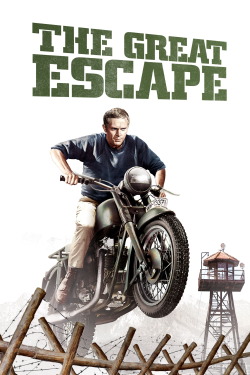
The action is also impressive. Since The Great Escape is not a war film about the battle, it does not offer a conventional style of action. There are some action moments in the climax, but they are not shootouts and explosions. They are depictions of the characters attempting to successfully make an escape, and the more exhilarating examples of this include James Garner and Donald Pleasence on an aviation journey and Steve McQueen's iconic motorcycle chase sequence. The select amount of action in The Great Escape is reserved for the climax and proves a satisfactory conclusion for the feature even though it is not on the scale of a typical war film.
And since the many characters in The Great Escape are portrayed by a large number of stars, the limitations on character exploration are elevated by the status of the actors.
Steve McQueen is a perfectly solid lead. With proud masculine charisma, Steve McQueen actively has fun in the role while taking it very seriously. Playing at Virgil Hilts' desire to taunt the enemy with his escape talents, Steve McQueen uses a lighthearted and likable spirit for most of the film while pulling it back for a focus on silent tension during the more richly atmospheric moments of the film. His interactions with the cast just rolls along with energetic development of the narrative while his dedication to performing his own stunts yields exceptional motorcycle stunts. Steve McQueen is a brilliant lead for The Great Escape.
James Garner is also a great addition to the cast. James Garner has a very strong edge of sophistication to him. With the spirit of a leader he manages to capture the essence of a soldier while his interactions with the surrounding cast members can range from intense to gentle, oscillating between different types of drama with organic flow. His work is brilliant, and his chemistry with Donald Pleasence is particularly deserving of praise for the soft spirit of genuine care for he displays for his brother in war, effectively balancing dramatic material on all different scales without hesitation whenever the story calls for it.
Richard Attenborough delivers one of his best acting performances in The Great Escape. Deep in the roots of his character and never stepping out, Richard Attenborough is always on guard for whatever happens. As the leader of the escape, Richard Attenborough works to develop his tension along with the film itself while keeping audiences informed of events with an intelligent and tenacious grip over the dialogue and a skill for delivering it with dramatic spirit. Richard Attenborough truly delivers a rich performance in The Great Escape and carries an impressive sense of leadership which reflects his real-life skill as a respectable film director.
Charles Bronson is given one of the most human characters in the story. Despite his hard edge and his legacy for portraying tough guys, Charles Bronson diverts his stereotypical status into a character who carries his iconic strengths yet is not bereft of humane vulnerability. Charles Bronson carries a likable attitude to him which brings in some comedic moments but he also grasps a lot of the best low-key dramatic sequences in the film enhanced by his chemistry with John Leyton, meaning that The Great Escape offers one of Charles Bronson's greatest performances from his heyday, even in the face of such a talented ensemble.
In a similar veign, James Coburn carries an intrinsic tough guy status about him but doesn't pursue a mundane path. Due to his hearty tone of voice and tall stature, James Coburn which reflects a young John Huston. He blends in with the crowd easily due to a sensibly restrained performance.
Gordon Jackson has a Charlton Heston -type look about him and the same charming smile that comes with it, although his hard edge is not as gritty and therefore he has greater depth to him. Donald Pleasence has a classy charm to him as well as a feeling of vulnerability, with the latter also being captured by Angus Lennie and John Leyton. Nigel Stock also carries a handsome charm.
So The Great Escape is an extensive war classic which never loses tension for a second due to its consistently moving narrative and brilliant script coupled with a brilliant cast, an unforgettable musical score and John Sturges' keen eye for magnificent imagery.
This review of The Great Escape (1963) was written by Harry W on 28 Jan 2016.
The Great Escape has generally received very positive reviews.
Was this review helpful?