Review of The Gray Man (2007) by Edith N — 29 Sep 2010
Stinting a Bit on the Horror.
People have this curious idea that mass killings are a modern development. As if there were no spree killers before Charles Starkweather, no serial killers before the Boston Strangler. Therefore, the mere existence of Albert Fish comes as a surprise to a lot of people. It doesn't seem as though someone like that could have existed so long ago. When people from before the '50s killed lots of people, they were in some sort of fantasy world, a world outside the real one. We know of very few of them, and they are all in a sort of legendary existence. Fact and fiction have long since blended together. However, Albert Fish was executed in the electric chair, for starters, which is in and of itself evidence of the modern nature of his crimes. Tony Curtis, who has just died (and what a fine body of work he leaves behind!), was ten when Fish was executed. Olivia de Havilland and Joan Fontaine (both still alive) already had careers at the time. He's before the '50s, but he has not had time to crystallize into the fantastic.
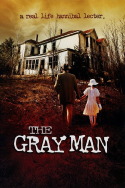
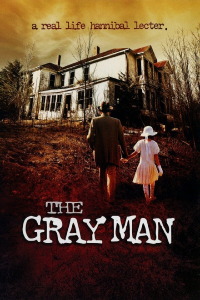
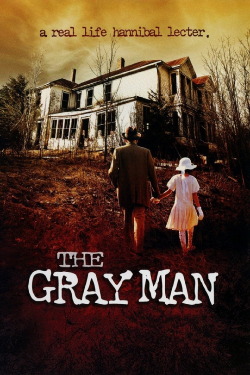
One day, young Grace Budd (Lexi Ainsworth) went away to a party with a friendly old man and was never seen again. The man, who said his name was Frank Howard, said he would hire Grace's older brother, Edward (Eric Parker). He said his niece was having a birthday party, and Grace should go. Her parents (Ben Hall and Jillian Armenante) trusted him. It turns out, however, that the man was actually Albert Fish (Patrick Dachau, playing a crazy person for once and not a psychiatrist), a deeply disturbed man who murdered and ate young Grace. Fish had a warped childhood and a complicated relationship with his own family; the idea that they're always so normal is not a reliable one. And then there's Detective Will King (Jack Conley), who is haunted by the memory of Grace and driven to find her killer, and not just because he suspects the person has killed before and will kill again.
Not that the film talks much about the other actual killings. They show a boy, possibly Francis X. McDonnell, another of his known victims, hanging from a tree, the bone of one leg exposed. And it is certainly true that Fish's own claims about his repeated rapes and murders of children are suspect at best. He claimed, you see, to have "had" a hundred children, at least one in every state. (That would be 48, as the last few states prior to Alaska and Hawaii were made states before Fish's capture and execution.) The claims were doubtful at best, and it seems reasonable to believe that his murders were limited to the Eastern Seaboard. However, if you knew nothing about Fish, this movie might reasonably lead you to conclude that he had killed two children and otherwise just written obscene letters. Dachau makes a fine Fish, but he feels somehow wasted here. I'm not saying I want gory detail, and certainly I'm even uncomfortable with the need to end the film on his execution, but it still seems to be missing something.
I note with some delight, however, that one of the actual defense witnesses at his trial was Fredric Wertham, unidentified by the film. Presumably on the grounds that no one who hasn't studied the history of comic books knows who Fredric Wertham was. Now, apparently, Wertham did some good work, and at least one or two of the points made in his infamous [i]Seduction of the Innocent[/i] are valid. (I can't look them up, as I don't have a copy; it's out of print and prohibitively expensive. Even the Evergreen library's copy seems to be a bound photocopy.) I can even see the argument, not presented by the movie, that executing Fish was a waste to medical science. I can see his desire to study the man and learn what creates an Albert Fish. Certainly it parallels some of my own views on the subject, though I'm not as certain about the usefulness of such studies, given I think the behaviour is at least in part innate and that someone like him wouldn't necessarily want to be cured anyway. However, I can still see Wertham's point, which is something over most of what he said about comics.
This is that rarest of things, a mediocre film about a serial killer. There are a few which are excellent, such as [i]Monster[/i] and [i]Zodiac[/i]. (I believe it was A&E which did an interesting one about Ted Bundy's offer to help catch the Green River Killer.) Mostly, they are terrible and exploitative. The story of Albert Fish could easily be the kind of gory and unpleasant stuff you get in a lot of those. About the worst gore here is the hanging body of that boy; about the most unpleasant is Fish's self-flagellation. The cannibalism is discussed but not shown. On the other hand, there isn't anything which rises to superior filming. The story of Fish is just kind of there. Dachau is a talented actor, and he does a good job with what's presented to him. The girl who played Grace looked properly winsome--and quite young, given she was seventeen and Grace was ten. It's just that doing the best with what's there is still not doing anything spectacular.
This review of The Gray Man (2007) was written by Edith N on 29 Sep 2010.
The Gray Man has generally received mixed reviews.
Was this review helpful?