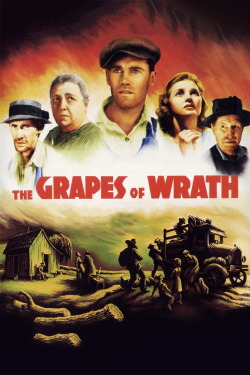
Review of The Grapes of Wrath (1940) by Carlitta N — 11 Aug 2013
"I'll be all around...Wherever there's a fight so hungry people can eat...Whenever there's a cop beating a guy, I'll be there...And when the people are eatin' the stuff they raise and livin' in the houses they build. I'll be there too.".
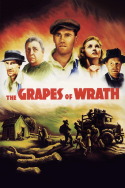
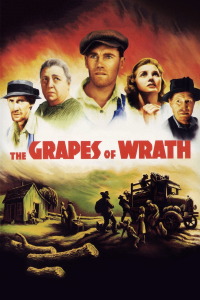
For a time, it was known as the greatest film of all-time, before it was beaten by the overrated Citizen Kane. Based on the classic and controversial novel by John Steinbeck, The Grapes of Wrath is deserving of the greatest film title and is possibly one of the most powerful films a person can witness.
During the Great Depression, Tom Joad (Henry Fonda) returns home to Oklahoma after spending jail time only to find that The Dust Bowl has consumed their crops and the lack of profits has forced them to leave their homes. Tom and his family load up and head to the "land of milk and honey", that is, California, to try to find work and live a better. What they learn the hard way is that the grass isn't always greener on the other side.
The film also features Jane Darwell in an Oscar-winning performance as Ma Joad, Russell Simpson as Pa Joad, John Carradine as Jim Casey, a former preacher who joins the ride, and Doris Bowden plays the family's pregnant girl.
The Grapes of Wrath, both the book and this film, have been the subject of controversy since its original release, especially in the political crowd. The "right" politicians accuse it of going too far to the "left" while others accuse it of promoting communism. Fans of the book have also criticized the film for changing the ending to make it a little happier. When it comes to watching movies, I don't watch a movie to analyze a director's political views or the whole political message of the story; I watch a movie to escape political problems and have a good time. For The Grapes of Wrath, this experience paid off, and I experienced a drama that's very powerful to watch.
Now I never experienced the Great Depression personally, but with this film, I can fully understand why it's called a great depression. Farmers being kicked out of their homes cause they don't have enough crops, coming to California to find a better life only to be accused of communist strikers. It's a very depressing film for some, especially those who are still around to remember it, and it's also a very difficult film to watch. But, I managed to get through it all, and I loved every minute of it.
For starters, the black-and-white cinematography is outstanding. Although the majority of the film was filmed in Hollywood sets, the cinematographer really makes you believe that the opening scenes were in Oklahoma. The lighting in the nighttime shots are stunning and should have at least earned an Oscar nomination. I don't know how the cinematography here was snubbed.
But what really serves as the inspiration to the film's success are the acting performances. The lead actor, Henry Fonda, is fantastic as Tom Joad, and should have won the Oscar here (he lost to best friend Jimmy Stewart for his role in The Philadelphia Story). Fonda delivers in a lot of emotional scenes, such as his reaction to the Dust Bowl and a scene involving the burning of a worker camp. The other strong performance here is Jane Darwell as Ma Joad. Like Fonda, she delivers in a lot of dramatic scenes, such as the scene where she says goodbye to the farm and her final speech at the end. She ended up winning the Oscar, and while I thought she was great, the Supporting Actress Oscar should have gone to Judith Anderson for her role as the creepy maid in Rebecca. I was also impressed with John Carradine as Casey the former preacher. For a preacher who "lost his spirit", Carradine's take on the character is very memorable and I was impressed with the intensity in his performance.
POSSIBLE SPOILERS AHEAD:
The ending has caused problems for many people, especially fans of the book. The book ending involved the pregnant woman's baby to die and something about her feeding an old man. (I might be rusty, cause I've never read the book). The film ended with Fonda's departure and the family's hope for survival. My belief in films based on books is that the film needs to keep the spirit of the book without trying to copy the book. For The Grapes of Wrath, I found nothing wrong with the film ending. For 1940, Hollywood was cautious of depressing its audience (especially in the wake of WWII), and I believe the ending was changed to inspire the audience for hope of better times. That's a good message that can apply in today's times.
END OF SPOILERS.
It may be controversial in the changed ending and in the world of politics, but The Grapes of Wrath is a powerful, stunning, and inspiring film. Had it not been for the political controversies, the film might have won Best Picture. But at least the year's winner, Hitchcock's Rebecca, was a film that was worthy of the award.
This review of The Grapes of Wrath (1940) was written by Carlitta N on 11 Aug 2013.
The Grapes of Wrath has generally received very positive reviews.
Was this review helpful?