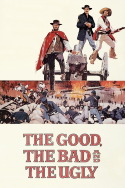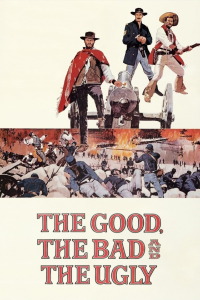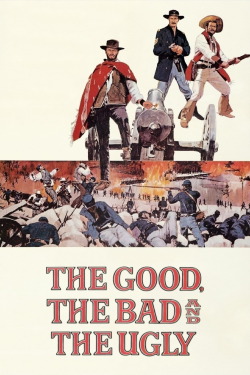
Review of The Good, the Bad and the Ugly (1966) by Swati — 25 Dec 2013
Three thugs come into information about a certain treasure hidden somewhere in a graveyard, which precipitates in a battle of wits and endurance that takes us through deserts, prisoner-of-war camps and battle encampments. There's never a dry moment, well except for the weather.
The Ugly, Tuco, is a low-life, good-for-nothing, petty thief who has an unwritten contract with Blondie a.k.a the Man with No Name (Clint Eastwood) which the latter usurps, making him want to seek vengeance. Some might find him the most sympathetic one because he talks about his life, which the others don't, and we know that he didn't know any better, or things might have been different. He overestimates his intelligence and suffers for that at the hands of the other two. But if he sets his mind to something, he will take such offence that he will pursue his enemy to the extreme.
The Bad, Angel Eyes, is singularly portrayed as the villain without redeeming qualities. Early on he kills a child to distinguish himself from the other two, though the others are not so much saints and Tuco is a rapist. Their life is hard and given the circumstances the other two might have done the same in the heat of a gunfight to save their skins, but the important thing is that they are not shown to do so and this is what immediately sets him apart and paves a separate path for him.
The Good is not so much good in character as in looks. The Man with No Name roams the desolate landscape in search for bounty. But since he appears to be the protagonist, he may come across as the most sympathetic one from the three. He is a man of few words. Initially it feels like he may get overwhelmed by the barbarity displayed by the other two, but through a combination of wits, deceit and an unmatched prowess at gun toting, he displays a skill at killing that often intimidates his peers.
Each of them kill with impunity and without remorse, sometimes over nothing at all. As they pursue this treasure, their paths cross several times. They change sides at first opportunity. They cannot sit down and talk about splitting it because The Man could never agree to that. Whether Angel Eyes would have is never really explored.
While these three compete for gold, in background we are constantly reminded of the Civil War. The battle sequences near the end were well shot and captured the chaos of a battle as accurately as it could be on the camera. The camera pans out and shows us the opposing sides and their positions. Glimpses of the war are shown throughout the length of the movie, sometimes a makeshift hospital in the ruins of a building, cannon balls landing in towns and streets, armies marching. No side is shown to be the more sympathetic one. No slaves are shown, not one. Leone clearly did not want to be caught up in a debate. The story he wanted to tell had little time for such discussions. But what he did want to show was the futility of war. Countless suffering youth is shown time and again.
What I loved about the movie is that it was more than just mindless killing and violence. Plenty of time is spent between action to let us reflect on our surroundings and what is going on in there. Hardly a moment is lost in a scene which does not have a bearing on later events. Everything is intricately plotted, meshed together perfectly. Leone spends a lot of time creating tension through silence. Even amidst all the carnage, the tone is always playful. Leone doesn't let the movie get too serious, often flanking scenes of death with humorous ones.
There is a fair amount of convenient coincidences throughout the movie but if you start paying attention to them and seek them out deliberately, it would distract from the whole experience. For as much a serious movie as it is, the intention clearly had been to make a movie that could be enjoyed several times without overbearing with the serious part. Some of the scenes stretch the imagination, like Blondie's ability to shoot off the hats of people from far away.
The score is iconic and added humour and a sense of thrill to the action it supported. The set design was fabulous. The towns, houses, rooms and their furnishings shows almost perfectly the world of that time. The eye for detail was impressive. Nothing seemed to be out of place. Costume was spot on. Cinematography really helped paint a picture of the action taking place.
The last sequence was riveting as the three stand in a Mexican stand-off. This is where we finally realize that the other two, no matter how cruel they could be, are really at the mercy of this mysterious person who is not named once. There was never a time these two could have outsmarted him. While they fidget about, The Man remains passive, defying every expectation. Nevertheless, the way luck plays its part in saving his neck time and again had a greater role than any other, without which no one could survive in this world.
This review of The Good, the Bad and the Ugly (1966) was written by Swati on 25 Dec 2013.
The Good, the Bad and the Ugly has generally received very positive reviews.
Was this review helpful?