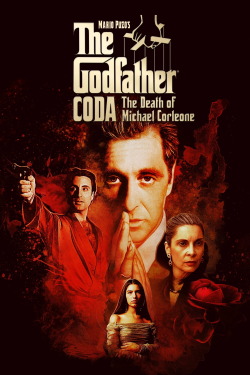
Review of The Godfather Part III (1990) by Cameron J — 07 Sep 2014
Forget the Corleone family, because by getting his father Carmine to do the score, and his daughter Sofia to co-star, Francis Ford Coppola has really turned this into a Coppola family affair, although it's not like he had a whole lot of options to go with at the last minute, because Nino Rota was dead long before this film came out, and Julia Roberts and Wynona Ryder were, you know, too busy to be in the long-anticipated conclusion of what is considered one of the great film series ever. Man, sixteen years is still a long time, so, at this point, shouldn't we call this "The Grandfather" or something? People, I'm very, very sorry, but I just have to say that... once you thought that you were out, they pull you back in! Yup, we finally come to the conclusion of this epic saga, and it took sixteen years for us to get around to it, but hey, that's only about the length of the first installment of this series. Wow, Al Pacino got old, so much so that he was just shy of 50 when he got into this film which portrayed him as just shy of 60, although there are equally great stretches, like Andy [u]García[/u] playing Italian. This must be some kind of an apology to Italian-Americans everywhere for Brian De Palma's having the nerve to turn Scarface into a Cuban, because Pacino is now back to being the definitive Italian-American gangster, and he's taking a Cuban through the Italianification with him. I'm sure there are plenty of Italian-Americans who would say that Coppola now has to apologize for this film, and really, as awesome as I think this film is, I can kind of see what they and their flamboyant hand gestures are talking about.
Not so much in pacing or consistency in its handling convoluted and near-episodically segmented narratives, the writing throughout this series has been pretty tight, and although Francis Ford Coppola's and Mario Puzo's script continues to shine in more than a few key areas, it makes more than a few missteps, with clichéd dialogue and, even worse, contrivances, which superficialize certain narrative attributes and characters, particularly the important Mary and Vincent Mancini/Corleone roles which feel like familiar types, at least early on. As matters progress, nuance builds to humanize the characterization with more layers, believability and overall depth, but with the thickening of the plot, subtlety issues find other targets, particularly dramatics that gradually devolve into melodramatics, and derivative ones at that, plaguing the storytelling with a certain predictability that seems to be challenged by the constant layering of plot aspects that eventually become something of a challenge to juggle. In my opinion, this series has never been anything if not rather overblown and confusing, and whether it be because it is somewhat questionably simplified, or simply because, as an original story that continues the canon of the novel "The Godfather", it is built to better accommodate film-style storytelling, this narrative is not quite as uneven as the predecessors, but it still has trouble in keeping a firm grip on its many layers, perhaps because most of the layers of the predecessors, no matter how excessive, bonded more organically than many a rather contrived aspect to this epic's plot. The final product is rather convoluted and overblown, and embracing its bloated structure would be a much easier task if the storytelling wasn't so busy, picking up nuance along the way while it hurries from event to event, with very few slow-downs throughout a sprawling course. The shortest installment in the saga, this film is still nearly three dadgum hours long, and that is too dadgum long, especially for a plot so bloated and busy, and unraveled with such meandering excess that repetition sets in, stiffening a sense of momentum that is smoothed out a good bit by heights in Coppola's directorial pacing, of which there are so many, compared to ponderous aspects in pacing that further challenge one's attention and investment. This series has been characterized by a meditative atmosphere that, no matter how penetrating in its subtlety and grace, has resulted in blandness, if not out-and-out dullness, and here, Coppola's thoughtfulness has been toned down enough to admittedly make this, at the very least, decidedly the most entertaining installment of the trilogy, but there's still a lot of limping about in directorial and structural pacing, making the film rather bland in a lot of ways, something that it cannot afford to be if you are to not be given the opportunity to focus on the other missteps of the final product, which, whether because of ambition or because of laziness, is misguided, with contrivances, convolutions and unevenness that render the final product shy of the competence or realization of its predecessor, and of its potential. Indeed, even I - someone who adores the predecessors, but does not view them as altogether pure masterpieces on a general standard - don't consider this a particularly satisfactory conclusion to Francis Ford Coppola's and Mario Puzo's saga, but it is a worthy one, and considering the caliber of the predecessors, that means that this effort is not simply rewarding or strong by its own right, but outstanding, with a wealth of worthy substance to be complimented by inspired storytelling and, for that matter, artistry.
Despite his efforts' being underused in this largely quiet series, Nino Rota crafted outstanding and iconic score work in the first two installments of this saga, before tragically passing in 1979, thus, Francis Ford Coppola's father, Carmine Coppola, - who provided additional music in the original "Godfather" - was employed to score this, his final project, and even though he was not nearly as unique or gifted as a composer than Rota, his efforts in this film are beautiful enough to compliment the aesthetic and tonal value of this drama. Gordon Willis' cinematography further impresses from an artistic standpoint, lacking the portraitist beauty that captivated in most every frame of the predecessors, but still being clean and crisp enough in its coloration and lighting to catch your eye time and again, particularly when falling over poetic visuals that are truly captivating in their craftsmanship. In addition to this, the visual style of the film has enough scope and intimacy for you to get a well-rounded feel for Alex Tavoularis' art direction, which doesn't take us as far back as the distinguished preceding period pieces, but still crafts many dynamic sets and visuals which are lavish, either in their being so expansive and distinct, or in their being pleasing on an aesthetic level. Really, even on a stylistic level, this film is not nearly up to par with its predecessors, despite being technically fresher, but there's still plenty of aesthetic value throughout the making of this film, which is musically and visually lovely, and technically immersive enough to help in complimenting the scale and importance of the substance through the style. Although there's plenty of story left to tell with this third installment in a saga comprised of, not expansive, but extensive epics, as a made-for-film conclusion to Mario Puzo's classic saga, this story also needs to do a lot of unraveling, thus, this story concept is not quite as complex and juicy as the subject matter of the predecessors, with a certain laziness that is reflected in contrivances, as well as convolutions that are found throughout this complex chronicle, but not in this forced of a fashion, and yet, much more outlandish than this story is the belief that this film's subject matter is not of significant importance, continuing to be an intriguing study on the workings of the mafia, backed by an enthralling meditation on a man's struggles with his enemies, family, faith, and guilt as an aging man of great sin, and on other affairs that, on top of being promising to begin with, evolves with its intrigue. As the plot thickens, it becomes more convoluted, as well as more melodramatic, but the fact of the matter is that this story gradually grows more complex, with more nuance, more thematic and dramatic depth, and extremes in the evolution of the plot progression which not even the narrative of "The Godfather Part II" hit, and which are more organic than the jarring segment shifts of the first installment in this saga. Sure, there's still plenty of convolution and unevenness to this narrative, even on paper, and that it's thin in certain places at any time reflects that it is not as rich with potential as the subject matter of the predecessors, but this story is always engrossing, to one extent or another, with a sound potential that I for one find is more than adequately fulfilled.
Francis Ford Coppola's and Mario Puzo's writing for this film is not as inspired as the writing for the predecessors, being about as excessive and uneven, with a lot more contrivances and clichés, and little less wit, so the excellence of this film's script is debatable, although there are excellent aspects, ranging from heights in sharp dialogue and moments of lighthearted relief, to extensive exposition and characterization that make this intimate epic nuanced, at least after a while. There's always something rather clichéd and manipulative about this story, but there is enough focus in its progression, even on paper, to hold your investment and flesh out worthwhile characters and conflicts, until crafting a solid plot to be brought to life by Coppola, as director. Where there are lazy spots in the writing of this film that beget missteps, the misguidance in Coppola's direction strictly derives from ambition, for although the filmmaking's legend's subdued storytelling in the predecessor's was a bit dull in its steadiness, it reflected a realization that is not as consistent here, but still very much prominent, with subtle stylization and color that liven up the thoughtful storytelling to the point of limiting bland spots, yet remains tasteful enough to tightly craft rich scenes that grow more recurrent as things go along. As I said, substance grows thicker, richer and more complex as the story progresses, and Coppola's direction emulates such a formula by growing more realized, thoughtful and resonant as the story thickens and unravels, until it ultimately comes down to an ending that, despite being rather awkwardly cut at the very conclusion, is one of the most devastatingly powerful moments of the entire series, thus securing Coppola's directorial performance as instrumental in the securing of excellence in this overambitious and often misguided, but engrossing drama, anchored by plenty of inspiration found in the onscreen performances. Criticism against this film has very recurrently been directed towards the performance of Coppola's daughter, now-notorious filmmaker Sofia Coppola, as the strong, but flawed young daughter of Michael Corleone, and to me, while Sofia is not necessarily bad, being no worse than her aunt, Talia Shire, was in the first "Godfather" (Man, Francis certainly knows how to work with his family, doesn't he?), she is flat, especially compared to the rest of the cast, which is filled with solid performances, the most outstanding of which, that is, in the supporting cast, belonging to the, even now, underappreciated Andy García, who nails the devilish charisma that always, in some way, defines the initially thin Vincent Mancini/Corleone character, whose gradual evolution from a brutal man of sleaze and crime to matured man of passion and criminal business who must face tremendous threats and tragedy is captured with nuance and dramatic range so subtle, yet so realized that García becomes his role, making it the last truly memorable major one in this saga. This series has followed the evolution of many distinguished characters, and yet, at its heart, it's all about Michael Corleone, and that especially goes for this film, which sees Corleone far into middle-age and wanting some sort of change to redeem himself, before the sins that wrack him with guilt over his great power catch up with his loved ones and destroy him, whether spiritually or literally, thus, this story has the potential to be the conclusion to Corleone's story that we've always wanted, and it's Al Pacino who fulfills that potential, capturing the esteemed presence and charisma of the, in some ways, good-hearted and, in other ways, intimidatingly dangerous head of a criminal empire, and backing it with some subtle degree of humanity and vulnerability, which grow greater and greater, with danger and a progression towards change, until peaking with heights in subtle, if not intense emotion that range from captivating to heartbreaking. Pacino has helped in carrying this series from the very beginning, and he does just the same here, all but single-handedly, with what may very well be his finest performance in the saga that played anything but a small part in defining his success, so the film is certainly fulfilling as a vehicle for Pacino and as a portrait on the tragic antihero who is Michael Corleone, but it satisfies beyond that, because for every shortcoming and misguidance, ambition and potential are met through an immense inspiration that, from both on and off of the screen, make the final product genuinely excellent by its own right.
When it's all finally said and done, clichés and contrivances come in the form of aggravations, if not formulaic melodramatics that corrupt the subtlety of this uneven, convoluted and busy narrative, whose repetitiously overdrawn and often blandly dry telling threaten an excellence that this series has always held, and continues to maintain, partly through the lovely score work, cinematography and art direction, and largely through a rich, gradually thickening story concept that is done more than enough justice by extensive writing, inspired direction and strong performances - the most outstanding of which being by the transformative Andy García, and the stellar Al Pacino - to make "The Godfather Part III" an ultimately plenty enthralling epic and worthy conclusion to Francis Ford Coppola's and Mario Puzo's classic saga of crime, family and humanity.
3.5/5 - Excellent.
This review of The Godfather Part III (1990) was written by Cameron J on 07 Sep 2014.
The Godfather Part III has generally received positive reviews.
Was this review helpful?