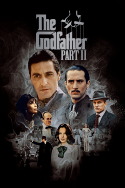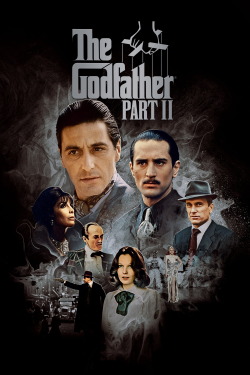
Review of The Godfather Part II (1974) by Cameron J — 06 Sep 2014
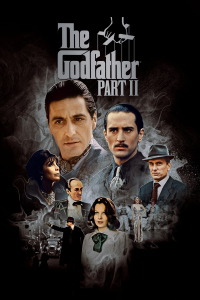
"Mob Wars Episode II: The Family Strikes Back"! The epic struggle continues, you know, because the first installment just wasn't long enough, and didn't quite win enough awards. Shoot, forget that, because in case the predecessor wasn't confusing enough, here's a sequel "and" a prequel, for those who wanted more Al Pacino and, well, knew that it was only a matter of time before Robert De Niro worked his way into this Italian-American crime epic, like he did the rest of them in the '70s. If this prequel-sequel answers no other pressing questions, it finally shows us that Pacino is, in fact, older than De Niro, although it does satisfy in more than just that respect. Now, I'm not saying that this isn't a satisfying sequel, but it's script is in a museum in blasted Turin, as in the place they stuck Jesus. I've heard of people following these film religiously, but it appears that the script, by association, is an honorary religious document, only with not even close to as many holes... I think. Like I said, this film is a little hard to follow, but it really is very much worth the convolution, even though this epic probably doesn't need to be so disjointed.
What really does a number on the predecessor is its unevenness, and although this film's plot is not quite as segmented as the plot of the predecessor, if this is at all a lesser sequel, it's because it's even more uneven, extensively exploring a study on the workings of the mafia, an investigation by the mafia regarding attempts on the life of a crime family's head, a portrait on a family falling apart from multiple angles, and other affairs, all of which are so complex that juggling them is a challenge, while unraveling them just about proves to be a chore. Following a tighter time frame, at least with its core plot, this story is not quite as nuanced a character study as the predecessor, but there's still too much going on, too many layers to the dramatics, themes and other storytelling attributes, and even though I wouldn't do away with any of the exceptional stories, their complexities, no matter how enthralling, are convoluted, and really starts pushing your patience when it has the audacity to incorporate branches, not from the plot, but of plot. Primarily focusing on Michael Corleone's continuing to rise to power in organized crime by taking out the greatest threats on, not simply his business, but on his life, this film has the audacity to incorporate extensive flashbacks that dramatize the origin of Corleone's father, Vito, and as compelling as that story is, it's expendable, and if nothing else stresses that, it's its sloppy alternations between it and the central plot, which is focused upon for so long, before being abandoned for the secondary plot that proceeds to be focused upon for so long. The relative perfect way to handle the secondary plot would be to centralize it by focusing on the flashbacks a little bit at a time, then focusing on the main timeline a little bit at a time, to where the secondary plot would not be all but abandoned long before the film's conclusion overall, and would not be forgotten when it is paused for the main storyline, and although such a formula would perhaps exacerbate the film's convolution, it's a whole lot smoother than the excessiveness that messes with the focus of the final product, and challenges your investment as much as any form of excess in the predecessor. Considering that this plot is not quite as extensive as that of the predecessor, and that this film ends up running much longer than an already overlong predecessor, excessiveness is a distinct trait in this epic, which, with all of its convoluted layers and expendable plot elements, has the audacity to incorporate some filler, if not scene structures that are overdrawn with chatter, thus retarding momentum with repetition that tries your patience almost as much as meditative directorial storytelling by Francis Ford Copola that might be a little more colorful than the atmosphere of the predecessor, at least enough to keep pacing sort of smooth, but is subdued to the point of often being bland, if not just plain dull. I think the lack of freshness and a slightly less extensive plot are what secure the final product as just shy of the quality of its predecessor, because there's a little more sweep and entertainment value in this film, challenged by a greater deal of unevenness and excessiveness, still backed by a problematic atmosphere that, for all of its piercing sobriety, may be too somber for excitement's own good. Like its predecessor, the final product's subtle shortcomings, whether they be natural or consequential, are recurrent enough to betray a pure masterpiece status, but make no mistake, both films remain outstanding triumphs in classic filmmaking, with this installment being even more aesthetically proficient.
Extremely reliant on a certain quiet intensity throughout a course of nearly three hours, "The Godfather" didn't do much with its amazing score, but here, Nino Rota, unaccompanied by Carmine Coppola, is allowed to further flesh out his musical tastes, at least in terms of range, featuring hauntingly subtle aspects whose Italian flavor is beautiful, and moments of height in musical scope that is almost transcendently symphonic. Sure, this film is also largely quiet, so you don't get too much of Rona's score, but when the soundtrack of this drama is played upon, it does not simply liven things up with its tremendous beauty, but encompasses the dynamicity of this epic with a rich range, not unlike the perhaps just as aesthetically pleasing, and decidedly more recurrent visual stylization. Gordon Willis returns after dazzling viewers of "The Godfather" with almost groundbreakingly portraitist cinematography, and where you should be used to Willis' visual style by this second installment, the cinematography continues to captivate, through range, characterizing the central plot with a ruggedly handsome bleakness that is artistically breathtaking in the context of almost lyrical visuals, and the secondary plot with a more conventional, but nevertheless stunning glow that is hauntingly dreamy, but still with a hint of grit to compliment consistent themes of the dark depths of man and his affairs. No matter what sort of lens it dawns, the cinematography is always captivating, but what really defines the visual style of this film is that it, while still very intimate, is even broader and dynamic in scope than the predecessor, giving this sequel a greater sense of scale which is, of course, supplemented by art direction that is just as sweeping at the very least. One has to respect Warren Clymer's art direction for the original "The Godfather" for its being more intimately environmental than emphatic on the period piece's time frame, but John Dapper and Angelo P. Graham really knock it out of the park with their art direction for this film, which, with extreme distinction, nails an economically feeble region of New York during the latter 1910s and early 1920s, when it's not nailing lavish, upscale properties in Las Vegas and, at one point, Havanna, Cuba, during the latter 1950s, always with that sweeping scope that not only secures the film as stylistically marvelous, but helps greatly in immersing you into the substance of this epic. I think what ultimately secures this film short of its predecessor is its narrative being not quite as extensive in its progression as the narrative of the predecessor whose central timeline spanned ten years of evolution in a crime organization and its most key members, but this midsection in novelist Mario Puzo's epic saga is still packed with dramatic meat, as well as scope, convolutedly and unevenly, but nonetheless compellingly studying on a crime organization's struggling with both nasty business and maintaining respectability and secrecy that threatened by unknown enemies, if not traitors, while exploring the origins of the man who originated the organization, and the new leader of the organization's gradual ascension to power, on the wings of brutality and betrayal he thought he never could commit. Fascinatingly realistic and humanly engrossing as a dramatization of organized crime and allegory for corruption, this epic's subject matter continues to buzz with intrigue, and a potential for high-caliber excellence that can be defined by a realized handling of riskily immense subject matter.
Mario Puzo's and Francis Ford Coppola's script is overblown, with excess in its uneven storytelling and repetitious filler, but it remains outstanding enough to be worthy of taking on ambitious subject matter, helping in keeping up a degree of entertainment value through sharp dialogue that, while not quite as quotable as the dialogue of the predecessor, is intelligent and believable, endearing you while the exposition enthralls, meticulously, if rather excessively fleshing out every aspects of this tonally and focally dynamic narrative as complex to the point of being about as, if not more intriguing than convoluted. The plot is well-drawn, but it thrives on its character aspects, which are even more fleshed out, for most every role in this sprawling character roster, whether subtly or extremely, is distinguished with layers and a worthy place in the progression of this epic, and is portrayed with just as much outstanding inspiration. Whether or not certain performances are stronger than any in the predecessor is debatable, but in terms of the consistency in solid performances, this sequel steps up the game, with Talia Shire not being given the opportunity to all but blow her dramatic material from the predecessor, while everyone else in the cast is strong, at the very least, with standouts including John Cazale as an ostensibly weak member in a crime family with his own dark secrets and potential; Michael V. Gazzo as a charismatic old man of crime who finds his long life threatened; Diane Keaton as a mob wife who grows tired of living in fear for herself and her loved ones; and, of course, the admittedly miscast Robert De Niro as a young Vito Corleone, whose rise from poverty and tragedy to power allows the then-up-and-coming De Niro to utilize enthralling dramatic layers and subtleties to sell a character transformation with almost as much effectiveness as leading man Al Pacino. No longer the morally pure outsider in a justly feared family who he was at the beginning of the predecessor, and now as powerful and dangerous as any member of his criminal clan, Michael Corleone still has plenty of promises to break, ties to sever and sins to commit as he further submits himself to a life of crime and corruption that didn't even taint his father to the extent it taints him by the end of this epic character study, and if no one sells a sense of evolution within Corleone, then, of course, it is Pacino, whose grippingly distinguished presence comes accompanied with a subtle intensity that grows more and more vulnerable, more and more definitive of the anger, fear, authority and guilt Corleone must face in his rise to unrivaled power, and of Pacino's connection with such an iconic and challenging role. Pacino may very well improve upon his revelatory performance in the predecessor, and carries this very human drama with peers who need to be of considerable talent in order to hold their own with such a stellar lead, thus, the onscreen talents are as instrumental as any component in the securing of this drama's excellence, yet couldn't get the job done without a certain offscreen inspiration. The inspiration in Coppola's direction is as realized as anything in this film, with a thoughtful, ponderous pacing that is often, not simply blanding, but dulling, yet is celebratory enough of the scripted cleverness and sharp stylization to keep up a little more liveliness than what was found in the strictly subdued and serious predecessor, thus holding your attention in between the heights in dramatic intrigue that, through Coppola's spot-on marriage of subtle taste and gripping intensity, include biting tension, if not crushing emotional resonance. The film is powerful on a number of occasions, but it's consistently enthralling, trying your patience with its convoluted excessiveness and overtly steady pacing, yet ultimately rewarding to a near-masterful extent as yet another outstanding triumph for Coppola and this saga.
When the book is closed once again, at least for now, unevenness - particularly with the handling of two separate plotlines - in the handling of an already convolutedly overblown narrative concept reflects an excessiveness that, when backed by a subdued atmosphere which is sometimes dull, tries the viewers' patience and defuses a state of masterfulness, all but achieved through the beautiful score work, awe-inspiring cinematography, sweepingly lavish art direction, across-the-board strong performances, - the strongest of which being by the nuanced Al Pacino - and intelligently, extensively well-scripted and thoughtfully, when not resonantly directed telling of an epic story concept which render "The Godfather Part II" outstanding as a worthy continuation of Mario Puzo's and Francis Ford Coppola's classic vision of a portrait on crime and corruption.
3.75/5 - Upstanding.
This review of The Godfather Part II (1974) was written by Cameron J on 06 Sep 2014.
The Godfather Part II has generally received very positive reviews.
Was this review helpful?