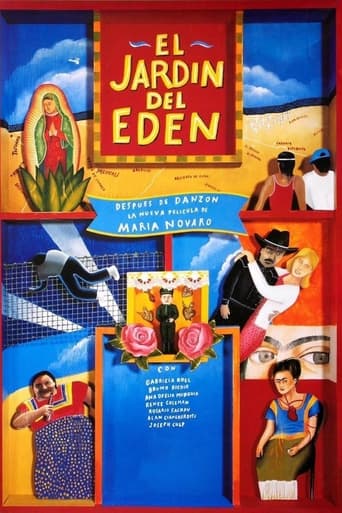
Review of The Garden of Eden (1994) by Christina C — 04 Nov 2014
I found this film to be very interesting. I compiled some opinions from others along with my own in this review.
Néstor García Canclini writes about a hybrid identity in his book, Culturas Híbridas: Estrategias para entrar y salir de la modernidad. Amy Kaminsky talks about El jardín del Edén in her article, ?Identity at the Border: Narrative Strategies in María Novaro?s El jardín del Edén and John Sayles?s Lone Star.? The theme of a hybrid identity is intimately linked to other main themes of the movie: the representations of the border; the representations of the biblical story, "Garden of Eden;" and the role of art in the resolution of personal conflicts.
The concept of a hybrid identity doesn't only apply to the film. Borders exist in every pair of countries. The borders create a hybrid culture that has it's own customs. The culture of the border is a third area that is different from the two countries that mix to create it. Also, any nation can be thought of as hybrid, because each country has influences from other areas. It is impossible to have a nation with a pure heritage.
Amy Kaminsky discusses El jardín del Edén and her position on border cinema in her article, ?Identity at the Border: Narrative Strategies in María Novaro?s El jardín del Edén and John Sayles?s Lone Star.? According to the Kaminsky article, the border is an uncomfortable and dangerous place characterized by passing and without rules. The border is similar to crossing in cars or moving in a train. According to the article, the people of the border are considered pollution. (2001, 91) The Garden of Eden is a movie in the border cinema genre that is more about the border than history and cinematographic customs of a single nation. (2001, 92) Novaro made the movie to show the border as a free space for Chicano art and literature. In her article, Kaminsky cites David E. Johnson and Scott Michaelsen. In border cinema there is a tendency to celebrate the border as ?a place of politically exciting hybridity, intellectual creativity, and moral possibility? the privileged locus of hope for a better world.? (2001, 94).
Tía Juana lives in Tijuana and obviously is a symbol of the city because her name is so similar to the city's name. She is the owner of a store which sells things taken by the government from people who were trying to cross the border. She doesn't give away anything for free, even to her family. Just like the corrupt city, she is devoid of morals. This can also be seen when she gambles with Paloma. Tijuana is a border city joining two different countries; therefore it is a borderland.
Liz's friend Jane (Renée Coleman) comes to Mexico to visit Liz and her brother, Frank (Joseph Culp). Frank studies whales in his house as a hobby and does not socialize much. Serena's son hurts his knee and Frank helps clean him up and give him a bandage. While he is mending the knee, Frank discusses his passion for whales with the boy. The boy says that since the whales were born in Mexico, they are Mexican. Frank answers that 'luckily for them no one has put lines on their territory. The whales don't have a nationality because they can roam wherever they want. Franks argument proposes the theme of the border and a hybrid identity. Since the whales cross the border wherever they want, they represent a hybrid identity.
Jane represents the United States because she is white and was grew up there. Jane romanticizes Mexico and its inhabitants such as Felipe (Bruno Bichir), Margarita Luna (Ángeles Cruz), the widow who cries because of the death of her husband, and the woman carrying cages on her back.
When she met Felipe, she saw him in slow motion and low angle camera. There was Mexican music in the background and he was smoking. In Garden of Eden, smoke is often used to hint that Jane is seeing a romanticized view of Mexico. He had a very strong and manly posture.
When she met Margarita Luna, Margarita Luna was laughing with the other women in the kitchen, while filled with unique lighting. This scene was also in slow-motion. When Jane realizes that the Mexican women has lost her husband, Jane gives her money assuming that she needs it. Upon seeing this, Felipe gets very angry with Jane.
When Jane sees a woman carrying many birds in cages on her back, the heavy weight and noise convert into something light and beautiful. This shows how she romanticizes Mexico and it's inhabitants. This also shows that Jane did not learn the error of her ways because at the end of the movie she continues to look at Mexico with a romantic view.
Felipe often refers to Jane's blonde hair by calling her "huera." Jane's Spanish has a very American accent. Liz jokes that Jane is the only person who makes Liz's Spanish look good. Amy Kaminsky describes Felipe as "a member of the next batch of migrants, swelling like an ocean wave well before the one ahead of it has dissipated." (2001, 95) Kaminsky says that Jane uses romanticism to change her ?grim reality into a beautiful vision.? (2001, 97) this reflects the view of the optimistic immigrant.
Jean helps Felipe and his "carnal" crossed the border. Jane drives the car while they are in the trunk. When they arrived to the United States they stay in a hotel named "Garden of Eden.".
There are many references to the biblical story of the garden of Eden in the film. The word, "paradise" is repeated often. For example, when Jane and Liz look at the book with the photos of the indigenous women, Jane says, ?These women must live in paradise.? Also on Jane's desk there is a magazine called, ?Paradise Lost.? This shows the optimistic view of the immigrant. I think that the movie is referring to the false paradise that many immigrants encounter when they come to the United States from Mexico. When a Mexican migrates to the United States in search of work, he or she is awaiting something magnificent on the other side (a paradise.) However when a Mexican arrives, they do not find a paradise, but a life filled with the migration police and a lack of papers. This false paradise is a reference to the biblical story.
In one scene Liz is watching a video by Guillermo Gómez-Peña as she eats and apple. I think that the apple is also a reference to the biblical story. Often artists paint the tree of knowledge as an apple tree. When Liz eats the apple it is reminiscent of eating from the tree of knowledge because she is in the process of learning and gaining knowledge about her dual heritage.
The hotel, "Garden of Eden," has a sign with the name outside. The shape of the sign is a tree which is also a reference to the tree of knowledge. However in this case the tree of knowledge is converted into a palm tree. I think that is because it seems a bit more Hispanic and it supports the idea of a paradise. The hotel supports the idea of a false paradise because it is called, "Garden of Eden,"but it is a cheap and dirty hotel. Therefore it is ironic. The hotel sign also seems a bit dirty. The title of the movie gets its name from the hotel and is another biblical reference. In the biblical story, Adam and Eve want to go to the tree of knowledge just as many immigrants want to go to the United States. However when Adam and Eve arrive it is prohibited to eat the apples from the tree of knowledge just as it is prohibited to be in the United States and work without papers.
The border is represented often in the movie in a great variety of metaphors and symbols which demonstrated a hybrid identity. The border is shown as a fence as the first visual image of the movie. It is a very interesting shot because the whole shot is black with the exception of two circles of vision. The audience has a privileged vision which moves a bit with the camera to give the illusion of looking through binoculars. I think that the two circles represent the two worlds that the movie centers around, Mexico and the United States. Each circle has its own side of the fence and together the two sides of the fence make an inverted V. Defense is an upside down V instead of a flat line because it is a symbol for the social disorder which surrounds the border throughout the movie. This fence also shows the double direction of migration because the slopes of the lines are almost the same but negative. The left line segment has an approximate equation of y=2x, while the right equation would be about y=-2x. One is a reflection of the other in the line, x=0. They create a vertical symmetry. This signifies that to migrate from the left side of the screen to the right would be the same as to migrate from the right side to the left. During the scene metallic sounds without rhythm can be heard. This lack of rhythm and the diagonal lines signify a lack of water. The two circles of vision in the binocular's form a Venn Diagram shape. This Venn Diagram represents very well the theme of a hybrid heritage. The left circle would be one country (Mexico or the United States) and the other circle would be the other country. The intersection of the two circles is where a Chicano or any habitant of the borderland would live. The Venn diagrams curved lines of the center where the two circles overlap are not included in the shot. To erase these curved lines which defined the intersection of the two circles symbolizes to erase the separation between the intersection of the two countries and each of the two countries. This converts the entire image into an area of intersection and hybridity. The fence seems like an extremely foreign object which interrupts the fluidity of the country. All of the plants, people, and the beach are the same on both sides of the fence. All of the land is very natural with green green, brown, and blue colors. However the fence is silver and has a very different shape.
Tia Juana's store also represents a bordered territory and supports the idea of a hybrid identity. She sells things left behind by immigrants of the United States-Mexico border. Many things are suspended in midair by cords just as many people feel to have a hybrid culture like Liz. The things that Tia Juana cells are pulled by two forces. The gravity pulls the things to the floor but at the same time there is a cord that pulls the items toward the ceiling. Liz feels very pulled by Mexico and the United States just like the things sold in Tia Juana's store. She feels Mexican because she has a Mexican Heritage and lives in Mexico, but she feels American because she cannot speak Spanish well, so she is pulled by two worlds just like the things which are pulled by two forces.
Felipe jumps into Jane's car over the door in order to go to the motel. He leaves the car while Jean is sleeping. This shows the border as a place of double direction. This double direction parallel the idea of a hybrid identity because the people with a hybrid culture migrate in both directions across the border.
Frank's vision of whales also supports the concept of a hybrid identity. Frank listens to the sounds of the whales and has many drawings of whales and lives in a beach close to whales. When Serena's son, Sergio, asks Frank why he has so many drawings of Wales, Frank says that "luckily for them no one has put lines on their territory."Frank likes the idea that the whales don't have borderlines in the sea and they are free to roam wherever they please. He does not like the idea that there is a border which separates two countries. This border creates a culture and a hybrid identity.
There are many media of art in the movie, The Garden of Eden. When Liz is in the backseat of a car there is a white painting of the Virgin of Guadalupe that is very detailed painted on the window. As the window rolls down and the image of the Virgin is hidden Liz appears from behind the window. This comparison of Liz and the virgin shows how she does not feel comfortable with her Mexican heritage because she looks very sad and she feels that she cannot speak perfect Spanish.
The code switching of the songs in the movie also support the idea of a hybrid identity. In one of the songs the lyrics are ?Dontcha know que te quiero? and ?Hey baby, que pasó.? The juxtaposition of the two languages parallels the juxtaposition of the two cultures and the two countries. Code switching is only possible when someone knows two different languages, so legal and switches are by definition a very hybrid concept. I found it very interesting that each of the 15 songs of the film is linked to a particular scene in the film and that scene usually comes right after its corresponding song. (Maciel 296).
One example of a song that matches well with the mood of the following scene is "baby, baby, corazón regresa." The song is filled with feelings of a warm welcome home through its lyrics and mood. The following scene is when Liz sees that Jane has finally come to visit her. Liz is very excited to see her friend and she gives her the song's predicted warm welcome home with a hug and a smile. During this song Liz says to Jane, "Tardaste mucho en volver." (Maciel 296).
Another example of a song that goes well with the following scene is "Hey baby qué pasó." (Maciel 297) During this scene, the camera pans across a sea of flashy show cars. The cars are lined up in a car show. Some of them have bright and unique paint jobs, while others are bouncing up and down. These cars show a small aspect of Chicano culture according to Maciel. (Maciel 298) I never knew that flashy cars bouncing on their shocks was part of Chicano culture. It seemed as if it were more part of pop culture because it is a very modern concept and is popular among younger generations mainly. Now I would have to agree with Maciel after having read his opinion. I suppose that there is a common ground between any culture which relates to a heritage and pop culture.
The two video clips that lives watches for her exposition have to do with the idea of a hybrid identity. The first video clip is a psychological session with a Chicana woman speaking about her inability to identify with her indigenous heritage. She said, "Who is that woman who looks so Indian?" Liz also feels the same feelings. When liz shows a picture to Jane Liz says, "I wish I could take those iguanas off my head," because she feels that she is not Mexican and she does not deserve the iguana. Many people with a hybrid heritage do not feel completely from one country or the other. They are 'ni de aquí ni de allá.".
Another video clip that Liz watches is by Guillermo Gomez-Peña. He is an artist who works with the idea of hybrid identities. His works are very radical, but just as the movie does, his works make the viewer feel uncomfortable to mimic the uncomfortable feeling that many people have when they have a hybrid identity.
Amy Kaminski says that liz uses her Chicana art to cross the border metaphorically and literally. Metaphorically she crosses the border in between the United States and Mexico by searching for the elements of Mexican influence and United States influence in the art. Literally her work gives her the possibility to travel from the United States to Mexico. (2001, 100).
The art, the representations of the border, and the representations of the biblical story in the movie, Garden of Eden, by María Novaro, support the main theme of the movie, a hybrid identity. The references to the biblical story include the repetition of the word, "paradise," the hotel sign, the title of the movie, and the moment that Liz eats an apple. The representations of the border with a double direction include the first shot of the movie, Tia Juana's store, the round trip that Felipe makes in Jane's car, and Frank's view of whales. The art of the movie serves to resolve Liz's personal conflicts and further develop the idea of a hybrid identity. Forms of art in the movie include the white painting of the Virgin on the window, the code switches, and the videos that list watches. Néstor Garcia Canlini discusses the theme of hybridity in his book, Culturas Hibridas: Estrategias para entrar y salir de la modernidad. Amy Kaminsky ri.
This review of The Garden of Eden (1994) was written by Christina C on 04 Nov 2014.
The Garden of Eden has generally received positive reviews.
Was this review helpful?