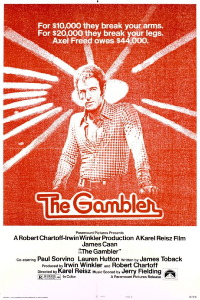
Review of The Gambler (1974) by Paul Z — 05 Mar 2011
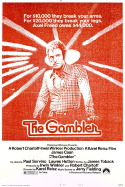
Karel Reisz's The Gambler opens with a problem. Axel's incredulity that anyone could draw so many worthless poker hands uninterruptedly has led him irrevocably $44,000 into debt. He doesn't have it, but it's been a big-time game, and he must find it somewhere or be in profound trouble. The way Axel resolves his dilemma is only somewhat challenging. He sponges the money from his doctor mother.
However then it's time to contend with his real problem, some overpowering urge within him that won't let him repay the money. He needs to lose, to experience threat, to put himself in jeopardy. He needs to gamble away the five figures on even more unpromising bets because in a way it isn't gambling that's his fixation: It's peril itself, borne out of a neurotic will to force his own reality.
"I play in order to lose," he tells his bookie at one point. "That's what gets my juice going. If I only bet on the games I know, I could at least break even." But he doesn't want that. In one scene, he's taken to staking he doesn't have on college basketball games chosen virtually without discrimination from the sports pages.
And yet Axel Freed is not just a gambler, but a dreadfully complex man in his mid-thirties who earns his living as a university literature teacher. He teaches Dostoevsky, William Carlos Williams, Thoreau. But he doesn't give the impression he teaches their works so much as what he extracts from them to substantiate his own fixations. One of the students in his class has Axel worked out so totally that she always has the answer he's looking for, when he asks what a quote means. They're saying, as Axel interprets them, to take chances, to put the self in the line of fire.
The death of the romantic era of heroes seems to preoccupy him. Before modernism's misanthropic upshot, he could've put himself to the test more honestly. His grandfather came to America destitute, fought and killed to prove himself, and still is a man of mammoth vigor at the age of eighty. The old man is reputable now, but the tale of his formative years beguiles Axel, who declaims it lyrically at the eightieth birthday party.
Axel extracts nothing from 1974 to test himself against, though. He has to find his own hazards, to incite and tempt them. And the greatest danger in his life as a gambler is that behind his affable bookies and betting buddies is the pitiless company of the Mafia, the guys who take his bets like him, but if he doesn't pay, there's nothing they can do. "It's out of my hands," his crony Hips makes clear. "A bad gambling debt has got to be taken care of." And that adjoins an further aspect to this James Toback-scripted drama, shot at a time when lead James Caan was fighting his own cocaine addiction, which starts as a study of Axel Freed's personality, expands into the story of his world, and then pays off as a thriller. We become so very held by Axel's troubles and threats that they seem like our own. There's a scene where he sits in the bathtub and listens to the climactic minutes of a basketball game, and another scene where he sits in the bleachers and watches a fixed game while a pair of hired guns look on, and these scenes have a characteristic of tension that Reisz makes all the more genuine because he doesn't colonize the rest of his movie with stock characters.
Axel Freed, as played by Caan, is himself a wholly persuasive personality, and unique. He doesn't have roots in other gambling movies or even from other characters he's played. And the people around him also are individual, distinctive creations. His mother, Jacqueline Brooks, is an experienced, self-supporting person who gives him the money because she fears for his safety, and yet sees that his problem is deeper than gambling. His grandfather, excellently played by Morris Carnovsky, is capable of meaning by his manners why he intrigues Axel so. The assorted bookies and collectors he encounters aren't completely Mafia pigeonholes in the sense that they enforce more in grief than in anger. Only his girlfriend falls short of feeling very authentic. Here's still another display of the failure of contemporary movies to give us fully developed female characters under thirty.
There's a scene in this otherwise very powerful film that has James Caan on screen all by himself for two minutes, locked in a basement room, waiting to meet a Mafia boss who will possibly order his legs broken. In another movie, the scene could've felt too long, too eventless. But Reisz, Caan, and screenwriter James Toback have built the character and the movie so compellingly that the scene is not only effective, but effective two ways: first as tension, and then as character unraveling. As we look into Axel's imprisoned eyes we see a person who is terrified to death and yet obstinately prepared for this moment he has brought down upon himself.
This review of The Gambler (1974) was written by Paul Z on 05 Mar 2011.
The Gambler has generally received positive reviews.
Was this review helpful?