Review of The Fortune Cookie (1966) by Creg L — 18 Mar 2009
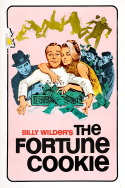
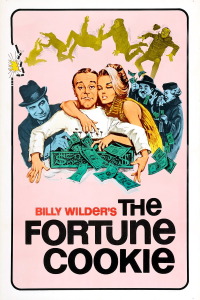
What separates Billy Wilder from the other filmmaking icons of his day is that an actor has a bigger chance of making a goofy face in one of his films than he or she does under the helm of Otto Preminger or William Wyler. In spite of his brazen sense of humor, he could enrapture a broad audience of common filmgoers with suspense or melodrama with a haunting movie like The Lost Weekend, a legal drama like Witness For the Prosecution, a noir like Double Indemnity or an eerie piece of meta-Hollywood like Sunset Boulevard. I believe that, while I've begun to consider him primarily a director of comedies, he learned a great deal from the apparent zeal of said classics. In an unprecedented surprise like The Fortune Cookie, he presents us with a rubber-faced farce, but he takes his time and builds drama and moral dilemma that projects toward us beyond the comfortable arm's-length distance of slapstick. The charm is that these curious instances of eyebrow-curling don't permeate the subsequent laughs with a breach of comic tone. They simply enter and exit on the cues of the story's character arcs.
This extraordinarily entertaining comedy takes its time by building scene by extensive scene. They are even given headings like chapters in a novel. Each scene is like its own self-contained play, beginning with Jack Lemmon's CBS cameraman Henry Hinkle covering a Browns game in Cleveland. Before disaster strikes, setting the scene for the progressing story, Wilder gives tremendous definition to the scene in and of itself, the game, the sportscasting, our protagonist's job and his attitude towards doing it. Such is the manner in which each and every story advance is treated, given whole substantial scenes, as Henry is visited in the hospital by his conniving lawyer brother-in-law "Whiplash Willie" Gingrich, played by a hilarious Walter Matthau in a much-deserved Oscar-winning performance, who convinces him to pretend that his legs have been paralyzed so they can make a killing off the insurance company. Of course, the insurance company suspects that the paralysis is a fake one, and so a cat-and-mouse game begins. The trouble is, Boom Boom, the football player responsible for Henry's hospitalization turns out to be a nice guy. Too nice, in fact. Almost like a samurai, he invests most of his time in taking care of, even pampering, Henry, whose guilt begins to take its toll as he witnesses guilt doing the same to Boom Boom.
Wilder was one of the great "smugglers," as Martin Scorsese would call him. Censors were still breathing down Hollywood's neck to some extent in the 1960s in spite of all the steps forward American movies were beginning to take. Wilder knew how to signify something considerable to the audience without directly telegraphing it, most of the time anyway. What The Fortune Cookie does is impose a bold move in favor of the era's civil rights movement. Boom Boom is black, played by Ron Rich, who was known very little elsewhere save for his performance here. For much of the film, he is overwhelmingly servile, almost saintly, to the white man he injures, and Wilder allows us to become slightly concerned with such a portrayal. Could this film be interpreted as demeaning? we think. However, the way the story proceeds, it is a ballsy storytelling tool that makes Henry's guilt significantly more poignant than it would've been had the character been less conspicuously defined.
This doesn't exactly seem like smuggling, but the trick is that Boom Boom's race is never treated as an issue by Henry or Willie, and thus the character is not dependent on race as a story issue or plot point. Every one of the movie's characters is so richly drawn by the script and cast with foreshadowing, one-liners based in a character's telling of half-truths about themselves, and a definite physicality. Indeed, Lemmon's character is based entirely upon whether or not he will move certainly parts of his body or not before the lawsuit is carried out, yet it's also Matthau who gives Gingrich a hilarious loose-jointed embellishment, a caricature of the sort of shady, get-rich-quick-obsessed uncle. Judi West, a little-known blonde with an appealing physicality of her own who plays Lemmon's ex-wife, lends a certain ambiguity on which Lemmon's teetering moral scales hinge. It's easy to be blinded by curves, even if they belong to someone who's proven distrustful in the past.
The film is special in its then-innovative employment of intercutting television footage, which is a technique that has become common since that is very difficult to do without nearly shattering the visual feel of a movie. Wilder, who doggedly refuses to make the audience conscious that anything exists but the forces within the frame, welds the two together gracefully within the subtly important black-and-white grain of the cinematography. Like the Woody Allen of his day, Billy Wilder had a knack for taking complicated, troublesome dilemmas and tragic social states and handling them smoothly and accessibly. We are sucked in, and whatever Wilder wants to tell us, we trust it, because we enjoy it so much.
This review of The Fortune Cookie (1966) was written by Creg L on 18 Mar 2009.
The Fortune Cookie has generally received positive reviews.
Was this review helpful?