Review of The Flowers of War (2011) by Alex G — 06 Mar 2013
Flowers of War - Effective and well made but has similar flaws that Spielberg and his copycats have - it manipulates it's audience way too much.
I am not really familiar with the details of the Rape of Nanking in the late 1930s. However, people from this side of the globe are very familiar with the suffering brought about by the brutal Japanese Imperial Army throughout Asia. In our country, many movies have shown Japanese brutality during the World War II.
Some people went as far as quoting very low post-massacre rape pregnancy/birth rate (vs. Nazi data) as evidence that the Rape of Nanking didn't happen, oblivious of the fact that the civilian population of Nanking was WIPED out by the Japanese. The women who were raped were then killed, with very few lucky exceptions. Dead women can't confirm pregnancy or give birth. The low post-rape birth number shows the Japanese brutality well-surpassed Nazi's.
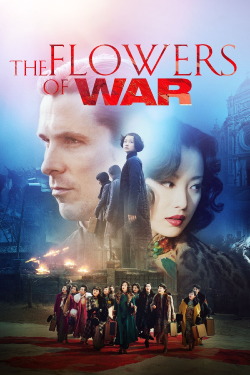
"The Flowers of War" tells the story of a roguish American mortician John Miller (Christian Bale) who was sent to a Catholic church/convent in Nanking to prepare the body of the priest for burial, who was then under siege by the Japanese. When he gets there, he found he also needed to take care of a group of convent girls led by the spirited Shu, a young caretaker boy George, and later, a gaggle of exotic prostitutes led by the classy beauty Yu Mo (Ni Ni). Everyone will go through a touching life-changing story arc that will show how even the most unlikely of people can become heroes in extreme adversity.
My main problem is the fact, that Flowers of War was made by Chinese people. A good depiction of war and dark subject matters should be made by those who can look at certain events with more subtly and leaving the politics and personal feelings out of it. It doesn't mean you have to romanticize and sugarcoat these events but making it into a borderline propaganda film isn't the way you do it.
The Japanese are portrayed as villains and Chinese soldiers are the white knights who are ready to sacrifice everything for their country. Reminds me a lot of Soviet propaganda war films and children history books. I understand that Rape of Nanking is one of the most heinous war- crimes in history, but you need to understand that not every Japanese soldier did those horrible crimes willingly or did them at all.
My other problem is the same which I share with a lot of war films in general. I don't like war films that emphasize on brutal violence too much. I don't think that I need to see scenes of brutal rape, scenes of women being brutally murdered or young girls being killed. I know that war is brutal, but unless it adds anything meaningful to the story, characters or atmosphere, we don't need to see it. It's hard to do a war film properly and very few have succeed - Apocalypse Now, Full Metal Jacket, Platoon, Three Kings and Bridge on River Kwai immediately come to mind.
Unlike most Nanking films, Zhang Yimou's film, based upon the novel by Yan Geling, chooses to focus on what would be a great escape, and a singular primary challenge that everyone had to overcome through sheer wit with death as a possible outcome, that makes the film really moving when it broaches the theme about sacrifice. The director's works are commercial fare and accessible compared to his earlier works, and The Flowers of War prove to be no different in offering a big budgeted tale about one of humankind's darkest period in our history. A recommended must watch, although not in the same vein as "City of Life and Death" which had a more holistic view of the initial days of the Nanking invasion.
Director Zhang Jimou is relentless in the first half we are taken through a continuous barbaric carnage perpetrated by the Japanese soldiers. These parts are reminiscent of the frankly violent blood-spurting "Saving Private Ryan" beach scene. The terror is very palpable.
The second half is more dramatic with some contrived cheesy moments. The character of the kind-hearted Japanese officer Hasegawa was a nice counter-balance to their other heinous acts of atrocity. I also felt the long sequence when a couple of prostitutes sneaking out to retrieve trivial things in their brothel was a rather unnecessary long detour. There will even be a scene that will remind you of Gwyneth Paltrow's body wrap scene in "Shakespeare in Love." However, when the film reaches its climax, everything falls back into place and the noble message is delivered on point. This movie may be difficult to watch because of the scenes of violence, but this is worth watching because the story of heroism and redemption was very good, well-told and well-executed.
Yimou's storytelling is complemented with the stirring performances of a top-notch cast. Christian Bale is perfectly cast, his usual understated but no less powerful acting creating a compelling character in Miller. It also enables him to blend in nicely with the rest of the massive ensemble, despite being the lone Westerner in a cast of Asians. Refusing to monopolise attention on himself or his character, he too strikes up great chemistry with his co-stars Tianyuan and newcomer Ni Ni- the latter of which steals the show with her luminous portrayal of Yu Mo, the pseudo-leader of the courtesans whose radiant beauty masks an equally sharp mind.
Yimou Zhang is a director that's pretty much made a name for himself as a director with his incredible use of color. Hero, House of Flying Daggers, and Curse of the Golden Flower are all lush, vibrant, and just visually brilliant. The Flowers of War is almost completely devoid of color. The battlefield is littered with shades of brown and gray until someone is shot and blood sprays into the air or trickles to the ground. The only real use of color comes in the form of the round stained glass window and the elaborate dresses the prostitutes wear. This adds for some incredible and dynamic shots seeing warfare on their doorstep through a multicolored filter and broken glass. Two prostitutes eventually escape with the intent of returning, but there's this amazing one-take sequence of their attempt of coming back to the church and their colorful dresses play a big part.
Flowers of War is a very flawed war film. I don't really like war films because they often take sides and emphasizes too much on violence, brutality and schmaltzy sentimentalism rather than telling a compelling story with great characters. Is it worth seeing? If you like Spielbergian war films and are big fan of Zhang Yimou or Christian Bale then it's worth a watch. However, if you like war films that are much more complex and offer more in terms of story and character, then I suggest finding another film.
Review Number: 26.
This review of The Flowers of War (2011) was written by Alex G on 06 Mar 2013.
The Flowers of War has generally received positive reviews.
Was this review helpful?