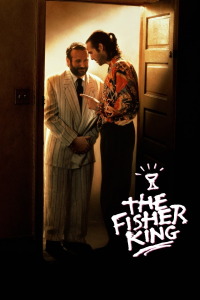
Review of The Fisher King (1991) by Edith N — 27 May 2010
Sometimes, a Little Whimsy Goes Too Far.
There is a genre I think of as "Works That Reward You for Knowing Stuff." These are works which are still entertaining if you come into them empty but which are better if you know something about what's behind the story. Terry Pratchett writes a lot of those--when I met him, I asked him if he did a lot of research or just kind of knew stuff. His answer was "The answer to that would have to be yes." (He has a very cute accent.) What's even more entertaining is that there are a lot of different subjects he rewards you for knowing about, though Shakespeare is easily his favourite. Here, Terry Gilliam is rewarding you for the more obscure bits of Arthurian legend. The title alone should be an indicator of that. The problem here is that the whole thing gets too caught up in its not-Arthurian plot bits.
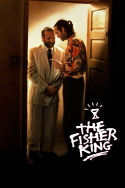
Jack Lucas (Oscar winner Jeff Bridges) is a shock jock. One day, he gets a call from a regular. He rants at the man about how yuppies aren't human and so forth; he is attempting to tell the man not to waste his time trying to attract these women in bars, but what happens instead is that the man goes into a nightclub that night and shoots up the place, killing several people before he kills himself. Jack then slips into depression and self-flagellation for three years. He goes from a fancy penthouse apartment with an artist (Lara Harris) to a one-bedroom apartment above a video store with its owner, Anne Napolitano (Mercedes Ruehl, who won an Oscar for the role). One night, he can't take it anymore, and he stumbles out into the street to throw himself into the river. He's set upon with the intent of being beaten and set on fire, but he's rescued by Parry (Oscar winner Robin Williams). Parry was once Henry Sagan, and then his wife (Lisa Blades) was killed when some lunatic shot up the nightclub they were in.
I would rather that, instead of delving into Parry's pursuit of gawky Lydia Sinclair (Amanda Plummer), the idea of Parcival in Manhattan had been better explored. It felt rather as though there were several movies shoved into one, which is seldom of benefit to any of them. I think Robin Williams could have been fine in any of them, but by making him Parcival in love in Manhattan, it was just an excuse for a Robin Williams Role, which is usually pretty disappointing. He can act; he can act really well. The problem is that the idea of who Robin Williams is was set in about 1978, and it's only been relatively recently that he's been allowed to be anyone else. At that, a Robin Williams-y Parcival roaming Manhattan in search of the Grail could have worked. A romantic comedy about a crazy homeless man wooing an awkward office worker could have been fun. It's just that each detracts from the other.
Part of the issue may have been that Terry Gilliam was trying to make a movie which wasn't a Terry Gilliam Film. There are no past Pythons in the movie. There are few special effects and few fantasy sequences. The scant minutes not set in the Real World are set in the mind of a tortured madman. And since the madman himself is a staple of Terry Gilliam Films, there must be something to this which is not. Ergo, romantic comedy. Of course, the reason Terry Gilliam Films are all like that is that he's very good at it. He is a genius at probing the stranger places of the mind, and to move away from that is to move away from what he does best. I don't always like the content of his films, but I do think there are few other directors so well suited to them even when I don't. The reason Terry Gilliam was so perfect for directing the biopic of Hunter S. Thompson (for a given definition of biopic) is that, well, he's a genius at probing the stranger places of the mind, and Hunter S. Thompson didn't have any other places in his mind.
Another place I'd like to have the romantic comedy plot jettisoned in favour of is the challenge of Jack Lucas. It is all too easy to blame an outside force for the actions of a lunatic. The best of the Bachman books was found in the locker of some kid who shot up his school, and so Stephen King had it taken out of print. In the '50s, comic books were blamed for juvenile delinquency. Today, it's violent video games. Poor Jodie Foster, in one of her best roles, influenced the shooting of a President. While I don't think the people in any of those cases would have been deterred from their actions had they not encountered that specific influence, I can understand Stephen King's discomfort at the finding of that book in that locker. (The book is about a kid who takes his English class hostage and forces them to confront themselves.) He knows about the comic book scare; he's a fan of EC himself. At the same time, though, he's going to have to live with that all his life. And his impact was nowhere near as direct as that of Jack Lucas. That's more interesting than watching Amanda Plummer (no Oscars or nominations) drop her dumplings.
This review of The Fisher King (1991) was written by Edith N on 27 May 2010.
The Fisher King has generally received very positive reviews.
Was this review helpful?