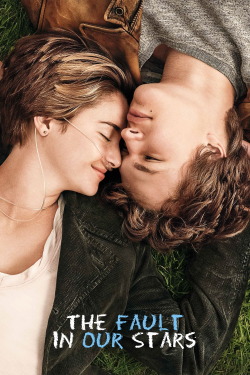
Review of The Fault in Our Stars (2014) by Nightreviews — 05 Jun 2014
I have never been surrounded by so many teenage girls before until I sat down to watch this film. During an early screening of the alluring teenage film adaptation of John Green’s novel The Fault In Our Stars, I was surely the minority of the sexes. To be honest, I don’t think I knew exactly how outnumbered I was until the film’s tragic scenes unfolded, delivering a current of waterworks and overwhelmingly loud wails of screaming, crying and sniffling, predominantly from female audience members. This early screening of the film was jam-packed, and had me sitting only a row away from the massive screen. If Josh Boone’s film adaptation of The Fault In Our Stars taught me anything, it’s to never underestimate the power of teenage girls and their ability to pack theaters and show their support for films and books they love.
The Fault In Our Stars is guilty of possessing a number of faults, but its biggest sin lies in its persistence to aspire to be greater than it actually is. It succeeds when it exposes us to the tragic relationship between its protagonists and the loved ones around them, and fails when it aspires to find new territory of plot and redemption for characters that are already born with unlimited amounts of pathos.
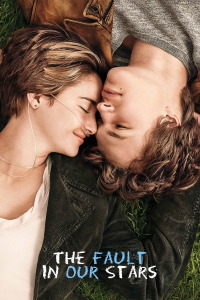
Hazel Grace Lancaster (Shailene Woodley) is as much a teenage girl as any other living in the United States. Her love of reality television, reading and curiosity of the taboo is just as strong as other girls within America. The only difference: Hazel Grace has terminal cancer. The Fault In Our Stars should be a film about cancer and how it effects the people surrounded by it (think 50/50), but it becomes overwhelming with its fascination to overly glamorize the telling of a tainted love story, therefore becoming a love story about people with cancer (think A Walk To Remember).
From the beginning, love, life and happiness are overshadowed by impending doom, and that is perhaps the problem with the film. No matter how much you fall in love with Hazel Grace or Augustus Waters (Ansel Elgort), their fates are sealed. Green’s novel may have been about telling a heart-breaking love story between young teens, but much like Hazel’s fascination with her favourite book and the open endedness of a certain literary character, Hazel’s happiness is less about coming to terms with death, and more about the continuation of the life of her loved ones. The interactions with the people who will survive and live well beyond Hazel’s existence are never given their due diligence on-screen, especially her mother (played delicately by Laura Dern), always being pushed aside by the love story that will ultimately end in unhappiness and tears.
There is sure to be a reason why Green’s novel has becomes such a pop culture sensation. The film is said to be a somewhat loyal adaptation, brimming with very clever metaphors of life and death through dialogue and foreshadowing. It does a masterful job of **** the most average looking parks, backyards and parking lots, and makes great use of its supporting actors. Sadly, the two actors that have the most screen time are the two weakest components of the film. Woodley, who is slowly following in the footsteps of Emma Stone and Jennifer Lawrence, seems to play Hazel Grace less, and herself more. With the exception of her chopping off her hair and having an oxygen tank follow her around everywhere she goes, Woodley only taps the surface of her character Hazel Grace, barely gracing audiences with the brilliance radiating with the promise of such a philosophically pessimistic character.
Elgort, who comes off as a character who is easy to fall in love with, shows much of his charm and promise as a young actor. Elgort as Waters shimmers with potential, delivering a performance of a person who may be a little too cherry and perfect, given sad circumstances.
Green had said to gain the inspiration of the novel by working as a student chaplain at a children’s hospital. Drawn to the exuberant life of its terminally ill patients, Green is quoted as saying he wanted to write a book about people who were constantly being dehumanized, while showcasing the abundance of humanity in people with a terminal illness. The film does an excellent job of making audiences believe that love is what keeps Hazel and Augustus alive. Love becomes the answer, but only for so long before the inevitability of death at the end of a terminal illness takes hold. There is a point where love exists, and people fade in the film, and although the relationships that held strong are bonded by love, hope of an improbably oblivion becomes the films main concern.
The Fault In Our Stars can be self-assured as being a quality film made for an audience that would be content with half-assed filmmaking. The production quality and storytelling is top-notch, even if its is constantly emotionally manipulating.
This review of The Fault in Our Stars (2014) was written by Nightreviews on 05 Jun 2014.
The Fault in Our Stars has generally received very positive reviews.
Was this review helpful?