Review of The Fabulous Baker Boys (1989) by Blake P — 13 Mar 2016
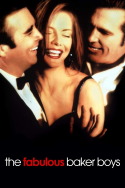
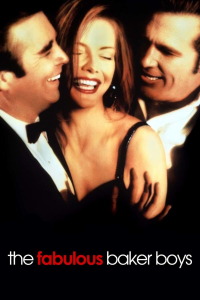
Michelle Pfeiffer could have made it as a major actress in any era. Her appeal is something that only seems to strengthen with each passing year, her sublime persona the kind that we yearn for years decades when we're in a hole of believing that real movie stars don't exist anymore. To look, to listen to her, is to become a victim of her magnetism. While she carries the appearance of an angel, her sinewy figure enough to keep you engrossed for a cinematic century, she also has the delivery to match, linguistic zing and physical self-possession providing her with enchanting intelligence. She knows that you're looking at her, enticed by her mystique, but she's also unfazed by the attention; she'll prove herself before she'll ever try to ensnare your affection.
Which is why I believe Pfeiffer has remained such a beloved sex symbol ever since she solidified her place among her generation's best actresses with 1988's "The Fabulous Baker Boys." Like Rita Hayworth and Sophia Loren, she's sexy in an unaware sort of way, knowing full well that she could knock a man dead just by looking at him but maybe not so adept at sensing that our preoccupation never really stops.
"The Fabulous Baker Boys" is the type of film more famous because it made a star - just look at what "To Have and Have Not" did to Lauren Bacall, what "Body Heat" did to Kathleen Turner - but don't be fooled by its legend central reputation. Though Pfeiffer is certifiably irresistible, it is a show biz drama of real wit and tangible emotion, a vehicle as good as its leading actors.
Pfeiffer is its centerpiece, but not its star - the stars would be Beau and Jeff Bridges, brothers playing brothers with a rivalry we'd like to think of as being autobiographical. In the film, they are Frank and Jack Baker, a piano playing musical duo who has survived on the same cabaret act for fifteen years. On a mostly unchanging nightclub circuit for the entirety of their adult lives, their dueling piano gimmick has slowly but surely lost its edge, their venues dropping in size, their money dwindling. As the film opens, they've hit an all-time low, and doom seems to be waiting in the wings.
But Frank, always the more enthusiastic of the two, decides it might be wise to add a lady singer to the mix - while it's easy for audiences to ignore background instrumentals, it's next to impossible to resist the wiles of a torchy crooner. Jack, albeit reluctantly, agrees, and they hold auditions that prove to be almightily disastrous. Thirty-some singers come by to showcase their worth, but not one of them can carry a tune.
That all changes when the disheveled Susie Diamond (Pfeiffer) stumbles onto the scene, almost two hours late and catching the brothers after they've all but decided to give up. Frank isn't impressed by her lack of timeliness, but Jack is intrigued - they let her perform a number, and, what do you know? She can sing. She's hired on the spot, and soon after does the brotherly act start to really take off. Venues begin to increase in size and in class. But the toned-down rift between the Bakers starts to inflame when an attraction between Susie and Jack becomes apparent.
"The Fabulous Baker Boys" is a compelling spin on the family-in-show-business storyline, taking the conventions of what we've come to know (singer causes turmoil within the act, act temporarily breaks up, act works things out and gets back together) and stirring in the necessarily freshness required for material of familiarity. First time writer/director Steve Kloves prefers snappy lines and melancholic truth to stock dialogue and sentimentality, and the stars, at their respective pinnacles, don't play types as much as they embody people we almost immediately understand.
And that's ultimately what makes "The Fabulous Baker Boys" the perceptively entertaining film that it is - it dramatically relies on a trio of characters and has the good sense to take the time to get to know them and to allow us to sympathize with them before throwing shattering hardships at them. The relationship between its fictional Bakers is the sort few show biz movies fail to characterize; where most opt for two-peas-in-a-pod harmony, an animosity exists that doesn't come as all too surprising. Jack is the more talented, the more handsome, but is also the more vulnerable; Frank, a family man with a wife and kids, deals with expenses and gigs but resents his brother's charisma and deficient appreciation. So of course Susie, who has acted as a high-class escort for most of her career, naturally broadens the tension between the men who hired her.
We'd like to think that the Bridges' mirror in their resentment of one another, and that's why "The Fabulous Baker Boys" is so effective. It creates discernible relationships with issues more complex than just romance, than just self-doubt, and so we come to decipher its characters before we necessarily like them (though we do like them an awful lot). The Bridges' are dependably excellent, fleshing out a relationship unlike their own as if it were like theirs, and Pfeiffer, as gushed over before, is superb; seeing her croon "Making Whoopee" atop Jack's piano dressed in a slinky red velvet dress is what movies are made for.
And maybe "The Fabulous Baker Boys" was made for Michelle Pfeiffer - the screenplay's marvelous, but would it bear the same corporeal energy without her? Hardly; she's the cherry at the top of a celluloid sundae that makes it more than just a great film. See her here and you'll want to see her in every movie.
This review of The Fabulous Baker Boys (1989) was written by Blake P on 13 Mar 2016.
The Fabulous Baker Boys has generally received positive reviews.
Was this review helpful?