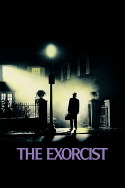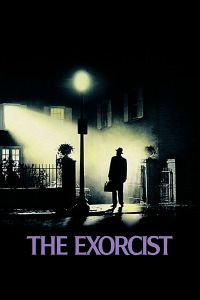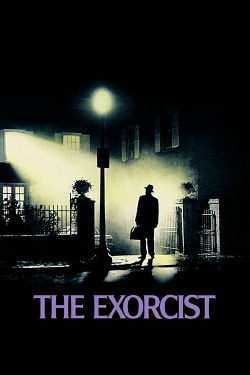
Review of The Exorcist (1973) by Blake P — 03 Dec 2015
Horror movies are better when they play beach volleyball with our emotional capacity, and "The Exorcist," one of the best of its kind, is a visceral experience, to say the least. It is horrifying, disturbing, and ugly, but it is also insightful, smart, and as realistic a film as supernatural as one like this can be. It details, based on the title alone, an exorcism, but it is unique in that is (1) among the first in its subgenre, and (2) a great deal more careful in examining the emotional toll the traumatic sequence of events has on those involved. Arguably, it is more impactful post-viewing, when we're lying in bed at midnights, alone with our thoughts - it is as though we were there, trapped in 1973, acting as a part of the group of people touched by the possession of Linda Blair's Regan. It grabs us, becomes a part of us, with more doggedness that we're comfortable to admit.
The film is an adaptation of William Peter Blatty's huge-for-its-time 1971 novel of the same name, which was, in turn, inspired by the real-life exorcism of Roland Doe, a 1940s farm boy whose name has still not been released to the public. It is the stuff of nightmares, sinister, shaking, and jarringly authentic.
Over the years, film has taught us to be afraid of crazed killers and criminals, but rarely do our fears come directly from the uncharted territories of Heaven and Hell, which, no matter your religion, are frightening places the more you consider them. While we have the ability to maintain some sort of control of monsters that roam the streets, we don't have a direct upper-hand to God or the Devil - I dare you to toy with a Ouija board after viewing "The Exorcist" and see if you'd rather play it safe than tease an embodied evil.
The evil portrayed in "The Exorcist," unapproachable, unknowable, is scarier than contrasting controlled doers of violence in the Michael Myers sense. With the latter, you at least can see the malevolence in front of you. But in "The Exorcist," the menace can slip through cracks in the floor, through doorways - you never know where it is, until it's too late. This "evil" is a demonic entity that decides to possess the body of loving 12-year-old Regan MacNeil, the daughter of a movie star (Ellen Burstyn) whose sweet personality is frighteningly overtaken by bizarre and sick-minded behavior after a few weeks of production.
It is the result of the using of a Ouija board, but the film mentions the action with nonchalant reverence that makes its tonal qualities all the more gritty. Immediately, Regan's mother, Chris, is able to tell that something is seriously wrong with her daughter, whether it be psychological or something ... else. Regular visits to the doctor coincide, tests performed left and right. It isn't until almost the last act of "The Exorcist" that it is decided that Regan may actually be possessed, and that no medical help will be able to change her condition.
Willing to do anything to return back to the normal life they once held in their hands, Chris calls upon Father Damien Karras (Jason Miller), a local priest who is still suffering from the aftermath of his mother's death. Karras is skeptical (perhaps an act, as no one in their right mind is necessarily willing to perform exorcisms for a living), but after seeing Regan for himself, he is drawn to the case and invites the older Father Merrin (Max Von Sydow) to aid him in his performance. Neither, however, realize the emotional and psychical fee it will pound upon them.
In terms of story, "The Exorcist" is largely conventional, playing like a typical Hollywood drama until things get heavier and heavier and we begin to understand that something is distinctly off-center. So many horror movies keep tension ringing in our ears long before the horror even lets itself be known, tonally establishing itself as a genre film. But no such flairs are given to "The Exorcist" - it feels like an event being broadcast throughout the world at the wrong time, a dark corner we would rather ignore than live through. That's one of the reasons it maintains to be such a terrifying film: it reminds us over and over that demonic possession could happen to any of us, no matter if our mother is a famous actress or a homebody. There's something universal in that fear.
Friedkin's no-holds-barred dedication to making "The Exorcist" as detailed as possible is astonishing. It's no wonder Friedkin was so forceful in his vision that antagonizing the cast was not off limits. Look at how closely he watches Chris's emotional deterioration, how he never for a second lets us forget that Regan is possessed, not a demon herself, how he establishes Karras as a damaged soul to heighten his character to three-dimensional levels normally absent in films like this one. Scenes are as readily able to take their time as they are ready to spit in our face - despite its supernatural face, nothing about it feels fictional.
This is in part to Dick Smith's special effects (extraordinary considering the limitations of the mid-1970s) and to the performances of the cast. Regan's possession sends a believable shiver down the spine both due to Smith's subtle and eventually horrifying account of her disintegration and to Blair's masterfully nuanced performance that travels from zero to sixty without the least bit of camp. The vocal work done by veteran actress Mercedes McCambridge (as the demon himself) is particularly scary. Burstyn develops herself as a wonderful mother in the film's pre-stages, her dedication to do anything to get her daughter back all the more harrowing; Miller is vulnerable and sympathetic as the priest fighting demons of his own.
So while "The Exorcist" is excellent, I still have inhibitions toward its many fans who claim it to be the scariest movie ever made. In truth, it's a matter of preference - I like my horror to be nonsensical and nightmarish, whereas "The Exorcist," while grabbing onto attributes of the latter characteristic, has a beginning, middle, and end, and therefore eliminates the prospects of letting the mind wander into darker territories following its conclusion. Even then, don't be surprised if you still find yourself grappling with what you just saw days, months, years, later.
This review of The Exorcist (1973) was written by Blake P on 03 Dec 2015.
The Exorcist has generally received very positive reviews.
Was this review helpful?