Review of The End of Poverty? (2008) by Gina W — 25 Apr 2010
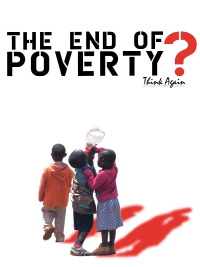
The End of Poverty?
1 Disc Widescreen Edition.
"The End of Poverty" is narrated by Martin Sheen and written and directed by Philippe Diaz. This documentary explores the reality where so many people have to live on less than $1.00 per day and entire families live in a single room. The focus is on military conquest, slavery, and colonization that created the class system of situations where the top 1% might make 400x as much as the bottom 1%. This film was chosen as an Official Selection at over 25 International Film Festivals and was an Official Selection Critics' Wee at the Cannes Film Festival.
With all the facts and history, this would be a valuable classroom resource for history, economics, government, or any type of cultural studies. The legacy of colonialism has left poor countries performing the labor and collecting natural resources for richer companies to benefit from. One example was that Germany being the largest exporter of coffee but no coffee is actually grown there. Along with economic exploitation, religion and missionaries came to convert the indigenous people, making them lose some of their culture and the combination of all this resulted in the people being slaves and constantly indebted to their employers. Even today, these people work for less than $1.00 a day. Racial and cultural prejudices were developed and taught and these people were made to believe themselves to be objects not worthy of equal treatment.
These original cultures believed in communal property until the colonists introduced the idea of individualism and commodity. Capitalism developed in these other countries and a focus on private property. Even now the atrocities being committed by U.S. companies coming over to countries like Kenya and building a dam that overflows and wipes out people's homes and sprays crops and people working in the fields making them very sick is a horrifying reality. The people who live in the land end up gaining nothing from it as the crops are not sold there but flown back to the U.S. with the help of some corrupt local government officials. Even these government officials almost cannot help themselves because the CIA would offer money or removal from office or assassination for their cooperation.
Numerous facts and figures are shown on the screen that make your head spin but sadly are not that hard to believe. The interviews with the affected people are very depressing. There are almost twice as many people suffering from malnutrition as there were in 1970. The most shocking is that the money the rich have hidden offshore is around 11 Trillion US Dollars and if it were taxed modestly at 30%, there would be a huge amount of money each year that could go towards fixing this poverty problem.
The most ironic part is that the United States was once a European colony itself and apparently learned too well to emulate the practices and improve upon them on other countries instead of learning the lesson to treat others as you wish to be treated. Twenty percent of the population uses eighty percent of its resources, thirty percent more than the planet can regenerate. What can we do about it? Well, awareness can be raised by viewing this film and teaching it to your students and families.
Unfortunately, it also FEELS like a classroom resource and is shot in a boring way and hits us over the head with depressing fact after fact with the only plea to end privatization.
DVD Extras:
The features include more information that did not fit within the documentary. There is a feature on the largest slum in East Africa where HIV rates affect 70% of the population. The Stawi Youth & Adult Centre in Kibera, Kenya takes care of many sick people and teaches them about HIV.
There are extended interviews on the DVD that give a great deal more information. Also there are resources and transcript that can be downloaded when inserted into a DVD-Rom.
The extended interviews and topics include:
Mason Gaffney - the flow of money and resources.
Joshua Farley - the distribution of land.
Heather Remoff - monoculture exploitation.
H.W.O. Okoth-Ogendo - private property.
Each of the interviews above ranges from about 5-15 minutes. Finally Philippe Diaz, the writer and director submits to an interview himself in November of 2009. He talks about how he came around to making this movie and comparing the reaction of the film to different people around the world. His interview segment finishes up around 50 minutes! All these extras are very informative and would do well if you are preparing a class.
There is also a book that can be purchased separately called Why Global Poverty: A Companion Guide to the Film "The End of Poverty?" available on Amazon.
This review of The End of Poverty? (2008) was written by Gina W on 25 Apr 2010.
The End of Poverty? has generally received very positive reviews.
Was this review helpful?