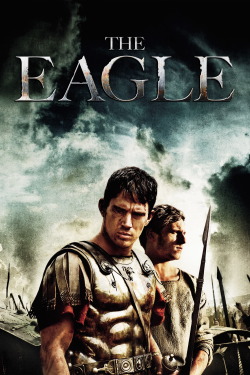
Review of The Eagle (2011) by Shiira — 20 Feb 2011
No mincing of words, this slave, who tells the Roman centurion in second century terms that he doesn't want to be friends. No uttering of thanks is coming forth from the northern tribesman, this Caledonian lad, only vitriol, which has been compounding itself over the intervening years with new each new increment of loss life at the hands of his people's long-standing enemy, "The Empire".
"I hate everything you stand for but I must serve you," Esra(Jaime Bell) begrudgingly tells Marcus(Channing Tatum), the day after the Roman saves the slave's life in the amphitheater, where the centurion prevents a one-sided gladiator match from taking place.
Possessing the power to determine life and death, Marcus gives the thumbs up sign, swaying the other spectators to do the same, therefore sparing Esra from being hacked to pieces by an executioner-sized man swinging an executioner-sized axe.
It's the young boy's lucky day: a pacifist Roman? Was there such a thing? No. This is an anachronism. The Romans were as bloodthirsty as they come, an unconscionable bunch. "You have stolen our lands, killed our sons, and defiled our daughters," shouts the spokesman of an angry mob, who hold Marcus' patrol hostage, and instigates a fight in which we gravitate toward the centurion, and root for his survival, even though we know the Celtics have a right to their rage.
The politics in "The Eagle" is tricky; it's pro-Imperialism. These Roman soldiers were depraved and incorrigible, responsible for countless crimes against humanity, and yet the filmmaker has the audience backing up this omnipotent regime in their attempt to signify their imperialism by capturing the legion's eagle standard back from the Seal People, a Pictish tribe up north.
Against the backdrop of an unofficial holocaust, "The Eagle" has the gall to concern itself with Marcus' angst, the shame he inherits from his militaristic father, who twenty years earlier, lost a campaign against the Seal People, in which the Legio IX Hispana(Ninth Spanish Legion) and its gilded bird went missing.
"The Eagle", based on the 1954 historical adventure novel "The Eagle of the Ninth" by Rosemary Sutcliff, is a throwback to that unenlightened era, whose denizens still subscribed to the manifest destiny principle, as it was reflected in its racist westerns, where Indians were slaughtered wholesale by cowboys without the moviegoer ever batting an eye.
In Esra, the film has in its employ a morally compromised character to fulfill the retrogressive ideology of the movie. At the killing grounds, where the elder Aquila's legion was slaughtered, we're supposed to be horrified by the brutality enacted by the tribesmen, who, according to Guern(Mark Strong), a legionnaire survivor, had "hacked the feet off the dead so they couldn't walk in the afterlife.
" His words strongly recall those of Ethan Edwards(John Wayne) from John Ford's "The Searchers", a rhetoric that forces the moviegoer to associate the racism of the cowboy with the Scottish rebels, which positions the Romans as Indians, the victims of a despicable act, and the Pictish tribes as cowboys, the cold-blooded killers.
Although the slave is prejudicial toward the Roman Empire, whose waves of marauding armies had decimated so many families like his own, the orphan joins forces with Marcus, adopting and internalizing the centurion's quest for familial redemption, and the moviegoer is supposed to accept this unilateral shift in loyalty as a byproduct of the deepening friendship between the two disparate men.
That's because "The Eagle" merely tells us about the violence that the Romans practiced on the the wild Brits, whereas the film shows us Roman skulls, Roman bones, which has a visceral impact on Esra, we assume, since it has a visceral impact on us.
Rome ends up looking like the victim. "The Eagle", in actuality, a western dressed in a historical epic's clothing, reimagines a "Dances with Wolves" that dances with hunters, where the Indian lives in isolation among the American soldiers and participates in the genocide of its own people.
In a nutshell, that's what Esra does when he befriends Marcus. Marcus is like Dunbar, the union soldier played by Kevin Costner, in which the centurion has the same innate kindness and humanity, but here, these benevolent attributes are in service of the colonizing faction.
"The Eagle" sides with the empire by overemphasizing the barbarity of the indigenous people(just like an old western), most emphatically, when the Seal father slits the throat of his young son after he allows the prisoners to escape.
This indescribably cruel act gives Esra the impetus to remain with his natural born enemy. By becoming a Roman, he'll become civilized.
This review of The Eagle (2011) was written by Shiira on 20 Feb 2011.
The Eagle has generally received mixed reviews.
Was this review helpful?