Review of The Docks of New York (1928) by Edith N — 22 Sep 2010
In the Part of New York We Pretend Doesn't Exist.
I have just finished reading an excellent book about the Great Heat Wave of 1896, an event I hadn't realized existed before. It's one of those books of very specialized information which turns out to be interesting beyond its own field. It entwines the stories of the city, Theodore Roosevelt, and William Jennings Bryan during a wave of excruciating heat which killed hundreds. (Why, yes, the author was a [i]Daily Show[/i] guest!) At any rate, a large part of the book talks about the slums, the tenements. Some people of higher means died, but most of the people were poor, many immigrants or the children of immigrants. Many of them were men who just couldn't take the time off their jobs, mostly involving physical labour, to escape the heat. This was even true of a handful of policemen. The heatwave vanished from public consciousness pretty quickly, but the characters in this story would have been among those who suffered most from it.
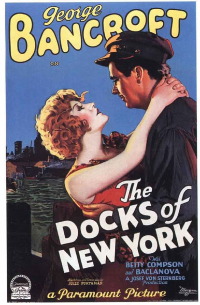
Bill Roberts (George Bancroft) is a stoker--he feeds the boiler on a ship. For reasons I don't remember, his much-anticipated leave is cut down to one night. Even beyond that, his captain tells his men that they'd better not come back drunk. So naturally, Bill goes right to a seedy waterfront bar. On his way there, he sees Mae (Betty Compson) jump into the river. He fishes her out and lectures her about the follies of suicide. He steals fine clothing from a pawnshop for her. He takes her along with him to the seedy bar. They drink together. They wallow in self-pity. Each scoffs at the idea that anyone would be willing to marry them. So naturally, Bill suggests that they get married. They call Hymn Book Harry (Gustav von Seyffertitz), a local dockside do-gooder, who agrees to marry them on the proviso that they get a license in the morning. Only most of the people they know are pretty convinced Bill won't be sticking around.
I've seen a couple of films by Joseph von Sternberg, and he seems a pretty talented director. I know he got at least one good performance, and probably more, out of Marlene Dietrich. (I haven't actually seen [i]Morocco[/i] yet, among others.) It strikes me that he was one of those directors who got where film could go before it really went there. These are not the kind of overblown, facially exaggerated performances you get in many films of the era. Though, of course, this was released the year after [i]The Jazz Singer[/i], and the rise of sound brought about a lot of changes in a few short years. However, it's argued that the true artform of the silent film was just coming into its own when sound films took over. Given what I've seen of the man's work, I think von Sternberg was one of those visionaries who realized that acting for the stage and acting for the screen were not the same thing, giving rise to a new naturalism.
Of course, it's also essential that these two be pathetic figures. Mae really doesn't have anything left to live for, if you think about it. It's never said, but I'm quite sure she's a prostitute, and she is awfully fast to marry Bill and go home with him. To be fair, there are times when you just need someone, anyone, and that's the person you get. Sometimes it works; sometimes it doesn't. There's no knowing how things will go for Bill and Mae, but the film does strongly imply that there's not much further down Mae can go. She's probably a drunk. He definitely is. He's the sort of person who would throw a punch at his boss--and rob a pawnshop to get clothes for a woman he'd just pulled out of the river. She's the kind of person who'd throw herself into the river. One of her friends at one point wishes Mae better luck than she herself had--but she also says she doesn't think Mae will get it. It's a message picture, really, and the possibly doomed romance is just one more degradation.
What I find curious is that Hymn Book Harry seems so disapproving of the marriage. On the other hand, there's the fact that only Bill and Mae seem to be taking the whole thing even approaching seriously. Sure, they've just met, but they've also found their soulmates, if you acknowledge that their souls are as bleak and empty as characters in a [i]Funky Winkerbean[/i] strip. And getting married is better than living in sin. I suppose it's his certainty that the marriage won't last, a not unreasonable assumption on his part. It's also the fact that, yes, the rest of the people in the bar are treating it as a riotous joke. And, after all, it's a wedding in a bar. Lou (Olga Baclanova, who would go on to be in [i]Freaks[/i]), the one who wishes Mae what luck is possible, ends up taking it seriously once she realizes that Mae is. I think Harry does, too, but he still isn't happy about doing so. I'm not sure von Sternberg is, either.
This review of The Docks of New York (1928) was written by Edith N on 22 Sep 2010.
The Docks of New York has generally received very positive reviews.
Was this review helpful?