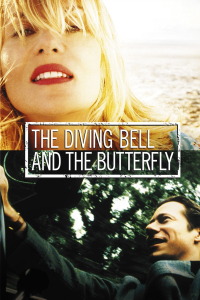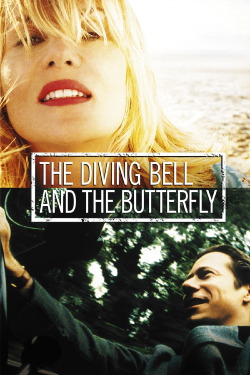
Review of The Diving Bell and the Butterfly (2007) by Edith N — 30 Mar 2011
The Slow Progression Into the Darkness.
I suppose it could have been worse. I mean, at least they knew he was in there; at least he could communicate with the outside world at all. The idea of being trapped inside your own mind, being unable to communicate at all, is a terrifying one to me. I have serious issues with feeling invisible as it is. Being unable to communicate at all? Various people in the movie respond to a person who can't move, can't talk, as furniture. I suppose it's part of what drives the idea of facilitated communication--it's a horror everyone has, I think. It's worse if you think it's someone you love. You want to believe that there's a way. And, of course, you want to believe that there's someone in there, because it may well be worse to know that the person you love doesn't even know you're there. And to be honest, knowledge of facilitated communication steals a little of the film's emotional impact for me. Was it really him?
Jean-Dominique Bauby (Mathieu Amalric) has had a stroke. It leaves him with "locked-in syndrome," a disorder wherein the person is completely conscious and aware of their surroundings but essentially unable to move. Jean-Do, as he's called, is able to blink--but his right eye isn't producing tears and so is sewn closed, leaving his only real functioning body part his left eyelid. It appears that his autonomic systems worked, but the only way they were able to communicate with Jean-Do was through that eyelid. The system they work out is that people trying to understand him slowly recite the alphabet in order of frequency (in French, of course), waiting for him to blink when they reached the next letter. Which rather makes one hope everyone concerned is a good speller. But slowly, he manages to dictate a book about his experience. Those he loves come in and out of his life, too, and we see into his memories, which do work.
I have to be honest; the filming style here doesn't really work for me when we're seeing things through Jean-Do's eye. I understand why it looks that way, but it feels as though director Julian Schnabel is a little enamoured of "exciting" camera angles and swoopy shots. Even when we aren't seeing the world through his perspective, the camera is seldom stable. For a certain kind of filmmaker, it seems, stationary cameras are a tool of The Man. You can get some creative film work out of this technique, but used too much, it just gets tiresome. Some of the most poignant shots so far as I am concerned are long, still shots of Jean-Do sitting in his wheelchair on a platform with the waves rolling in. Though in retrospect, part of the poignancy may well come from the knowledge that he would not be able to call for help if he needed it. His needs rely on having someone there to see that blinking eyelid. There's something pleasing about the images of stillness, but beneath that, there is the awareness that there are no others.
It was difficult in places for me to tell if something was happening for real or in Jean-Do's imagination, which I suppose was the point. There was the brief moment of "Hey, that's Lenny Kravitz!" At the time, though, I had no idea who Jean-Do actually was. Clearly, he was someone with money, but it was that moment which made me aware that he was someone in the art world. (He was the editor of [i]Elle[/i], which I only know from looking it up.) We're shown a discussion with his father (Max Von Sydow!) about a book contract Jean-Do has to rewrite [i]The Count of Monte Cristo[/i]; instead, the book contract is fulfilled by the book which became the movie we were watching. There was some guy who was a hostage in Beirut whose name I never quite got, and I'm still not sure whether this was a real guy or not. And so forth. It is, in short, as much a stream-of-consciousness movie as you'd expect, given the circumstances.
It is, however, a very moving stream-of-consciousness movie. It follows enough of a plot so that you can feel a connection to anyone, which is where many movies of this sort lose my interest. If Jean-Do were just a situation, it would be horribly depressing, but it wouldn't be [i]moving[/i], which is of course different. You see, for example, that the guys who come in to install the phone go from thinking he's just asleep or deaf or both to treating him like furniture in about two sentences. One of Jean-Do's friends, whose name I also missed, starts to communicate with him the way the speech therapist (Claude, I believe, played by Anne Cosigny) has taught him, but he forgets that he must pay strict attention to Jean-Do's eyelid while he does so. He also shows a distinct lack of tact, mentioning that people assume Jean-Do is a vegetable (in French, it is [i]legume[/i]). In short, even though Jean-Do's thoughts are roaming, they stay on an even enough track to keep every important character as a character, not a string of mannerisms.
This review of The Diving Bell and the Butterfly (2007) was written by Edith N on 30 Mar 2011.
The Diving Bell and the Butterfly has generally received very positive reviews.
Was this review helpful?