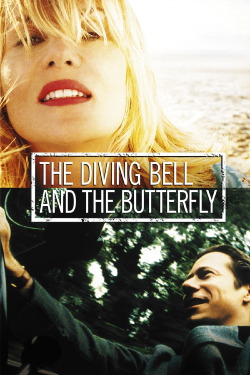
Review of The Diving Bell and the Butterfly (2007) by Josh S — 06 Sep 2010
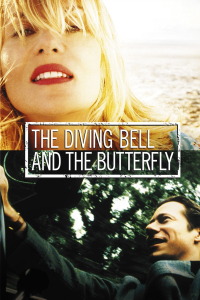
Certain painter-directors really know how to strut their stuff. David Lynch comes to mind, but Julian Schnabel really puts forth a masterful effort with the uplifting story about a man trapped in his own body. Not many films successfully embody a character, and this film is a literal cathartic experience, right from the opening frames.
Based on the autobiography written by Jean-Dominique Bauby, the film details the hospital stay endured by Bauby after a stroke leaves him completely paralyzed and unable to communicate verbally. Afflicted with what the doctors call "locked-in" syndrome, Bauby can only blink his left eye. At first suicidal and morose, Bauby then grows an inner heart and stops pitying himself when he realizes the help he is receiving from his gentle and caring therapists who teach him how to communicate despite being trapped. Using a means of communication based on the more frequently used letters of the alphabet, Bauby blinks his words to people and eventually puts his handicap to important use.
It's like what they say about a person who is afflicted by blindness or deafness, the other senses seem to make up for the lost one. Although Bauby does not possess 99% of his faculties, he even tells us that he still has his imagination. And what an imagination it is. His voice speaks in a poetic prose as he internally narrates his thoughts. However, we are the only ones hearing his voice. Although we get to hear Bauby's real voice inside his head, the therapists, Bauby's family and his father all get to associate with him on a whole different level, and this is masterfully done.
The performances are top notch as Mathieu Almaric wears the mask of a stroke victim for a vast majority of the film. He possesses his human faculties only through certain flashbacks and some fantasies that he uses to either explain his viewpoints on certain things or express his means of escape from his situation. His narration is highly emotional as he talks to us/himself expressing impatience, sadness, anger and even humor. It is a truly cathartic experience. Supporting are the supporting roles of his family and doctors. Emanuelle Seigner plays the mother of Bauby's children, and despite their shady relationship, a loving air is seen in all of their scenes together. Also involved is Quebec actress Marie-Josee Croze who plays Bauby's communication therapist. Her almost loving personality towards Bauby garners a lot of sympathy on both actors' parts. It is not a romantic relationship in the least, yet her smile is that of someone who has so much hope in life. The third woman involved is the author played by Anne Consigny, who acts as Bauby's voice as she takes down his thoughts and puts them on paper to publish what eventually would become "The Diving Bell and the Butterfly." One of the more emotional aspects of the story revolves around the relationship between Bauby and his 92 year old father, who cannot visit him due to his old age. Trapped inside his apartment, their exchanges are highly emotional and meaningful as they are both limited in their communication, try speaking to someone who cannot respond via telephone.
The camera work is very well done as it is mostly POV shots that wander to and fro all over the room. These movements indicate Bauby's wandering eye and give constant motion to what would have been an otherwise boring film. The rest are painterly landscapes that accentuate a beauty that is sometimes unseen by those who wander aimlessly through life without any limitations at all. Through the lens, we see what Bauby sees, and we should not be taking it for granted. He also fixes his gaze upon arms and legs. At first, it seems like he is just a perverted man, yet once you see that there is always a movable limb in these close-up shots, you can almost feel a sense of envy in Bauby's gaze. Even his glances at women's necklines give us more to look at than mere cleavage, there are nametags, crosses and other important things that are highly relevant to the plot.
Someone wrote that this film is a "resurfacing of cinema" and indeed it is a real experience.
This review of The Diving Bell and the Butterfly (2007) was written by Josh S on 06 Sep 2010.
The Diving Bell and the Butterfly has generally received very positive reviews.
Was this review helpful?