Review of The Dish (2000) by Edith N — 25 Jan 2010
No, Really--Worldwide Effort.
One of the arguments, though hardly the strongest, against the concept of Apollo's having been a hoax is the sheer number of people involved. People arguing for the hoax clearly don't know how many there were. Estimates, in fact, range up to 400,000, many from countries other than the United States, and that's not including all the amateur astronomers who tracked the missions from the ground. Indeed, as is shown at one point in the movie--in, admittedly, a moment which never actually happened--basically what you could do to find the Apollo capsule by radio was point at the Moon. That was what it took, and many people here on Earth did just that. There were also people in little non-NASA installations all over the world who helped in some small, unacknowledged way, names lost to history but each, in their own way, vital to one of humanity's greatest achievements to date. Every character in this movie was important to its universe's Apollo 11, and their real-world counterparts were important to ours. Worth keeping in mind, really.
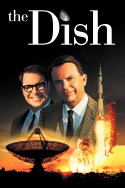
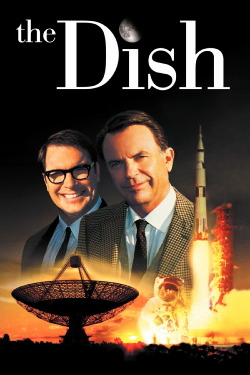
Because of various orbital mechanics, of course half the Earth is pointed away from the Moon at any one time. In this particular case, that also means that the United States can't track their space missions without the help of others, specifically in this case the Parkes Observatory Radio Telescope. They are to help receive the television broadcasts from Apollo 11, something extraordinary coming to their little town and their dish in the middle, as they tell us, of a sheep paddock. They are led by Cliff Buxton (Sam Neill), an avuncular man who is clearly quite good at what he does. They have a laid-back existence there at the observatory, one where the guard's sister walks in and out, basically bringing them tea. They are a little uncomfortable with the outsider, NASA man Al Burnett (Patrick Warburton), but most people seem pleased by the attention all of this is bringing to their middle-of-nowhere little town. And, of course, there's the pure excitement of the landings.
The history of this movie is a bit dodgy. For one thing, you didn't just get stodgy Patrick Warburton; there were quite a few NASA employees down there, and what's more, there weren't really conflicts. There was no dramatic power outage, and the movie rather ignores the existence of Honeysuckle Creek, out by Canberra, less in the middle of nowhere. (Presumably fewer sheep.) Honestly, I suspect that the wackiness has been dialed up a bit as well. It makes for a better story that way. Also, the Prime Minister was, well, up at Honeysuckle Creek, probably at least in part because it's much closer. You know, being the Canberra's being the capital and all. The staff and so forth at Parkes have also been greatly reduced, mostly to give us a handful of characters with whom to connect, and at that, I honestly can't remember most of the characters' names. On the other hand, one of the most dramatic events--the wind--really did happen.
The people in this movie, however, really are charming. The American ambassador (John McMartin) is a funny guy, clearly trying hard to get along with the Australians, many of whom are made to feel more than a little provincial by the worldly Americans. For example, he's forgiving about the funniest moment in the movie, wherein the band plays a song that is not at all "The Star-Spangled Banner" while they're supposed to be playing the American national anthem. There is also more than a little awareness that the younger generation here are familiar with a world beyond anything their elders could have imagined. Apollo is just one more example of that. At one point, it is mentioned how many people around the world are expected to be tuning in for this, and most of the people having the conversation are stunned by it, the mayor's daughter, Marie (Lenka Kripac), is at least as interested--or rather thinks she ought to be in her sense of youthful rebellion--in whether or not the missions were funded by the CIA.
I choke up still, I must admit. I will be reading about the landings or watching the footage, and it just hits me. It's stunning. And the clip of Walter Cronkite just kind of taking off his glasses and dealing with his own awe for a minute kind of sums it up. Any story involving the landings must also involve that feeling. Doubtless there were people who were blasé about it, or even angry, but it must have been simply amazing. I look up at the Moon today and think, "Before I was born, people walked up there." How much more awe-inspiring must it have been to look up at the Moon and think, "People are walking up there"? And even beyond that, imagine how it must have felt to have thought, "I helped people walk up there." I have friends who are, or can be, involved in the process of getting people--and maybe women, this time--back up there, a thing I never could. But oh, it would be incredible. It's something which would stay with you your whole life, though I wonder how you'd handle its being over.
This review of The Dish (2000) was written by Edith N on 25 Jan 2010.
The Dish has generally received very positive reviews.
Was this review helpful?