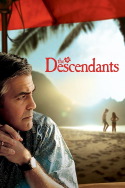
Review of The Descendants (2011) by Shiira — 04 Feb 2012
By no means should North Shore be confused for an accurate depiction of life in Hawaii. The 1987 film about an Arizonian surfing champ who nearly wins the Pipeline Masters, however, is honest enough to depict the racial strife that sometimes exist between the mainlanders and the locals.
Rick Kane, oblivious to the tricky dynamics that govern the Hawaiian waters, rebuffs the advice of two seasoned surfers(who in a colonial context, are outsiders) to vamoose, when the "hui" suggests that he may be infringing on their turf.
"He's so haole, he doesn't even know he is haole," one wave rider complains. To put it more succinctly, Rick is "haole as s***", to borrow a phrase from Matt King in The Descendants.
Chandler, a longtime board-shaper and resident, who despite being white like his protege, knows the island's stormy history, and explains to the political naif that his victimization(a local boy steals his stuff) pales next to what the Hawaiians lost during the transference of land ownership, the meat and potatoes of colonization.
North Shore, warts and all, is redeemed by having a conscience that nearly matches the white guilt of The Descendants, in which Matt's diatribe about skin color, also extends to language, admitting how his clan "can't even speak pidgin, let alone Hawaiian.
" Just before this searing self-critique, the filmmaker shows the land baron alone in a special room that contains old photographs of his ancestors, the people who made this generational inheritance possible, set to soft indigenous music that, depending on who you are, adds to the scene, either a sense of harmony or dissonance, in regard to the tradition of land stewardship.
When Matt ends his backyard speech to the kinfolk with the assertion that they have "Hawaiian blood", that they are, in so many words, indeed local, The Descendants may still be deemed by some as being a film about the problems of privileged white people, a la Sofia Coppola's Somewhere.
Despite the filmmaker's good intentions, is the King family Hawaiian enough to escape such easy ghettoization, the same upscale zip code where The Royal Tennenbaums reside. As the family takes one final look at their property, acres upon acres of verdant green that reaches, in both directions, the rolling mountains and crystal blue seawater, some will bristle a little when Scottie laments that she missed out on the King family tradition of camping with their comatose mother, like elder sister Alex before her, as if it was a tragedy on par with genocide.
Although Matt takes great pains toward not instilling a sense of entitlement in his daughters, when he says that "in Hawaii, some of the most powerful people look like bums and stuntmen," don't forget that he's including himself, not just his cousins in the boardroom, or Hugh, the unassuming barfly at that locals only hangout.
In spite of himself, good man and all, there's still a whole lot of pride, and perhaps, a little hubris in Matt, as he surveys his kingdom from a cliff where King Kamehameha may have once stood. But to the lawyer's credit, he's upfront about his soft-hearted tyranny, admitting in all honesty that "we didn't do anything to own this land," and yet, it's not as if he would give the soil back to the rightful descendants, the homeless Hawaiians, whose forefathers were overrun by foreign interlopers who used religion as a weapon, soon after washing up on island shores.
In George Roy Hill's Hawaii, a flawed, but relatively accurate portrayal of how an indigenous group of people lost the war against progress, it's one of the Hawaiian gods, surprisingly enough, not Jesus Christ, who makes his presence known, following the death of the "alii'nui", by creating a windstorm that all but blows away the Christian church ministered by the unctuous Rev.
Hale. More importantly, as it relates to The Descendants, the 1966 film explains how a man like Matt could inherit such obscene wealth, in a scene where a preacher is expulsed from the ministry for marrying a native woman.
"My wife has bought me several thousand acres of prime land," he brags. Still, Hawaii is, by no means, historically accurate. The Hawaiians, inexplicably, don't surf. Just like Matt, who hasn't picked up a board in fifteen years, according to the island chain's unlikely spokesman.
Unlike the aforementioned films, Soul Surfer, the inspirational true story about Bethany Hamilton, all but whitewashes the precedence of a self-governing island nation by filling the screen with nary a brown face.
Not so coincidentally, the film is faith-based. And yet, one of the gods from Hawaiian folklore accidentally makes a subtextual cameo, in which chanting can be heard over the soundtrack during the shark attack, suggestive of Mano, avenging, perhaps, the wholesale death of his people.
Whereas Bethany lost an arm, and the King family loses a wife and mother, the Hawaiians, in the end, lost everything.
This review of The Descendants (2011) was written by Shiira on 04 Feb 2012.
The Descendants has generally received very positive reviews.
Was this review helpful?